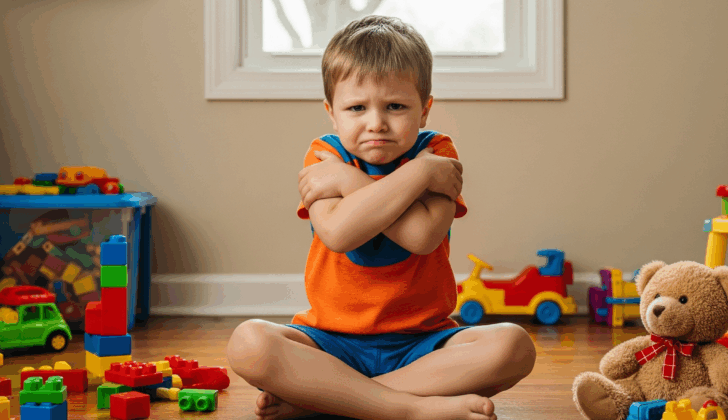
Many parents worry that their child is being defiant, stubborn, or intentionally difficult. You might hear yourself thinking, They know what I am asking, or They could use their words if they wanted to. Sometimes behavior truly is about limits and learning expectations. However, very often, especially in young children, behavior is a sign that communication skills are not yet strong enough to meet the situation.
From my perspective, challenging behavior is often not about refusing to cooperate. It is about a child trying to get a message across when words are hard to access.
Why Communication Breakdowns Often Look Like Behavior
Children rely on communication to navigate their world. They use language to ask for help, express feelings, understand routines, handle transitions, and solve problems. When any part of that system is underdeveloped or overwhelmed, behavior often becomes the fastest and most effective way to communicate.
This is why tantrums, grabbing, throwing, or shutting down often appear during moments of frustration, waiting, transitions, or being told no. The behavior itself is not random. It serves a purpose. It is sending a message.
How to Tell If Behavior Is Really a Communication Struggle
A helpful way to look at behavior is to notice patterns rather than isolated moments. If challenging behavior consistently shows up when your child wants something, is asked to transition, or seems misunderstood, communication is likely playing a role. Many parents notice that once they finally figure out what their child is trying to say, the behavior decreases almost immediately. That is a strong clue that the behavior was doing the job language could not yet do.
On the other hand, when a child understands expectations, can clearly express needs and emotions, and behavior improves with consistent limits, communication may be less of the driving factor. Even then, strong language skills continue to support regulation and problem-solving.
Why “Use Your Words” Often Does Not Help
Telling a child to “use your words” assumes that language is readily available in the moment. In reality, when children are upset or overwhelmed, their ability to access language drops. This is not a choice. It is neurological.
When a child is dysregulated, the brain prioritizes survival and emotion over language organization. Expecting clear speech in those moments is often unrealistic and increases frustration for everyone involved.
How to Respond When Communication Is Driving Behavior
The most effective response begins with curiosity rather than correction. Instead of immediately addressing the behavior, start by assuming your child is trying to tell you something. A calm statement such as, “I am trying to understand what you need,” can immediately reduce tension.
Rather than asking questions, offer the language your child needs. If a child throws a toy, you might say, “You are telling me you’re upset.” This gives them words without demanding that they produce them on the spot.
Choices are another powerful tool. Offering two clear options provides structure and reduces overwhelm. A child who cannot yet generate language independently may still be able to point, look, or choose, which keeps communication moving forward.
Teaching Words That Replace Behavior
Children benefit from short, functional phrases that are easy to access under stress. Phrases like “help please,” “all done,” or “I need a break” are far more usable than longer sentences when emotions are high. These phrases should be taught during calm moments, modeled frequently by adults, and gently prompted during difficult situations.
It is important to respond to communication attempts, even when they are not perfect. If a child points, whines, or uses a partial word, labeling and expanding that attempt teaches them that communication works better than behavior.
A Real-Life Example
Imagine a child who screams every time it is time to clean up. It can easily look like refusal or defiance. Often, it is actually difficulty with transitions and frustration around stopping a preferred activity.
A supportive response might sound like this: “You are upset. You want more time.” After acknowledging the feeling and modeling the language, you can add structure by saying, “Two more turns, then we clean up.” Over time, children learn the words that match the situation, and behavior often softens.
The Role of Emotional Language
Many behaviors are rooted in emotions children cannot yet name. Teaching simple feeling words during calm moments gives children a way to express themselves before behavior escalates. When children can say they feel frustrated, tired, or mad, they no longer need behavior to carry that message.
When to Consider Extra Support
If challenging behavior frequently replaces communication, if your child struggles to express needs clearly, or if multiple caregivers share similar concerns, a speech-language evaluation can be a helpful next step. Early support provides children with tools that reduce frustration and improve participation across settings.
Final Thoughts From an SLP
When we shift our question from Why is my child acting like this? to What is my child trying to tell me? we change the outcome. Many challenging behaviors decrease as communication skills grow.
Children do well when they can. When adults provide language models, emotional support, and consistent structure, behavior often improves naturally. Communication is not separate from behavior. It is the foundation beneath it.
Keep Learning & Stay Connected
Follow First Words Bright Futures on Facebook and Instagram for:
-
Daily speech tips
-
Fun activity ideas
-
Q&A with a pediatric SLP
Explore More:
- MDS: Why My 4-Year-Old Hits Instead of Using Words
- MDS: Teaching Kids to Ask for Help: A Powerful Skill That Reduces Meltdowns
Disclaimer: This article offers general educational information. It is not a substitute for professional evaluation or treatment. Please consult a licensed Speech-Language Pathologist for personalized concerns regarding your child’s speech development.