Parents ask me all the time, “What toys should I buy to help my child talk?”
I completely understand the question. When you have a toddler or preschooler who is not talking much yet or who struggles to engage. Parents want to find something that will help. The toy aisle is full of products labeled “educational,” “talking,” or “interactive,” and it is easy to assume those must be best for language development.
Here’s something that surprises many families:
The toys that build the most speech and language skills are usually the simplest ones.
In speech therapy, we often rely on what are called open-ended toys because these toys do not have just one job, one button, or one right way to play. Instead, they invite creativity, interaction, and conversation.
Open-ended toys are the toys children can use in a hundred different ways and that flexibility is exactly why they are so powerful for communication.
What Are Open-Ended Toys?
An open-ended toy is any toy that allows your child to:
- imagine
- pretend
- create
- problem-solve
- interact
- use language naturally
These toys do not “do the talking” for your child. Instead, they make space for your child to communicate.
Compare that to a toy that lights up, sings, talks, and directs the play. Those toys can be entertaining, but they often lead to quiet, solo play. There is not much need for conversation because the toy takes over. Open-ended toys do the opposite. They invite your child to lead and they invite you to join. That’s where language grows.
Why Open-Ended Toys Help Children Talk More
Speech and language develops through back-and-forth interaction, not through memorizing words or answering questions.
Open-ended toys naturally create opportunities for children to:
- request (“more,” “help,” “go”)
- label (“car,” “baby,” “block”)
- describe (“big,” “fast,” “hot”)
- pretend (“hungry,” “sleep,” “doctor”)
- answer and ask questions
- tell stories
Most importantly, they create shared moments of connection. The best language-building toy is the one that helps your child think: “I want you involved in this.”
The Best Open-Ended Toys for Language Development
Here are some of the top open-ended toys SLPs love and exactly how to use them to build communication.
1. Blocks and Building Toys
Blocks might be the most underrated language tool of all time. Children can stack them, knock them down, sort them, build towers, make houses, create roads. There is no “correct” ending. That open-endedness creates endless conversation.
What language it builds
- early words (“up,” “down,” “more”)
- describing (“big,” “tall,” “heavy”)
- problem-solving (“uh-oh,” “fix it”)
- turn-taking (“my turn,” “your turn”)
How to play (step-by-step)
Sit down beside your child and start building alongside them. You do not need to lead or teach. Just join. Make comments as you go:
“Tall tower!”
“Oh no… crash!”
“Let’s fix it.”
Then pause and wait. Let your child respond with a look, a laugh, a word, or an action.
Simple scripts
- “Uh-oh!”
- “Again!”
- “My turn… your turn.”
- “Big one!” / “Small one!”
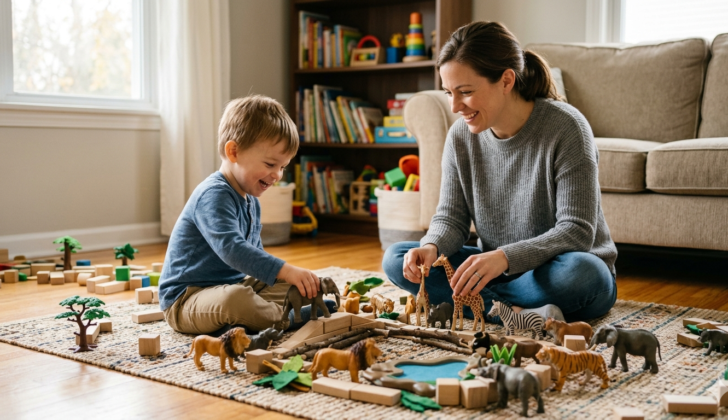
2. Toy Animals or People Figures
Little animal sets, dolls, or simple figurines are amazing for pretend play and pretend play is one of the best foundations for language. Children begin learning storytelling through play: someone gets hurt, someone helps, someone eats, someone sleeps.
What language it builds
- action words (“run,” “jump,” “eat”)
- emotions (“sad,” “scared,” “happy”)
- social language (“help me,” “come here”)
Easy play idea: “Rescue” game
Hide an animal under a cup or behind a pillow and say:
“Uh-oh! He’s stuck!”
Pause.
Then add:
“We need help!”
Let your child jump in and rescue the toy.
Scripts
- “Help!”
- “Oh no!”
- “We did it!”
- “Where should he go next?”
3. Pretend Kitchen or Food Sets
Pretend food toys are open-ended because children can cook, serve, feed, clean, and create silly stories.
What language it builds
- vocabulary (“pizza,” “hot,” “yummy”)
- requesting (“more,” “want”)
- sequencing (“first,” “then”)
How to play naturally
Instead of asking, “What are you making?” over and over, try joining with playful comments:
“Mmm… I’m hungry!”
“Oh no, it’s too hot!”
“Blow, blow, blow!”
That sparks much more language than quizzing.
Scripts
- “Taste it!”
- “Too hot!”
- “Yummy!”
- “Let’s feed the baby.”
4. Cars, Trains, Ramps, and Roads
Transportation toys are perfect for toddlers and preschoolers because they create repetitive, engaging play.
What language it builds
- early sound effects (“beep,” “vroom”)
- action words (“go,” “stop,” “crash”)
- turn-taking
Step-by-step play idea
Roll the car, then pause.
Say:
“Ready… set…” (wait)
Your child will often look at you or anticipate the next part.
Then:
“GO!”
This teaches communication without forcing words.
Scripts
- “Fast!”
- “Crash!”
- “Again!”
- “Go!” / “Stop!”
5. Playdough and Sensory Play
Sensory play is open-ended because it can become anything: pizza, snakes, cupcakes, letters, roads.
What language it builds
- describing (“soft,” “sticky,” “big”)
- pretend language (“cut,” “roll,” “make”)
- social interaction
Scripts
- “Squish!”
- “Roll it!”
- “Cut, cut!”
- “What should we make?”
6. Books (Yes, Books Count!)
Books are one of the most open-ended tools because you can talk, wonder, predict, relate, and imagine. Books are not just for reading.
Best way to build language through books
Comment more than you question:
“I see a dog!”
“Uh-oh, he’s sad.”
“I wonder what happens next…” (pause)
Scripts
- “Look at that!”
- “Oh no!”
- “That’s silly!”
Open-Ended Toys by Age
Toddlers (1–3)
Best choices:
- blocks
- cars
- bubbles
- simple animals
- sensory bins
Focus on:
- single words
- turn-taking
- “more/help/go” moments
Preschoolers (3–5)
Best choices:
- pretend kitchen
- figurines
- playdough
- building sets
- dress-up
Focus on:
- pretend stories
- describing
- early WH questions in play
School-Age (6+)
Best choices:
- Legos
- board games
- crafts
- cooking kits
Focus on:
- storytelling
- explaining
- social language
Final Thoughts From an SLP
If you are looking for the best toys to build speech and language, do not feel like you need the loudest, flashiest, most expensive option.
Keep Learning & Stay Connected
Follow First Words Bright Futures on Facebook and Instagram for:
-
Daily speech tips
-
Fun activity ideas
-
Q&A with a pediatric SLP
Explore More:
- MDS: Toy Rotation: The Simple Trick to Boost Your Child’s Language Skills
- MDS: Using Predictable Books to Boost Speech and Language in Young Children
Disclaimer: This article offers general educational information. It is not a substitute for professional evaluation or treatment. Please consult a licensed Speech-Language Pathologist for personalized concerns regarding your child’s speech development.