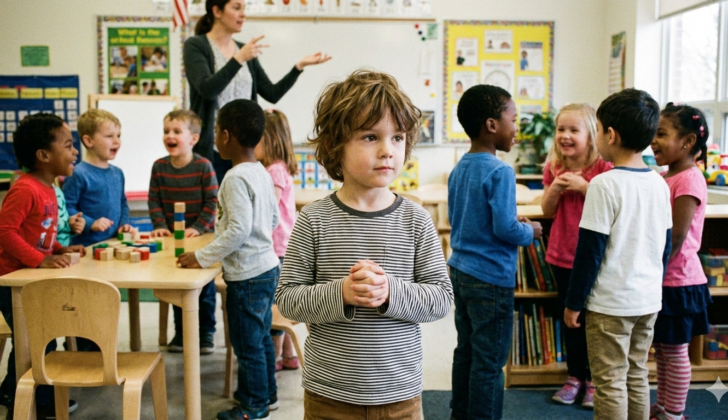
Many parents express concern when their child who talks freely at home suddenly becomes quiet or is not talking in school or other social settings. You may wonder, “Why does my child talk so much with me, but barely whispers or does not speak at all at school?” This situation can feel confusing and even worrisome, but it is more common than you might think. The good news is that with understanding, patience, and the right support, children can learn to feel more confident communicating across settings.
Understanding the “Home vs. School” Difference
Children feel safest and most comfortable in familiar environments, especially at home, where routines, voices, and expectations are predictable. At home, your child knows what to expect and feels secure enough to express thoughts freely. School, however, brings new factors that can affect how and when a child chooses to speak.
Some children may feel shy or overwhelmed by new environments. Others may be naturally quiet observers who take time to adjust. For some, especially when the quietness is consistent and lasts more than a month in school or public settings, the cause may be selective mutism, which is an anxiety-based condition where a child is physically capable of speaking, but feels unable to do so in certain environments due to intense worry or fear.
It is important to remember that your child is not being defiant or stubborn. A lack of speech in certain settings is not a choice; it is a sign that your child feels uncomfortable or anxious.
Common Reasons Children Speak Differently Across Settings
1. Social Anxiety or Shyness
Many children experience mild anxiety when meeting new people or entering unfamiliar environments. They may worry about saying something “wrong” or being judged. At home, they know their audience is safe and familiar, which lowers anxiety and allows speech to flow more freely.
2. Personality and Temperament
Some children are naturally more cautious or introverted. They may prefer to observe before engaging. This quiet observation is not always a problem, it is simply part of their personality.
3. Language Differences
If your child is learning more than one language, they may use one language more at home and another at school. Sometimes children pause speaking in one setting as they adjust to understanding and sorting through multiple languages.
4. Sensory or Environmental Factors
Noise, crowds, or busy classrooms can be overwhelming. Some children become overstimulated and may shut down verbally as a way to cope.
5. Selective Mutism
For a small group of children, silence outside the home becomes persistent and intense. Selective mutism is an anxiety disorder that typically begins in early childhood. A speech-language pathologist and psychologist can work together to provide gentle exposure-based strategies that help the child gain confidence speaking in different settings.
What Parents Can Do at Home
Your support and understanding make a world of difference. Here are several steps you can take:
1. Stay Calm and Supportive
Avoid pressuring your child to speak in situations where they feel anxious. Pressure often increases fear and shuts down communication further. Instead, show warmth and acceptance by saying things like:
“I know it feels hard to talk right now, and that is okay. You can try when you are ready.”
2. Use Play to Build Confidence
During pretend play, children can “practice” speaking in different roles or settings, like pretending to be the teacher, the cashier, or the friend. This type of play allows your child to rehearse social language in a safe, comfortable environment.
3. Model Social Language
Show your child how you greet people, ask for help, or start a conversation. Children learn by watching. Narrate your own experiences:
“I am saying hello to Mrs. Brown because she is my friend. It is kind to greet people.”
These small examples help your child understand what to expect and what to say in similar situations.
4. Create Predictable Routines
Predictability helps children feel secure. Practice small routines together that include verbal interaction, such as:
- Saying “Good morning” to each other.
- Asking, “What would you like for breakfast?”
- Taking turns sharing something about the day at dinner.
Over time, these routines strengthen confidence and social language.
5. Use Visual Supports
Pictures or cue cards can help your child communicate when speaking feels difficult. For example, a “feeling card” with pictures of happy, scared, or worried faces lets your child express emotions nonverbally. Over time, verbal labels can be added naturally.
6. Celebrate Small Successes
Praise effort, not just speech. For example:
“I saw you wave to your teacher this morning. That was brave!”
Positive reinforcement helps build confidence and motivation to try again.
How Teachers and Schools Can Help
Your child’s teacher plays a key role in supporting communication at school. Here are a few strategies that can make a difference:
1. Build a Relationship First
A teacher can start by connecting through play, shared interests, or parallel activities. A trusting relationship creates a sense of safety, which is the foundation for speech to emerge.
2. Avoid Direct Pressure
Instead of asking questions like “Can you say that again?” teachers can provide choices or yes/no questions that allow nonverbal participation until the child is ready. For example:
“Would you like the blue crayon or the red one?”
The child can point or nod initially, which still builds communication skills.
3. Offer Gradual Exposure
Start small, such as having the child whisper to the teacher when no one else is around. Then, slowly increase the audience or setting. Progress should be celebrated at every stage.
4. Collaborate with Specialists
If silence in certain environments continues beyond a few months, ask your child’s pediatrician for a referral to a speech-language pathologist or psychologist familiar with selective mutism. Collaboration between home, school, and therapy ensures consistent support.
When to Seek Professional Help
If your child:
- Speaks freely at home, but remains silent for a month or longer in other settings,
- Appears distressed or anxious about talking,
- Has difficulty participating socially or academically because of silence,
it may be helpful to consult a speech-language pathologist and possibly a child psychologist. These professionals can assess your child’s communication, observe behaviors, and develop a gentle plan to reduce anxiety and build comfort speaking in new settings.
Therapy often focuses on gradual exposure and success-based communication. The goal is not to “force” speech, but to build trust and help the child feel confident that speaking is safe.
A Final Word of Encouragement
If your child talks at home, but not at school, you are not alone and neither is your child. Silence in certain settings is not a reflection of intelligence or defiance. It is a signal that your child needs more time, safety, and support to find their voice in the world beyond home.
With understanding adults, predictable routines, and calm encouragement, children learn that communication can feel safe everywhere. Every small step, a whisper, a nod, a quiet “yes” is progress worth celebrating.
Keep Learning & Stay Connected
Follow First Words Bright Futures on Facebook and Instagram for:
-
Daily speech tips
-
Fun activity ideas
-
Q&A with a pediatric SLP
Explore More:
- MDS: Making Communication Visible: Using Visual Supports in Daily Routines
- MDS: Teaching Children to Use Words for Feelings
Disclaimer: This article offers general educational information. It is not a substitute for professional evaluation or treatment. Please consult a licensed Speech-Language Pathologist for personalized concerns regarding your child’s speech development.