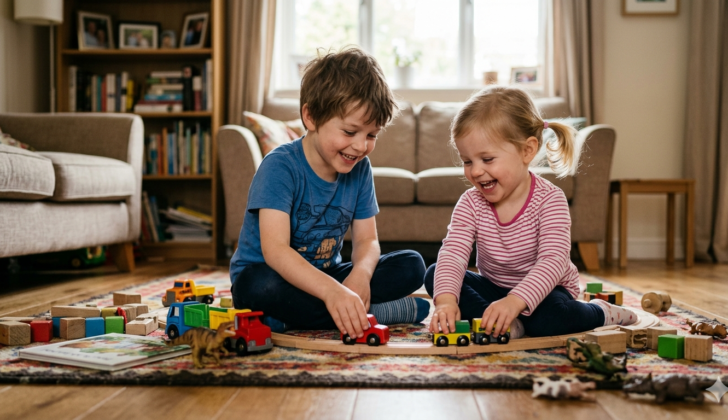
When you imagine siblings playing together, you may picture laughter, teamwork, and creativity. In reality, sibling play can sometimes look more like arguing over toys, grabbing, or one child dominating the play while the other disengages. This is completely normal. Cooperative play is not something children simply “know” how to do. It is a skill that must be taught, modeled, and practiced over time.
I often remind families that cooperative play is one of the most powerful ways to support speech and language development at home. When siblings learn to play together, they practice communication, problem solving, emotional expression, and social interaction. These are foundational skills for both academic and social success.
This article will guide you step by step through how to encourage cooperative play between siblings while also supporting speech and language development. No prior knowledge is assumed. You will find practical strategies, clear scripts, and detailed instructions that you can begin using right away.
Why Cooperative Play Matters for Speech and Language Development
Before diving into strategies, it is helpful to understand why cooperative play is so important.
When siblings play together in a positive, supported way, they naturally practice:
- Taking turns in conversation
- Listening and responding
- Using new vocabulary
- Asking and answering questions
- Problem solving
- Expressing feelings
- Negotiating and compromising
- Using longer sentences
These are all core communication skills. When children practice them during play, they are learning in the most natural and meaningful way possible.
Cooperative play does not need to be perfect. It only needs to be supported and guided by an adult who helps children learn how to interact with each other.
Understanding Stages of Play Between Siblings
Children move through stages of play. Understanding these stages can help you set realistic expectations.
Parallel Play
Children play near each other but not together. This is common for toddlers and younger preschoolers.
Associative Play
Children begin interacting but may not share a clear plan or goal.
Cooperative Play
Children work together toward a shared idea or goal. This stage typically develops around ages 4–6 but requires adult guidance.
If your children are not naturally playing cooperatively yet, that is normal. Your role is to gently teach and support the skills needed.
Step 1: Set Up the Environment for Success
Before children can play cooperatively, the environment must support success.
Choose the Right Time
Avoid starting cooperative play when children are:
- Hungry
- Tired
- Overstimulated
- Already upset
Choose a calm time of day when you can be present and available to guide them.
Limit the Number of Toys
Too many toys can lead to conflict and overwhelm.
Step-by-Step Directions
- Choose one or two shared activities.
- Place other toys out of reach or in bins.
- Sit near the children to support interaction.
Select Cooperative Activities
Choose activities that naturally require teamwork.
Examples:
- Building with blocks
- Playing with dolls or action figures
- Pretend kitchen or restaurant
- Puzzles
- Art projects
- Board games (simple turn taking)
Avoid highly competitive games at first.
Step 2: Teach Turn Taking Explicitly
Turn taking is the foundation of cooperative play and communication.
Children do not automatically know how to take turns. This must be taught and modeled.
How to Teach Turn Taking
Step-by-Step Directions
- Sit with both children.
- Hold the toy or activity.
- Clearly explain that everyone gets a turn.
- Model the language you want them to use.
- Use a visual or timer if needed.
Script for Parents
Use simple, clear language.
“First it is your turn. Then it is your brother’s turn.”
“I am setting the timer. When the timer beeps, it is time to switch.”
“You can say, ‘My turn please.’”
“Now say, ‘Your turn.’”
Repeat this every time. Consistency builds understanding.
Support Language Development During Turns
Encourage children to talk during play.
“Tell your sister what you are building.”
“What should we add next?”
“Ask your brother for the blue block.”
This encourages functional communication instead of grabbing or arguing.
Step 3: Model Cooperative Language
Children learn how to talk to each other by listening to you.
Instead of telling children to “play nicely,” show them exactly what to say.
Key Phrases to Teach
- “Can I play with you?”
- “Let us build together.”
- “You can have it when I am done.”
- “Can you help me?”
- “Let us take turns.”
- “That is a good idea.”
Step-by-Step Modeling
- Sit with children during play.
- Narrate what they are doing.
- Provide the exact words they can use.
- Prompt them to repeat the phrase.
- Praise their effort.
Script Example
If one child grabs a toy:
Parent says:
“Stop. Hands are not for grabbing.”
“You can say, ‘Can I have a turn when you are done?’”
Then guide child to repeat:
“Say, ‘Can I have a turn when you are done?’”
When the other child responds:
“That was kind. You listened and answered.”
Step 4: Use Structured Cooperative Activities
Some children need structured play to learn cooperation.
Activity: Building Together
Goal: Encourage requesting, commenting, and problem solving.
Step-by-Step Directions
- Give both children blocks.
- Tell them they are building one structure together.
- Assign simple roles.
- One gathers blocks.
- One stacks blocks.
- Switch roles every few minutes.
- Encourage talking during building.
Script for Parents
“Ask your sister what piece she needs.”
“Say, ‘I need a big block.’”
“Tell your brother where to put that piece.”
“Say, ‘Put it on top.’”
Praise cooperation immediately.
“You worked together. That was great teamwork.”
Activity: Pretend Play (Restaurant or House)
Pretend play builds vocabulary, sentence length, and social language.
Step-by-Step Directions
- Choose a pretend theme (restaurant, doctor, house).
- Assign roles.
- Provide simple props.
- Model dialogue.
- Stay nearby to support.
Script Example: Restaurant Play
Parent models:
“I am the customer. Who is the cook?”
“Say, ‘What would you like?’”
“Now say, ‘Here is your pizza.’”
“Ask, ‘Do you want juice or milk?’”
Encourage children to talk to each other, not just to you.
Step 5: Teach Problem Solving Language
Conflict will happen. Conflict is actually a valuable learning opportunity.
Instead of solving problems for children immediately, teach them how to communicate through the problem.
Teach a Simple Problem Solving Routine
Step-by-Step Directions
- Stop the conflict calmly.
- Label the problem.
- Help children express feelings.
- Offer two solutions.
- Let them choose.
Script for Parents
Step 1: Stop and label
“I see a problem. You both want the same toy.”
Step 2: Express feelings
“You look frustrated.”
“You look upset.”
Step 3: Encourage language
“Tell your sister, ‘I feel mad.’”
“Now listen to your brother.”
Step 4: Offer solutions
“You can take turns.”
“You can play together.”
Step 5: Praise resolution
“You solved the problem with words. That was excellent.”
Step 6: Expand Speech and Language During Play
Cooperative play is the perfect time to expand language.
Expand What Children Say
If a child says:
“Car.”
You can expand:
“Yes, a fast red car is driving to the store.”
If a child says:
“My turn.”
You can expand:
“My turn with the blue truck please.”
Ask Open-Ended Questions
Use questions that encourage longer responses.
- “What should happen next?”
- “How can we fix that?”
- “Who is going to help?”
- “Why did that happen?”
Avoid too many yes or no questions.
Step 7: Keep Play Sessions Short and Positive
Quality matters more than length.
Start with 10–15 minutes of supported cooperative play. Gradually increase as children improve.
End play before major conflict occurs.
How to End Successfully
Give a warning:
“Five more minutes of playing together.”
Praise cooperation:
“You shared.”
“You talked to each other.”
“You worked as a team.”
Preview next time:
“We will play together again tomorrow.”
Common Challenges and What to Do
One Child Dominates Play
Give each child a role.
“You are in charge of building.”
“You are in charge of choosing colors.”
Switch roles frequently.
One Child Does Not Want to Play
Start with parallel play and slowly build interaction.
“You build here. Your sister builds next to you.”
“Now let us connect your buildings.”
Frequent Arguing
Reduce time and increase support. Stay close and coach language.
Final Thoughts
Cooperative play between siblings is not automatic. It is a learned skill that develops with patient guidance and consistent support. When parents and caregivers intentionally teach turn taking, communication, and problem solving during play, they are also strengthening speech and language development in meaningful ways.
Progress may be slow at first. There may be disagreements and moments of frustration. This is part of learning. Stay calm, model language, and celebrate small successes.
Over time, children will begin to:
- Use more words and longer sentences
- Express feelings with language
- Solve problems with words
- Enjoy playing together
These are powerful lifelong communication skills that begin right at home, during simple moments of shared play.
Your presence, modeling, and encouragement make all the difference.
Keep Learning & Stay Connected
Follow First Words Bright Futures on Facebook and Instagram for:
-
Daily speech tips
-
Fun activity ideas
-
Q&A with a pediatric SLP
Explore More:
- MDS: My Child Gets Frustrated When Talking: What Parents Can Do
- MDS: Teaching Children to Use Words for Feelings
Disclaimer: This article offers general educational information. It is not a substitute for professional evaluation or treatment. Please consult a licensed Speech-Language Pathologist for personalized concerns regarding your child’s speech development.