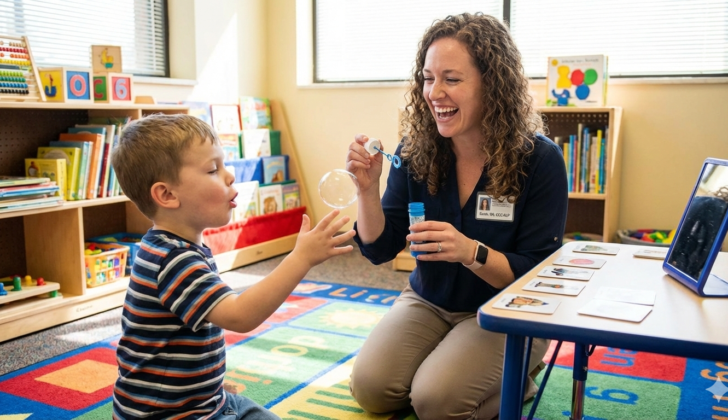
If you have ever heard a therapist mention oral motor skills, you might picture tongue exercises, blowing bubbles, or chewing games. Parents often ask, “What do these have to do with my child’s speech?”
It is a great question and an important one.
Oral motor skills are the physical abilities that allow us to move the muscles of the mouth, tongue, lips, and jaw. These movements are used for everyday tasks such as eating, drinking, blowing, and, of course, speaking.
However, the relationship between oral motor strength and speech clarity is often misunderstood. While oral muscles are involved in speech, evidence shows that general mouth exercises (like blowing or tongue wagging) do not automatically improve speech sound production. Speech is a highly specific, coordinated motor act, not simply a matter of strength.
This article will explain what oral motor skills really are, how they support speech and language, what current research says, and what parents can do to help their children develop strong communication skills.
The Foundation: What Oral Motor Skills Include
Oral motor skills can be divided into two categories—gross motor movements of the jaw, lips, and tongue, and fine motor coordination needed for precise speech sounds.
Examples of Oral Motor Functions:
- Jaw stability: opening and closing the mouth smoothly.
- Lip control: sealing lips for feeding, blowing, or producing sounds like /p/, /b/, and /m/.
- Tongue movement: lifting, flattening, or retracting the tongue for chewing and articulating sounds like /t/, /d/, /l/, and /k/.
- Breath control: coordinating breathing with speech for smooth phrases.
- Soft palate movement: closing off the nasal cavity during speech and swallowing.
These systems must work together in perfect timing to produce clear speech.
The Connection Between Oral Motor Skills and Speech
It is easy to assume that stronger mouth muscles naturally lead to clearer speech, but research shows that the connection is more complex than that.
Speech is not about muscle strength. It is about precise, rapid, and coordinated movement. The muscles used for speech already have more than enough strength; what matters is how well they are coordinated and sequenced.
Evidence-Based Understanding:
Research from the American Speech-Language-Hearing Association (ASHA) and multiple peer-reviewed studies shows that:
- Non-speech oral motor exercises (such as blowing whistles, tongue curls, or puffing cheeks) do not generalize to speech production.
- Speech requires task-specific motor planning—the brain learns how to move the tongue and lips in specific ways for sounds, not for unrelated tasks.
- The best way to improve speech is to practice actual speech sounds within meaningful words and sentences, not isolated mouth movements.
How Oral Motor Skills Support Language—Indirectly
Although isolated oral motor exercises do not fix speech, functional oral motor abilities are still essential for overall communication development.
Here is how oral motor control contributes to communication readiness:
1. Feeding and Early Exploration
Chewing, sucking, and mouthing toys strengthen the foundational movements for future speech. When babies explore with their mouths, they are building awareness of how their lips and tongue move.
Example: A baby who babbles “ba-ba-ba” is using the same lip closure needed for later words like “ball” and “baby.”
2. Breath Control and Voice
Children who can coordinate breath with movement learn to produce longer, smoother phrases and control vocal loudness.
Example: A child who runs out of breath mid-sentence may need help developing breath support and pacing.
3. Sensory Feedback
Children must feel what their mouths are doing to refine movement. Oral sensitivity (knowing where the tongue or lips are) helps guide clear speech.
Example: A child who drools or chews messily might not yet have full oral awareness; addressing that can improve attention and readiness for speech tasks.
4. Motor Planning and Coordination
Speech depends on the brain’s ability to plan and sequence muscle movements. Some children, especially those with motor speech disorders like Childhood Apraxia of Speech (CAS) struggle with this “motor planning” even when muscle strength is normal.
Real-Life Example: Emma’s Story
Emma, a three-year-old, had difficulty producing sounds like /k/ and /g/ and was often told she “needed to strengthen her tongue.” Her parents tried home exercises blowing bubbles, licking peanut butter off a spoon, and puffing cheeks, but saw little improvement.
During therapy, we shifted focus from strength exercises to speech-specific practice. Emma worked on feeling where her tongue should go for /k/ by saying real words “car,” “cookie,” “key” and playing with those words in fun contexts (pretend baking cookies, racing toy cars).
Within a few weeks, her clarity improved significantly. Her success came from practicing the exact movements required for speech, not general oral exercises.
What the Research Really Supports
The scientific consensus (ASHA, Lof & Watson, 2008; McCauley et al., 2009) is clear:
- Speech and feeding share anatomy, but differ neurologically.
- Practicing non-speech oral tasks does not create the brain connections needed for accurate speech sounds.
- Speech is learned through speaking. Therapy should focus on phonetic placement, auditory feedback, and repetition of actual sounds, syllables, and words.
This means your child’s SLP might include oral motor activities if they are functionally tied to speech (for example, using a straw to work on lip rounding for /o/), but these exercises are always paired with verbal practice, not done in isolation.
Evidence-Based Therapy in Action
Here is how therapists use oral motor knowledge in an evidence-based way:
| Goal Area | What the SLP Does | Why It Works |
| Speech Sound Production | Teaches tongue/lip placement for specific sounds through play and repetition | Builds accurate muscle coordination for real speech |
| Breath and Voice Control | Practices short phrases with exhalation support | Improves phrasing, loudness, and fluency |
| Oral Awareness | Uses sensory play (chewy toys, cold spoons, mirrors) for feedback | Helps the child feel and control movements |
| Feeding and Swallowing | Targets chewing, drinking, and safe swallowing patterns | Improves oral stability and readiness for speech work |
How Parents Can Support Oral Motor Development at Home
You do not need special tools or drills. Everyday routines and play naturally strengthen oral coordination while supporting language.
1. Encourage Speech Through Real Words
Model clear sounds in daily life.
“Car goes k-k-k! Big cookie!”
“Open wide! Ooo—ahh!”
Playful sound imitation teaches movement in meaningful contexts.
2. Promote Chewing and Mouth Exploration
Offer foods with varied textures (when safe) to promote chewing and tongue movement. Avoid long-term purees once your child is ready for solids.
3. Build Awareness With Mirrors
Let your child watch their mouth while making silly faces or sounds.
“Let us make fish lips! Now blow a kiss!”
This builds awareness of lip and tongue positions in a fun way.
4. Strengthen Breath Control Naturally
Sing songs, blow bubbles, or use wind instruments to encourage controlled breathing—then link it to speech:
“Blow the bubbles—now tell me what you see!”
This helps transition from breath to speech phrasing.
5. Avoid “Strength-Only” Drills
Skipping ropes strengthens legs because it mimics jumping, but puffing cheeks does not mimic talking. Focus on function rather than isolated exercises.
When to Seek Professional Guidance
Consult a speech-language pathologist if you notice:
- Drooling or difficulty chewing past age three
- Speech that is unclear beyond what is typical for age
- Groping movements or frustration when trying to talk
- Trouble coordinating breathing and speech
- Limited progress despite consistent practice
Your SLP will evaluate oral motor skills in context. Examining how your child uses their mouth muscles for both speech and feeding and design an individualized plan rooted in evidence.
Final Thoughts: The Power of Precision, Not Strength
Oral motor skills form the foundation for speech, but they are not the full picture. Speech is not about muscle strength. It is about precision, timing, and coordination that only come from practicing real speech sounds in meaningful contexts.
When parents understand this difference, therapy becomes clearer, progress feels purposeful, and frustration decreases.
Parent Takeaways
- Oral motor skills involve the coordination—not strength—of the lips, tongue, jaw, and breath.
- Non-speech oral exercises (like blowing or tongue wagging) do not directly improve speech clarity.
- The most effective therapy targets speech-specific movements within real words and play.
- Everyday routines—eating, singing, talking—are powerful tools for building oral coordination.
Ask your SLP to explain how oral motor skills fit into your child’s individualized plan.
Keep Learning & Stay Connected
Follow First Words Bright Futures on Facebook and Instagram for:
-
Daily speech tips
-
Fun activity ideas
-
Q&A with a pediatric SLP
Explore More:
Disclaimer: This article offers general educational information. It is not a substitute for professional evaluation or treatment. Please consult a licensed Speech-Language Pathologist for personalized concerns regarding your child’s speech development.