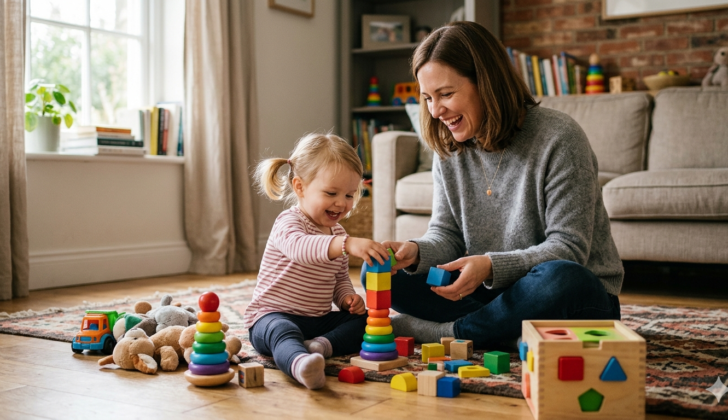
If you have ever sat down on the floor with your child, hoping for a sweet little moment of connection and play, but then you realize you do not know what to say or do? You might say to yourself things like:
“What color is that?”
“What’s this called?”
“How many do you have?”
“Can you say it again?”
Honestly, this is very common. Parents are trying so hard to do the right thing. They want to support language. They want to help their child learn. So they do what makes sense: they start asking questions. A lot of children do not experience play as a time to “show what they know.”
They experience play as a time to relax, explore, connect, and be with you. When play starts to feel like a pop quiz, many kids quietly check out.
They walk away.
They get silly.
They stop talking.
They shrug.
Not because they can’t answer, but because it doesn’t feel fun anymore.
Here ist how to shift playtime into something that feels more natural. More like a back-and-forth conversation and less like a lesson.
Why kids shut down when we ask too many questions
Questions are not bad, but if most of what your child hears during play is:
“What’s that?”
“What color?”
“How many?”
“What are you doing?”
It can start to feel like they are being tested. Some kids love answering, however many children (especially toddlers, late talkers, or kids who struggle with language) feel pressure quickly. They start thinking:
What if I’m wrong?
What if I don’t know?
What does she want me to say?
Conversation do not grow when a child feels put on the spot. What works better is something very simple:
Instead of asking your child to perform language…
just start using language with them.
The easiest change: talk more like a partner, less like a teacher
One of the most helpful tips I give parents is this:
Try making more comments than questions.
It is such a small shift, but it changes everything.
Instead of:
“What is that?”
Try: “Oh! A dog!”
Instead of:
“What color is it?”
Try: “Red car!”
Instead of:
“What are you making?”
Try: “Wow… a tall tower!”
Those little comments are powerful because they do not demand anything.
They just invite your child in. Kids are much more likely to join in when they do not feel pressure.
If you do not know what to say during play, start here
A lot of parents tell me, “I want to play with my child, but I honestly don’t know what to do or say.” That is so normal. You do not need to entertain. You do not need to pretend to be a preschool teacher. You do not need the perfect toy. Most of the time, the best thing you can do is simply: Sit down and watch what your child is doing. Then talk about it in the simplest way possible.
Almost like you’re narrating.
“You’re driving.”
“Fast car!”
“Uh-oh, crash!”
“Again!”
That’s it. That’s language support.
The magic is in the pause
Here’s something that surprises people: One of the best things you can do for speech and language is… wait. Say something simple, then pause. Not because you’re waiting for your child to “answer correctly”, Just because you’re giving them space to respond in any way.
A look.
A point.
A sound.
A word.
It all counts.
Conversation starts there.
What this looks like with toddlers (1–3)
Toddlers do not need lots of questions. They need simple, repeated language in the moment. Let’s take bubbles, for example.
Instead of:
“What do you want?”
“Can you say bubbles?”
Try:
“Bubbles!”
“Pop pop pop!”
(then pause)
Close the bubbles for a second, wait, and watch.
If your toddler reaches or looks at you, you can say:
“Oh! More bubbles!”
And blow again.
That’s a conversation.
It’s not about getting the word perfectly.
It’s about building that back-and-forth exchange.
What this looks like with preschoolers (3–5)
Preschoolers are learning to use language for pretending, problem-solving, and sharing ideas. They still do not want to feel tested. So if you are playing kitchen, instead of:
“What are you cooking?”
“How many cookies?”
Try commenting your way into the play:
“Mmm, pizza!”
“I’m hungry!”
“Oh no… it’s too hot!”
Suddenly your child has something to respond to.
They might laugh.
They might pretend blow on it.
They might say “Eat it!”
That is real language. If you want to work questions in, do it gently:
“Should we feed the baby too?”
That feels like play, not school.
What this looks like with school-age kids (6+)
Even older kids do not want constant questioning. Some kids come home and shut down the minute they hear:
“How was school?”
“What did you do?”
Who did you play with?”
Try a softer entry instead:
“Tell me one funny thing from today.”
“What was the best part?”
“I’ll guess… something silly happened.”
That kind of language invites conversation instead of demanding it. Board games are another great place for natural talking:
“Oh wow, you got a six!”
“That was lucky!”
“I’m nervous… you might win!”
That is connection language and it builds vocabulary, storytelling, and social interaction.
If your child doesn’t respond, it doesn’t mean you’re failing
This is important. Sometimes children need lots of exposure before they jump in. If your child does not say anything right away, keep going.
You can help by:
- pointing
- offering choices
- modeling again
- keeping it simple
Celebrating the small things:
A look is communication.
A gesture is communication.
A sound is communication.
Words come from those first steps.
A gentle goal to try this week
Next time you play, try this:
For just 10 minutes…
- ask fewer questions
- make a few more comments
- pause after you speak
- follow your child’s lead
Final thoughts
You do not have to be amazing at pretend play. You do not have to sound like a therapist. Your child does not need you to be a teacher during play. They need you to be present. The best conversations do not start with questions. They start with shared moments:
“Wow!”
“Uh-oh!”
“Again!”
“That was funny!”
“I love playing with you.”
That’s where language grows.
Keep Learning & Stay Connected
Follow First Words Bright Futures on Facebook and Instagram for:
-
Daily speech tips
-
Fun activity ideas
-
Q&A with a pediatric SLP
Explore More:
Disclaimer: This article offers general educational information. It is not a substitute for professional evaluation or treatment. Please consult a licensed Speech-Language Pathologist for personalized concerns regarding your child’s speech development.