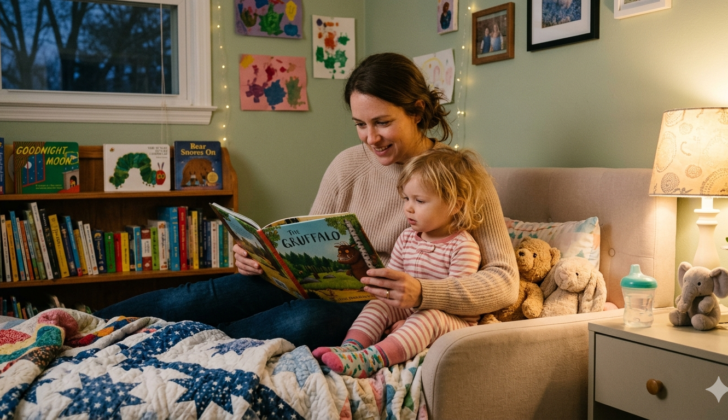
Many parents and caregivers want to support their child’s speech and language development, but feel unsure where to start. They are not sure if they should be asking more questions, correcting speech errors, or drilling words. Often, the most effective tools are already sitting on the bookshelf.
One of the most powerful and overlooked language-building tools for young children is the predictable book.
Predictable books are books with repeated phrases, patterns, or structures. Children quickly learn what comes next, even if they are not yet speaking clearly or using many words. This familiarity creates confidence, reduces pressure, and opens the door for meaningful communication.
When used intentionally, predictable books can support vocabulary growth, sentence structure, turn-taking, and overall confidence in communication.
What Are Predictable Books?
Predictable books follow a clear and repetitive pattern. The repetition may be in the words, the sentence structure, the storyline, or the rhythm of the text.
Common features of predictable books include:
- Repeated phrases or refrains
- Familiar sentence patterns
- Rhythmic or sing-song language
- Clear cause-and-effect sequences
When children know what is coming next, they feel safer and more confident participating.
Predictable books are especially helpful for:
- Toddlers and preschoolers
- Children with speech or language delays
- Children who are hesitant communicators
- Children learning English as an additional language
Why Predictable Books Build Language Confidence
Language learning requires risk. Children must try sounds, words, and sentences that may not come out perfectly. Predictable books lower that risk.
When a child knows what comes next:
- Their brain is not working as hard to process new information
- They can focus on participating instead of just listening
- They feel successful, even with small attempts
Confidence grows when children experience repeated success.
Over time, this confidence transfers from book reading to everyday conversations.
A Real-Life Example: Bedtime Reading
Imagine reading the same book at bedtime night after night. At first, your child listens quietly. After a few nights, they begin to smile at certain pages. Soon, they fill in a sound, a word, or a gesture at the right moment.That moment matters. Your child is learning that communication is predictable, meaningful, and enjoyable. This is how language grows.
What Predictable Books Teach Without Pressure
Predictable books naturally support many language skills at once, without drilling or correction.
They help children learn:
- New vocabulary through repeated exposure
- Sentence structure through consistent patterns
- Turn-taking as they participate in shared reading
- Anticipation and sequencing
- Confidence using language in a safe context
All of this happens through connection, not correction.
How to Choose the Right Predictable Books
You do not need an extensive collection. A few well-loved predictable books can go a long way.
Look for books that:
- Repeat the same phrase on each page
- Follow a clear routine or pattern
- Match your child’s interests
- Use simple, clear language
Books about animals, routines, food, or movement are often great starting points.
Step-by-Step: How to Read Predictable Books for Language Growth
Step 1: Read the Book All the Way Through
The first few times, simply enjoy the story. Do not quiz your child or ask many questions.
Let them listen.
Step 2: Emphasize the Repeated Phrase
Use slightly slower speech and a natural pause before the repeated line.
For example:
“And the bear said…”
Pause.
“Go away.”
This pause invites participation.
Step 3: Wait and Watch
Give your child time to fill in a sound, word, gesture, or look.
Any attempt counts.
Step 4: Respond Positively
If your child participates in any way, respond warmly.
“You said go.”
“You knew what came next.”
“You were ready.”
This reinforces confidence.
What If My Child Does Not Say the Words?
Language development does not begin with perfect words. Participation may look like:
- Smiling
- Looking at the page
- Pointing
- Making a sound
- Saying part of a word
These are all meaningful steps.
Your job is to notice and respond, not to correct.
Using Predictable Books With Children Who Use Few Words
Predictable books are especially supportive for children with limited expressive language.
Example Script During Reading
Adult: “Brown bear, brown bear, what do you…”
Pause.
Child: Looks at page.
Adult: “See?”
Pause.
Adult: “You are watching. You know this book.”
Over time, children often begin adding sounds or words naturally.
Turning Books Into Interactive Language Moments
You do not need to read every word on every page.
You can:
- Pause and wait
- Repeat favorite pages
- Let your child turn the pages
- Act out parts of the story
This turns reading into a shared interaction instead of a performance.
Using Predictable Books Throughout the Day
Predictable books do not need to stay on the bookshelf.
You can:
- Read the same book at breakfast
- Keep one in the car
- Use one during bath time
- Bring one to appointments
Repetition across environments strengthens learning.
Common Concerns Parents Have
“We read the same book over and over.”
This is a good thing. Repetition builds mastery.
“My child memorizes the book.”
Memorization is a stepping stone to flexible language.
“Should I ask more questions?”
Less is often more. Pauses and comments are usually more effective than constant questions.
How Predictable Books Support Emotional Safety
Predictable books create a sense of control and safety.
Children know:
- What is coming next
- What is expected
- That they can succeed
This is especially important for children who feel overwhelmed by language demands.
When children feel safe, they are more willing to communicate.
A Final Thought for Parents and Caregivers
You do not need to turn reading into a lesson.
Your presence, your voice, and your willingness to slow down and wait are enough.
Predictable books teach children that language is:
- Safe
- Enjoyable
- Something they can do
Confidence comes before complexity.
Read.
Pause.
Repeat.
Enjoy the moment.
That is how language grows.
Keep Learning & Stay Connected
Follow First Words Bright Futures on Facebook and Instagram for:
-
Daily speech tips
-
Fun activity ideas
-
Q&A with a pediatric SLP
Explore More:
- MDS: Teaching Kids to Ask for Help: A Powerful Skill That Reduces Meltdowns
- MDS: My Child Gets Frustrated When Talking: What Parents Can Do
Disclaimer: This article offers general educational information. It is not a substitute for professional evaluation or treatment. Please consult a licensed Speech-Language Pathologist for personalized concerns regarding your child’s speech development.