Parents and caregivers often use pictures to help children learn new words. Flashcards, apps, books, and worksheets are filled with colorful cartoon images. These tools are easy to find and appealing to children, but many families wonder if they are the best option for teaching real, functional vocabulary.
A common question I hear is:
“Should I be using real photos or are cartoons fine?”
The answer is not either-or. Both can be helpful, but they serve different purposes. Understanding when and why to use real-life photos versus cartoons can make a big difference in how well children learn and use new words in everyday life.
Why Visuals Matter in Language Learning
Children learn words by connecting language to meaning. Visuals help make that connection clearer, especially for young children and children with speech or language delays.
Pictures help children:
- Understand what a word represents
- Hold attention longer
- Make sense of spoken language
- Learn new vocabulary faster
However, not all pictures support learning in the same way.
What Real-Life Photos Offer
Real-life photos show objects, people, and actions exactly as they exist in the world. These images closely match what a child sees in their daily environment.
Examples include:
- A photo of an actual cup instead of a cartoon cup
- A picture of real shoes instead of animated footwear
- Photos of real food, animals, vehicles, or household items
These images look familiar, children can more easily connect the word to real experiences.
Why Real Photos Are Often Better for Early Vocabulary
For many children, especially toddlers and preschoolers, learning new words is challenging because it requires generalization. Generalization means using a word across different situations, people, and environments.
Real-life photos support this process by:
- Reducing confusion
- Matching what children see every day
- Making it easier to transfer words from pictures to real objects
A cartoon apple may look very different from the apple on the kitchen counter. A real photo bridges that gap.
A Real Example: Learning the Word “Shoe”
Imagine teaching the word “shoe.”
If a child sees a cartoon shoe:
- It may be a bright color
- It may have exaggerated features
- It may not resemble their own shoes
When the same child sees a real photo of a sneaker or boot, the connection is clearer.
When you later say, “Get your shoes,” the child is more likely to understand and respond.
When Cartoons Can Be Helpful
Cartoons are not bad. They are just more abstract.
Cartoon images can be helpful:
- After a word is already familiar
- For older children with stronger language skills
- For storytelling, imagination, and play
- When teaching categories or concepts
Cartoons often work best once a child already understands the word in real life.
Why Some Children Struggle With Cartoons
For children with language delays, autism, or limited vocabulary, cartoons can sometimes create confusion.
Cartoons may:
- Look too different from real objects
- Include extra details that distract from meaning
- Represent ideas symbolically rather than literally
For these children, starting with real-life photos helps build a stronger foundation.
Step-by-Step: How to Teach Vocabulary Using Real-Life Photos
Step 1: Choose Familiar Words
Start with words your child encounters daily, such as:
- Food
- Clothing
- Toys
- Household items
Step 2: Use Clear, Simple Photos
Use photos with:
- One main object
- Minimal background clutter
- Realistic size and color
Photos you take yourself often work best.
Step 3: Pair the Photo With the Real Object
Show the photo, then show the real item.
For example:
“This is a cup.”
Pause.
“Here is your cup.”
This reinforces meaning.
Step 4: Repeat Across Routines
Use the same word during:
- Meals
- Bath time
- Getting dressed
- Play
Repetition across real situations strengthens learning.
Simple Script for Parents and Caregivers
Here is a natural way to model language using real photos:
Adult: “Look. Apple.”
Pause.
Adult: “Apple.”
Pause.
Adult: “We eat the apple.”
Keep language simple and calm. There is no need to quiz or correct.
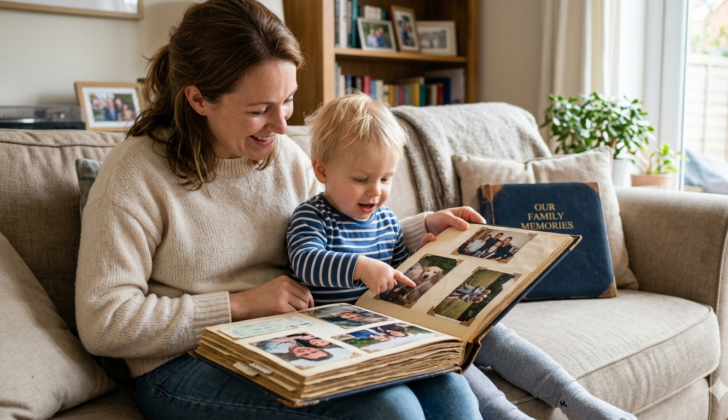
Using Family Photos to Teach Vocabulary
One of the most powerful tools is already on your phone.
Photos of:
- Your child
- Family members
- Favorite places
- Daily routines
These images are meaningful and motivating.
Example:
Show a photo of your child at the park.
“You are swinging.”
Pause.
“Swing.”
Children often attend more closely to pictures of themselves and their family.
When to Introduce Cartoons
Once a child:
- Understands the word
- Uses it consistently
- Recognizes it in real life
Cartoons can be added as another way to practice.
At this stage, cartoons help expand imagination and flexibility, not introduce meaning.
Mixing Both Without Confusion
It is okay to use both real photos and cartoons with intention.
A helpful rule of thumb:
- Teach new words with real photos
- Practice known words with cartoons
This keeps learning grounded while still allowing creativity and fun.
Common Parent Questions
“My child prefers cartoons. Is that a problem?”
Preference does not mean effectiveness. You can start with real photos and gradually include cartoons once understanding is established.
“Should I avoid apps and flashcards?”
Not necessarily. Look for apps that use real images or photos rather than only illustrations.
“Do I need professional materials?”
No. Your phone camera and daily life are more than enough.
Why Real-Life Photos Build Confidence
When children understand words easily, they feel successful. Success leads to:
- More attempts to communicate
- Less frustration
- Increased confidence
Confidence is the foundation of language growth.
A Final Thought for Parents and Caregivers
Teaching vocabulary does not require perfect tools or fancy programs. It requires meaningful connections.
Real-life photos help children understand that words apply to their world, not just a page or screen.
Start with what is real.
Build understanding first.
Add imagination later.
That is how language becomes functional, flexible, and meaningful.
Keep Learning & Stay Connected
Follow First Words Bright Futures on Facebook and Instagram for:
-
Daily speech tips
-
Fun activity ideas
-
Q&A with a pediatric SLP
Explore More:
- MDS: How to Give Specific Praise to Support Your Child’s Communication Skills
- MDS: How Siblings Shape Speech and Language Development
Disclaimer: This article offers general educational information. It is not a substitute for professional evaluation or treatment. Please consult a licensed Speech-Language Pathologist for personalized concerns regarding your child’s speech development.