Many parents start to feel frustrated when they catch themselves repeating the same words over and over. I already said that. Shouldn’t they know this by now? Over time, repetition can start to feel like a sign that something isn’t sticking or that progress is slower than it should be.
If you’ve ever felt this way, you’re not alone. Many parents worry that repeating the same words, phrases, or routines means their child is not really learning. Some even fear that repetition might hold their child back. In reality, the opposite is true. Repetition, when done naturally and without pressure, is one of the most powerful tools we have for building speech and language.
I often explain it this way, children do not learn language by hearing something once. They learn it by hearing it again… and again… and again, across real, meaningful moments in their everyday lives. Through connection, routines, play, and shared experiences. In this article, we’ll explore why repetition matters so much, what effective repetition actually looks like, and how you can use it at home in ways that feel natural.
Why Repetition Is Essential for Language Development
Language is complex. When a child hears a word, they’re not just hearing a sound. Their brain is doing a lot of invisible work all at once:
- Processing the sound pattern
- Connecting the word to meaning
- Figuring out how it fits into a sentence
- Learning when and how to use it
- Coordinating mouth movements to say it
That’s a lot for a developing brain.
Repetition gives the brain multiple chances to organize and store language in a way that becomes automatic over time. Each repetition strengthens the neural connections.
This is why children often:
- Say the same word over and over
- Want the same book every night
- Repeat a phrase from a show or song
- Use one word for many situations
What Repetition Does Not Mean
Before we talk about how to use repetition well, let’s clear up a common misconception.
Repetition does not mean:
- Quizzing your child
- Making them repeat words after you
- Correcting every mistake
- Turning playtime into a lesson
Those approaches often increase pressure and pressure can shut language down.
Instead, effective repetition is:
- Embedded in daily routines
- Responsive to your child’s interests
- Low-pressure and playful
- Modeled, not demanded
How Repetition Builds Language Skills Over Time
Repetition supports multiple areas of communication at once.
1. Vocabulary Growth
When children hear the same words used across different situations, they learn what those words truly mean.
For example:
- “Open” when opening a door
- “Open” when opening a snack
- “Open” when opening a toy
Each time, the meaning becomes clearer and more flexible.
2. Sentence Structure
Hearing the same sentence patterns helps children learn how language is organized.
“I want ___.”
“Let’s go ___.”
“Put it ___.”
These sentence frames become templates children eventually fill in themselves.
3. Speech Sound Development
Repeated exposure to sounds helps children learn how words should sound, even before they can say them correctly.
4. Confidence and Participation
When children recognize familiar words and phrases, they are more likely to attempt communication because they know what’s coming.
Real-Life Example: Snack Time
Here are some examples of how repetition might naturally show up during snack time.
You might say:
- “You want crackers.”
- “More crackers.”
- “Crunchy crackers.”
- “Let’s open the crackers.”
- “All done crackers.”
Notice what’s happening:
- Same word
- Slightly different sentence
- Same routine
- No pressure to repeat
Over time, your child starts to anticipate the word and eventually tries it.
The Power of Repetition Through Routines
Routines are language perfect for language:
Daily activities like:
- Getting dressed
- Bath time
- Meals
- Car rides
- Bedtime
Why routines work so well:
- The context stays the same
- The language becomes predictable
- The child knows what comes next
- Cognitive load is reduced
This frees up brain space for learning words.
Step-by-Step: Using Repetition During Daily Routines
Step 1: Pick a Routine
Choose one part of the day that already happens every day.
Examples:
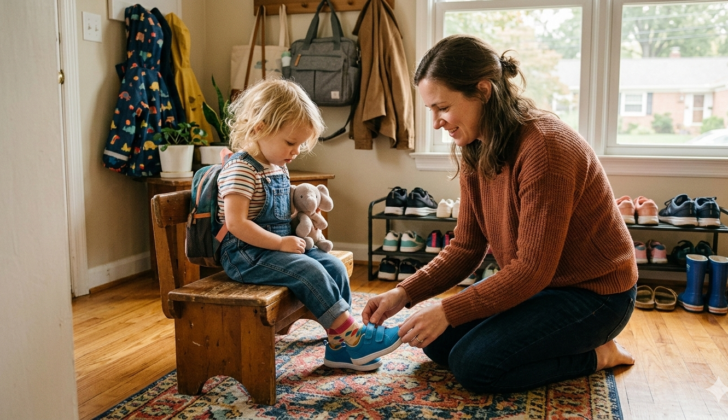
- Putting on shoes
- Brushing teeth
- Buckling into the car
Step 2: Choose 3–5 Target Words or Phrases
Keep it simple and functional.
For shoes:
- “Shoes”
- “On”
- “Off”
- “Help”
- “Go”
Step 3: Repeat Them Naturally
Use the same words each day in short, clear sentences.
Example Script:
- “Shoes on.”
- “Help with shoes.”
- “Shoes on—go!”
- “Shoes off.”
Step 4: Pause and Wait
After modeling, pause for a few seconds. This gives your child time to respond—verbally or non-verbally.
Step 5: Respond to Any Attempt
A sound, gesture, look, or partial word all count. Acknowledge it and model again.
Repetition Through Play
Play is one of the best places to repeat language because it does not feel like work.
Example: Playing with Cars
Instead of narrating everything, focus on a few key words.
Target words:
- “Go”
- “Stop”
- “Fast”
- “Crash”
Natural Language Models:
- “Car go!”
- “Go fast!”
- “Stop!”
- “Crash! Oh no!”
You might say “go” twenty times in five minutes and that’s okay. That repetition is meaningful because it is tied to action and excitement.
Books: The Ultimate Repetition Tool
If your child wants the same book every night, that’s not a bad habit, it’s actually beneficial.
Familiar books allow children to:
- Anticipate words
- Fill in phrases
- Focus on sounds instead of content
How to Use Books Repetitively (Without Reading Word-for-Word)
- Read the book normally the first time
- On later readings, emphasize repeated phrases
- Pause before predictable lines
- Use the same comments each time
Example Script:
- “Uh oh…”
- Pause
- “The bear fell!”
Eventually, your child may say the word before you do.
Repetition Doesn’t Mean No Progress
One of the hardest things for parents is seeing their child use the same words for weeks or months.
But repetition is often the bridge between understanding and expression.
A child might:
- Understand a word long before saying it
- Say it incorrectly before saying it clearly
- Use it in one setting before generalizing it
This is all normal development.
Common Parent Concerns
“I feel silly repeating myself.”
You are not repeating for no reason. You are building a language map.
“They already know this word.”
Knowing a word and being able to use it flexibly are different skills.
“Shouldn’t I correct them?”
Modeling the correct version repeatedly is more effective than direct correction.
When to Be Intentional With Repetition
Repetition is especially helpful if your child:
- Uses few words
- Gets frustrated communicating
- Uses gestures instead of words
- Has unclear speech
- Struggles with combining words
In these cases, repetition gives them multiple low pressure opportunities to learn without being put on the spot.
Final Thoughts: You Are Probably Already Doing This
Here is the good news: most parents naturally repeat language more than they realize.
Every time you:
- Sing the same song
- Read the same book
- Say “time to go” the same way
- Use familiar phrases
You are supporting language growth.
The key is not doing more.
It is doing it intentionally, consistently, and without pressure.
Language grows best when it feels safe, predictable, and connected to real life.Repetition helps make all of that possible.
Final Thoughts
Describing words turn simple labels into more powerful communication. When children learn to describe, they are learning how to share their world with others.
Keep Learning & Stay Connected
Follow First Words Bright Futures on Facebook and Instagram for:
-
Daily speech tips
-
Fun activity ideas
-
Q&A with a pediatric SLP
Explore More:
- MDS: When Should Toddlers Start Using Phrases?
- MDS: Making Communication Visible: Using Visual Supports in Daily Routines
Disclaimer: This article offers general educational information. It is not a substitute for professional evaluation or treatment. Please consult a licensed Speech-Language Pathologist for personalized concerns regarding your child’s speech development.