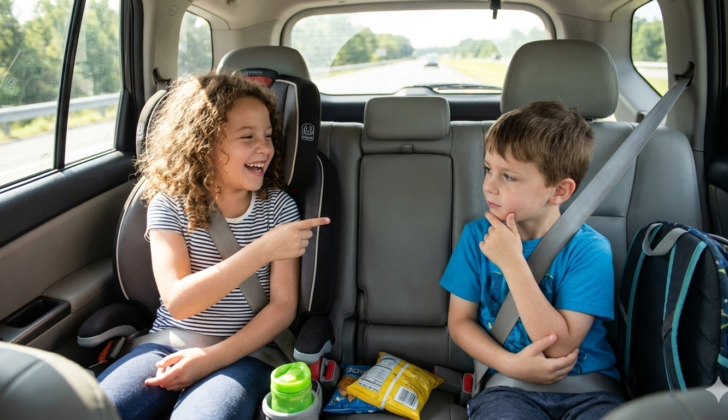
Road trips can feel long, loud, and a little chaotic. They can also be a goldmine for speech and language growth because you have something many families do not get much of during a regular day: repeated time together with fewer transitions.
You do not need special toys or fancy materials. With a few simple games, you can build your child’s vocabulary, listening, sentence skills, storytelling, speech clarity, and even social communication. The best part is that you can adjust every game for toddlers through elementary-aged kids, and you can include children who use gestures, pictures, or AAC.
Below you will find easy games, step-by-step directions, and ready-to-use scripts you can say out loud.
Before You Start: Simple SLP Tips That Make Any Game Work Better
1) Keep it short and predictable
Aim for 3–5 minutes per game, then switch. Short games prevent frustration and help kids stay engaged.
2) Model first, then invite your child
Children learn language by hearing it used clearly and repeatedly.
Quick script:
“I will show you first. Then it is your turn.”
3) Give choices instead of open-ended questions
Open-ended questions can feel hard in a moving car when attention is split.
Instead of: “What do you see?”
Try: “Do you see a truck or a car?”
4) Expand what your child says
If your child says one word, you can turn it into two or three without requiring repetition.
- Child: “Dog.”
- Adult: “Big dog!” or “Dog is running.”
5) Use a “help” phrase and a “break” phrase
This reduces power struggles and supports communication.
Scripts:
- “If you need help, say: Help please.”
- “If you need a break, say: Break please.”
Game 1: “I Spy” (The SLP Version)
What it builds
Vocabulary, describing skills, listening, attention, inferencing.
How to play
- Pick something your child can see.
- Give 1–3 clues depending on age.
- Let them guess.
- After the guess, add one expansion sentence.
Scripts by age
Toddlers (2–3):
“I spy something red.”
If they struggle: “It is the red car.”
Preschool (3–5):
“I spy something big and yellow.”
After: “Yes, it is the school bus. The school bus is big and yellow.”
Elementary (6+):
“I spy something you use to help you drive, it is round, and you hold it.”
After: “That was a great guess. You used the clues.”
Make it a speech sound game (optional)
If your child is working on /s/, /k/, /t/, etc., choose targets that start with that sound.
Script:
“Let us find three things that start with ‘s’: sign, sun, seat.”
Game 2: “Category Hunt”
What it builds
Word-finding, vocabulary organization, semantic skills, faster naming.
How to play
- Choose a category (animals, foods, places, colors, things with wheels).
- Set a small goal (5 items).
- Take turns naming items.
- Add one describing word for each item.
Script
“Let us do things with wheels. I will start: bus. It is big. Your turn.”
Make it more advanced
- Subcategories: “Farm animals” vs “zoo animals”
- Attribute rule: “Only foods that are crunchy”
- Location rule: “Things you might see at a dentist”
Game 3: “Sound Detective” (Listening Game)
What it builds
Auditory attention, sound awareness (early phonological skills), following directions.
How to play
- Choose a sound you might hear: horn, siren, train, motorcycle, turn signal.
- When someone hears it, they call it out.
- Add one language task after the sound.
Scripts
- “I heard a siren. Where do you think it is going?”
- “We heard a horn. Was it loud or soft?”
- “We heard a motorcycle. Tell me two words to describe it.”
For younger kids
“Listen… I hear a horn. Beep beep! Your turn: beep beep!”
Game 4: “The Yes/No Guess Game”
What it builds
Question-asking, sentence structure, critical thinking, social turn-taking.
How to play
- One person thinks of something you can see (or a simple item like “pizza”).
- Everyone else asks yes/no questions to guess.
- Limit to 10 questions to keep it moving.
Starter question bank (post this in your notes app)
- “Is it an animal?”
- “Is it bigger than a car?”
- “Do you use it at home?”
- “Is it something you eat?”
- “Is it a place?”
Script for kids who do not ask questions yet
“You can copy me. Say: Is it a ___?”
Game 5: “Tell Me More” (Expand the Sentence)
What it builds
Longer sentences, grammar, storytelling basics.
How to play
- You say a short sentence about something you see.
- Your child adds one piece of information.
- You add one more. Keep it going 3–6 turns.
Example
Adult: “I see a truck.”
Child: “Big truck.”
Adult: “Big truck carrying wood.”
Child: “Going fast.”
Adult: “Yes, it is going fast on the highway.”
Script
“Your job is to add one more idea.”
Game 6: “Silly Directions” (Follow-the-Direction Fun)
What it builds
Following directions, concepts (first/next/last), body parts, listening.
How to play (car-safe version)
Directions should be small and safe in a car seat.
1-step examples:
- “Touch your nose.”
- “Show me your fingers.”
- “Point to the window.”
2-step examples (preschool +):
- “Touch your head and then clap quietly.”
- “Point to the door and then show me two fingers.”
3-step examples (elementary):
- “Touch your ear, take a deep breath, and then whisper ‘ready.’”
Script
“Listen first, then do it.”
Game 7: “Story Chain” (Build a Road Trip Tale)
What it builds
Narrative skills, sequencing, creativity, describing, perspective-taking.
How to play
- Someone starts with one sentence.
- Each person adds one sentence.
- Every few turns, summarize what happened so far.
Starter prompts
- “Once we were driving to…”
- “Then we saw a…”
- “Suddenly…”
- “The problem was…”
- “So we decided…”
Script
“I will start. You add one sentence. We keep it going.”
For younger kids or limited language
Offer choices:
“Did the dog feel happy or scared?”
“Did we go to the park or the store?”
Game 8: “Rhyme Time” (No Reading Required)
What it builds
Phonological awareness (a strong early reading foundation), listening to sounds.
How to play
- Pick a simple word: cat, car, boat, sun.
- Take turns saying rhyming words (real or silly).
- Celebrate effort.
Script
“Cat… hat… bat… lat (silly). Your turn.”
If rhyming is hard
Do “same sound” instead:
“Let us find words that start with ‘b’: bus, bag, big.”
Game 9: “Emotion Spotting” (Social Language on the Go)
What it builds
Emotion vocabulary, perspective-taking, pragmatic language.
How to play
- Look for people in signs, billboards, or safe observations (no staring at real people).
- Label an emotion.
- Give one reason.
Script
“He looks surprised. Maybe he saw something unexpected.”
Child-friendly choices
“Do you think he feels happy, sad, or mad?”
Game 10: “The Road Trip Reporter” (Conversation Builder)
What it builds
Answering questions, sentence formulation, retell skills.
How to play
Your child becomes the “reporter” and asks questions, or you ask and they answer. Keep it light.
Question set
- “Where are we going?”
- “What will we do first?”
- “What do you think we will see?”
- “What is one thing you packed?”
- “What is your plan if you feel bored?”
Script
“You are the reporter. Ask me one question.”
Quick Supports for Common Road Trip Challenges
If your child only answers with one word
Use the “two-choice plus model” approach.
Script:
“Do you see a truck or a car?”
Child: “Truck.”
Adult: “Yes, a big truck.”
If your child gets silly or dysregulated
Use a predictable regulation phrase and switch to a calm listening game.
Script:
“Your body needs a reset. Let us do three deep breaths, then we will play Sound Detective.”
If your child uses AAC or a core board
You can still play every game by modeling core words: go, stop, look, more, help, want, like, not, turn, big, little.
Scripts:
- “It is your turn. Touch ‘turn.’”
- “Do you want more game or break?”
- “I see big truck. Touch ‘big.’”
A Simple Road Trip Game Routine (So You Do Not Have to Think)
Try this rotation:
- I Spy (3 minutes)
- Category Hunt (3 minutes)
- Snack or break
- Story Chain (5 minutes)
- Sound Detective (until the next stop)
Keep it flexible. The goal is connection and practice, not perfection.
Final Encouragement
If you play just one of these games for five minutes, you are giving your child rich language input and meaningful practice. Over time, those tiny moments add up.
Keep Learning & Stay Connected
Follow First Words Bright Futures on Facebook and Instagram for:
-
Daily speech tips
-
Fun activity ideas
-
Q&A with a pediatric SLP
Explore More:
- MDS: Winter Indoor Play Ideas to Build Language Skills in Young Children
- MDS: Holiday Language Activities for Toddlers (Ages 1–3)
Disclaimer: This article offers general educational information. It is not a substitute for professional evaluation or treatment. Please consult a licensed Speech-Language Pathologist for personalized concerns regarding your child’s speech development.