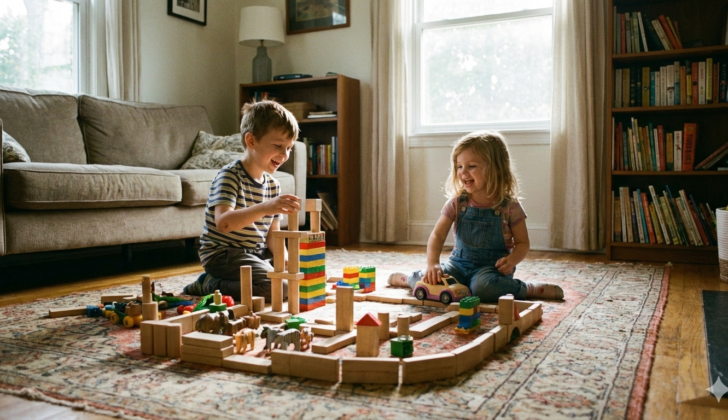
When families think about supporting speech and language development, they often picture one-on-one time with an adult. While adult interaction is extremely important, there is another powerful influence in your home that is often overlooked: siblings.
Brothers and sisters shape how children learn to communicate every single day. They model language, create motivation to speak, challenge social skills, and provide natural opportunities for problem-solving. Sometimes this influence looks helpful and sometimes it looks messy. Both matter.
This article explains how siblings influence speech and language development, what this looks like at different ages, and how caregivers can intentionally use sibling interactions to support communication without turning family life into therapy sessions.
Why Siblings Matter So Much for Communication
Sibling interactions are different from adult-child interactions in important ways:
- They are frequent and repetitive
- They happen during real life moments
- They involve shared interests and emotions
- They naturally require negotiation, repair, and compromise
From a speech-language perspective, siblings provide a rich communication environment that cannot be fully replicated by structured activities alone.
The Positive Ways Siblings Support Speech and Language
1. Siblings Provide Constant Language Models
Younger children hear how language is used naturally when they listen to their siblings talk, argue, negotiate, and tell stories.
This supports:
- Vocabulary growth
- Sentence structure
- Grammar
- Pragmatic language (social rules of communication)
Real-life example:
An older sibling says, “You can use the blue marker after I am done.”
A younger child hears turn-taking language, time concepts, and polite negotiation in one sentence.
2. Siblings Increase Motivation to Communicate
Children are often more motivated to talk to siblings than to adults. Siblings control toys, games, and access to shared fun.
This creates a natural reason to:
- Request
- Protest
- Ask questions
- Clarify misunderstandings
SLP insight:
Motivation is one of the biggest drivers of communication growth. Siblings naturally create it.
3. Siblings Teach Social Communication Skills
Sibling relationships require skills that are essential for social language:
- Taking turns
- Reading emotions
- Repairing communication breakdowns
- Understanding another person’s perspective
Even conflict is valuable when supported appropriately.
4. Siblings Create Repetition Without Pressure
Children hear the same words, phrases, and routines repeatedly during play. Repetition strengthens understanding and expression without feeling like practice.
When Sibling Dynamics Can Make Communication Harder
Sibling influence is powerful, but it is not always positive without guidance.
Common challenges include:
- Older siblings talking for younger ones
- Younger siblings relying on gestures instead of words
- Competition or frustration reducing communication attempts
- One child dominating play
These situations are not harmful by default. They are opportunities for gentle coaching.
How to Support Healthy Communication Between Siblings
Strategy 1: Teach Older Siblings to Pause, Not Speak For
Older siblings often help by answering for a younger child. While well-intended, this can limit communication opportunities.
What to say to the older sibling:
“Let us give your brother a turn to tell us.”
What to model:
Pause. Look at the younger child. Wait a few seconds before stepping in.
Strategy 2: Coach Turn-Taking Language
Turn-taking does not always come naturally. Explicit language helps.
Scripts to model and practice:
- “My turn, then your turn.”
- “You can have it when I am finished.”
- “Let us decide together.”
Say these phrases often during play so siblings can copy them.
Strategy 3: Use Sibling Play as a Language Opportunity
You do not need special materials. Everyday play works best.
Step-by-step example:
- Sit nearby while siblings play.
- Narrate briefly: “You are building a tower together.”
- Model one helpful phrase: “Can you help me?”
- Step back and let them try.
Less talking from adults often leads to more talking from children.
Sibling Support by Age Group
Toddlers (1–3 years)
What siblings help with:
- First words
- Joint attention
- Turn-taking
- Sound imitation
How caregivers can help:
- Encourage simple imitation games
- Label actions during shared play
Scripts:
- “Push car.”
- “Go fast!”
- “Your turn.”
Preschoolers (3–5 years)
What siblings help with:
- Longer sentences
- Question-asking
- Pretend play language
- Emotional vocabulary
How caregivers can help:
- Prompt problem-solving language
- Encourage pretend roles
Scripts:
- “What should we do next?”
- “How does your character feel?”
- “Let us make a plan.”
Elementary-Age Children (6+ years)
What siblings help with:
- Storytelling
- Negotiation
- Perspective-taking
- Repairing misunderstandings
How caregivers can help:
- Support respectful disagreement
- Encourage explaining ideas
Scripts:
- “Tell your sister why you disagree.”
- “What is your solution?”
- “Can you explain it another way?”
Supporting a Child With Speech or Language Delays in a Sibling Group
If one child has a speech or language delay, sibling interactions can still be a strength.
Helpful strategies:
- Model short, clear phrases siblings can copy
- Encourage waiting and listening
- Praise communication attempts, not perfection
Script for siblings:
“Wait and listen. They are telling you something.”
Script for the child with delays:
“You tried. I heard you.”
Using Conflict as a Teaching Moment (Without Over-Correcting)
Disagreements are part of sibling life. They can support communication when handled calmly.
Instead of:
“Stop arguing.”
Try:
“Tell me what you want.”
“Now tell me what your brother wants.”
“Let us find a solution.”
This teaches:
- Expressing needs
- Listening to others
- Flexible thinking
What Caregivers Should Remember
- Siblings are not therapists, and they do not need to be.
- Natural interaction is more powerful than forced practice.
- Small moments add up over time.
- Communication grows best in relationships.
You do not need to manage every interaction. Choose one or two strategies and use them consistently.
Final Thoughts from an SLP
Sibling relationships are one of the richest language environments a child can have. They are full of emotion, motivation, repetition, and real-world problem-solving. When caregivers step in with gentle guidance and simple language models, siblings become powerful partners in communication development.
Keep Learning & Stay Connected
Follow First Words Bright Futures on Facebook and Instagram for:
-
Daily speech tips
-
Fun activity ideas
-
Q&A with a pediatric SLP
Explore More:
- MDS: How Speech Delays Affect Social Skills and Friendships
- MDS: Stop the Quiz: How Fewer Questions Help Your Child Talk More
Disclaimer: This article offers general educational information. It is not a substitute for professional evaluation or treatment. Please consult a licensed Speech-Language Pathologist for personalized concerns regarding your child’s speech development.