If your child can label objects (“car,” “dog,” “ball”), but struggles to describe them (“big,” “fast,” “soft”), you are not alone. Describing words are also known as adjectives. Describing words are an important step in language development and many children need time and support to use them confidently.
Parents sometimes feel like they need to use flashcards or adult directed tasks to teach language, however children learn them best through experience, repetition, and play. When children touch, move, build, crash, squish, and explore, their brains are primed to learn descriptive language.
You are probably already creating perfect opportunities to teach describing words every single day. You just have to make these moments more intentional.
This article will help you understand:
- What describing words are and why they matter
- When children typically start using them
- Why some children struggle with descriptive language
- How to teach describing words naturally through play
- Simple scripts and step-by-step ideas that fit into daily routines
What Are Describing Words?
Describing words (adjectives) tell us more information about an object, person, or action. They help children explain what something looks like, feels like, sounds like, or does.
Examples include words that describe:
- Size: big, little, tall, short
- Color: red, blue, yellow
- Texture: soft, rough, sticky
- Speed: fast, slow
- Quantity: more, empty, full
- Temperature: hot, cold
Instead of just saying:
- “Ball”
A child can say:
- “Big ball”
- “Red ball”
- “Bouncy ball”
This added detail makes communication clearer and more meaningful.
Why Describing Words Are So Important
Describing words help children:
- Build longer phrases and sentences
- Share more detailed ideas
- Improve storytelling and retelling
- Understand directions (“Get the big cup”)
- Prepare for reading comprehension and writing
Descriptive language moves children from labeling to true communication.
When Do Children Typically Use Describing Words?
Every child develops differently, but general expectations include:
- Ages 2–3:
Children may begin using basic descriptors like big, hot, more, or color words. - Ages 3–4:
Children use describing words more consistently in short phrases (“big truck,” “fast car”). - Ages 4–5:
Children begin combining multiple descriptors and using them in sentences (“The big red truck is fast”).
Some children understand many describing words but use very few. Others use them only when prompted. Both patterns are common and can improve with intentional modeling.
Why Some Children Struggle With Describing Words
Children may have difficulty using adjectives if they:
- Focus on labeling rather than expanding language
- Have limited expressive vocabulary
- Are unsure which detail is “important” to share
- Have language delays or processing differences
- Have not heard descriptive language modeled often
This does not mean they are not capable, it means they need more exposure in meaningful contexts.
The Most Important Rule: Experience First, Words Second
Children learn describing words best when they:
- Touch it
- See it
- Move it
- Play with it
Rather than asking:
“What color is this?”
Try modeling:
“This is a big red truck!”
Children absorb language through repeated, natural exposure, not constant questioning.
Teaching Describing Words Through Everyday Play
Below are practical, play-based ways to build descriptive language without adding extra work to your day.
Activity 1: Toy Play Commentary
Best for: toddlers and preschoolers
When: free play, floor play, pretend play
How to Do It:
- Join your child’s play.
- Narrate what you see using one or two describing words.
- Repeat key words often.
Example Scripts:
- “That is a big truck.”
- “The car is fast!”
- “Oh no! The tower fell. It is tall… now it’s down.”
You do not need to quiz your child. Hearing the words repeatedly is what builds learning.
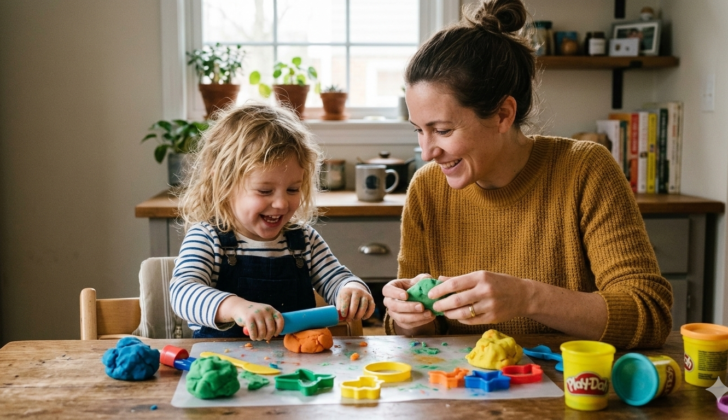
Activity 2: Sensory Play (The Best Describing-Word Builder)
Best for: hands-on learners
When: bath time, playdough, sand, water play
Use Words Like:
- Soft / hard
- Wet / dry
- Sticky / smooth
- Heavy / light
Example Scripts:
- “The playdough is soft.”
- “That rock is heavy.”
- “Your hands are wet!”
Sensory experiences give meaning to words, making them easier to remember.
Activity 3: Snack Time Describing
Best for: busy families
When: meals and snacks
How to Do It:
Describe food as your child eats it.
Example Scripts:
- “That cracker is crunchy.”
- “The apple is cold.”
- “Your cup is empty.”
- “More milk. Now it’s full.”
Food naturally invites descriptive language without feeling like practice.
Activity 4: Describing Through Movement
Best for: active children
When: outdoor play, living room movement breaks
Use Action Words:
- Fast / slow
- High / low
- Big jumps / little jumps
Example Scripts:
- “You are running fast!”
- “That was a big jump!”
- “Now you’re moving slow.”
Movement helps children connect language to their bodies.
Activity 5: Book Reading With a Describing Focus
You do not need special books.
How to Do It:
- Pick one or two describing words per page.
- Emphasize them as you read.
- Relate them to real life.
Example:
- “Look at the big bear.”
- “The bear is sleepy.”
- “You look sleepy too!”
Keep it conversational—not a test.
What If My Child Only Labels and Doesn’t Describe?
That is very common.
Use expansion:
- Child: “Dog.”
- Adult: “Yes! Big dog.”
- Child: “Car.”
- Adult: “Fast car!”
You are showing them what comes next without pressure.
How Often Should We Practice?
Describing words grow best with:
- Short, repeated exposure
- Daily routines
- Play-based interaction
Even a few minutes a day makes a difference.
When to Seek Extra Support
You may want to consult a speech-language pathologist if:
- Your child uses very few words overall
- Language is hard to understand or very limited
- Your child rarely combines words
- Progress feels slow despite consistent modeling
An SLP can help identify which language skills need support and show you how to build them naturally.
Final Thoughts
Describing words turn simple labels into more powerful communication. When children learn to describe, they are learning how to share their world with others.
Keep Learning & Stay Connected
Follow First Words Bright Futures on Facebook and Instagram for:
-
Daily speech tips
-
Fun activity ideas
-
Q&A with a pediatric SLP
Explore More:
- MDS: Teaching Kids to Ask for Help: A Powerful Skill That Reduces Meltdowns
- MDS: Teaching Children to Use Words for Feelings
Disclaimer: This article offers general educational information. It is not a substitute for professional evaluation or treatment. Please consult a licensed Speech-Language Pathologist for personalized concerns regarding your child’s speech development.