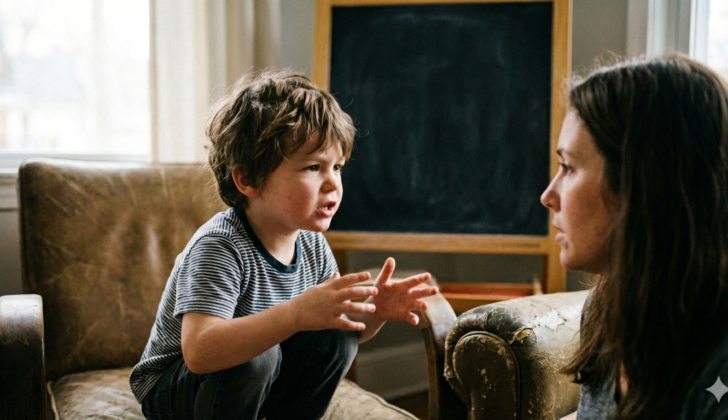
You ask your four-year-old to turn off the tablet, and before you know it his hand swings out in frustration. You offer the wrong color cup and he hits, kicks, or throws something instead of telling you what he wants.
Many parents feel hurt, embarrassed, or confused in these moments. You might wonder, “Why does my child hit me when he knows how to talk?”
I want to reassure you that this behavior is common and it is not a sign that your child is “bad” or “out of control.” Rather, it is a sign that your child’s emotional and communication skills are still developing.
When children hit, they are not simply misbehaving. They are sending a message their words cannot yet express.
Understanding the Communication Behind the Behavior
At age four, a child’s vocabulary and grammar may seem advanced, but communication under stress is a very different skill. When a child is upset, the brain’s emotional center (the amygdala) activates, while the rational, language-based part of the brain (the prefrontal cortex) temporarily goes offline.
In simple terms: the emotion shows up before the words do.
That means your child may know what to say, but in the heat of frustration, anger, or disappointment, the body reacts faster than language can.
Common Reasons a Four-Year-Old Hits Instead of Using Words:
- Emotional Overload – Strong feelings rise quickly, and hitting becomes a physical release.
- Language Breakdown – Even if the child speaks well, words feel “stuck” when emotions are high.
- Desire for Control or Attention – Physical behavior gets an instant response, whereas words might not.
- Learned Patterns – If hitting has led to getting a toy back or changing the situation, it becomes a default strategy.
When you see hitting, think of it not as defiance, but as a communication gap. It is a moment when emotion overpowers language.
Real-Life Example: A Common Scenario
Scene:
You tell your son it is time to leave the playground. He yells “No!” and hits your leg.
What It Means:
He feels disappointed, powerless, and not ready to stop playing. His body reacts before his words can.
What He Needs:
Help regulating his body, labeling his feelings, and practicing words for next time.
Parent Response:
“I will not let you hit. You are mad because it is time to go. Take a breath. You can tell me, ‘I am mad!’ or ‘I want one more slide.’ Let us calm first.”
This script both sets a boundary and teaches the language of emotion and problem-solving.
The Language of Feelings: Teaching Emotional Vocabulary
Many children hit simply because they lack the words to describe their feelings. Emotional vocabulary is as important as academic vocabulary and it must be taught intentionally.
Begin by Modeling:
- “You look angry that I said no.”
- “You feel sad because your tower fell.”
- “You are frustrated that it is not working.”
- “You are excited to play outside!”
When you name emotions for your child, you are connecting their internal experience to language. Over time, they learn to use those words on their own.
Tip: Keep feelings words visible. A “Feelings Chart” with faces labeled mad, sad, tired, frustrated, excited, and scared helps children connect emotion to expression.
Replacing Hitting With Communication
Children need concrete alternatives to replace physical reactions. Telling a child “Use your words” is too vague; we must show them exactly what that looks like.
Step 1: Acknowledge the Feeling
“You are mad. That is okay.”
Acknowledging the emotion shows empathy and helps calm the brain.
Step 2: State the Limit
“I will not let you hit.”
This maintains safety and consistency.
Step 3: Teach the Replacement Phrase
“You can say, ‘I am mad!’ or ‘I want a turn!’”
Use short, simple sentences. Practice them during calm times, not only in the heat of the moment.
Practical Scripts for Everyday Situations
| Situation | What Your Child Feels | Words You Can Model |
| You took away a toy | Angry | “I am mad. I wanted more time.” |
| He needs help | Frustrated | “Help me, please.” |
| A sibling took something | Jealous or upset | “Give it back, please.” or “I want a turn.” |
| You said no | Disappointed | “I really wanted that.” |
| He feels ignored | Unheard | “Listen to me, please.” |
Role-play these during calm moments so he knows what to say when big emotions come.
Teaching Through Play: Practice When Calm
Children learn best through playful, low-pressure repetition. Use puppets, stuffed animals, or role-play to practice feelings and replacement phrases.
Example Activity:
Pretend two toy animals are fighting over a block. Model what each could say:
“Lion is mad. He says, ‘I want a turn.’ Monkey says, ‘Okay, you can have it next.’”
Then invite your child to take a turn making the toys talk. These imaginative moments teach empathy, problem-solving, and self-expression.
Using Visual and Sensory Supports
Some children benefit from visual or physical strategies that help them pause before reacting.
Try:
- Visual cue cards: pictures showing “Stop,” “Breathe,” and “Use words.”
- Calm-down spot: a cozy corner with books, fidget toys, or a weighted stuffed animal.
- Sensory breaks: pushing the wall, jumping, or squeezing a pillow to release tension safely.
You might say:
“Your body feels tight. Let us squeeze the pillow. Then we can talk.”
This shows that physical energy can be released in safe ways, not hurtful ones.
Reinforce Effort, Not Just Perfection
The first time your child uses words instead of hands, even partially—celebrate it.
“You told me you were mad instead of hitting. That is what big kids do!”
Positive reinforcement wires the brain to repeat that behavior next time. Praise effort, not outcome.
The Power of “Do-Overs”
After your child hits and has calmed down, guide a short repair moment.
- Name the behavior:
“You hit Mommy. That hurt.” - Model the correct response:
“Next time, you can say, ‘I am mad.’” - Practice together:
“Let us try again—‘I am mad.’ Perfect.”
These small, calm “do-overs” teach accountability and build confidence.
Real-Life Story: Progress in Action
One of my preschool clients, struggled with hitting whenever his play was interrupted. Through therapy, we practiced short scripts like “Stop!” and “I am mad!” using puppets and games. At home, his parents reinforced those same phrases, praised his efforts, and reminded him of his words before transitions.
Within a few months, this kiddo began using “I am mad” or “I want one more minute” instead of hitting. His parents noticed fewer power struggles and more conversations.
This child’s progress did not come from punishment,it came from connection, modeling, and repetition.
When to Seek Extra Support
If hitting becomes frequent or severe, or if your child:
- Has difficulty calming down after outbursts,
- Shows limited language for his age,
- Has trouble connecting with peers,
- Or seems overly reactive to sensory input,
it may be time to consult with a professional. A speech-language pathologist or occupational therapist can assess whether language, sensory, or emotional regulation challenges are contributing factors.
The Parent’s Role: Connection Before Correction
Children learn emotional control through the adults around them. When you stay calm, set consistent limits, and model clear language, you are teaching much more than words. You are teaching safety and trust.
Remember this sequence:
Calm first. Connect second. Teach third.
Connection regulates the body; regulation makes learning possible.
Final Thoughts: Hands to Words, Frustration to Communication
When your four-year-old hits, it is not because he does not love you or because he does not understand. It is because his feelings are bigger than his words.
Your job is not to punish the behavior away, but to build the bridge between emotion and communication, through modeling, patience, and consistent language.
With time, those little hands that once lashed out will start to reach out to hug, to ask, to explain, and to connect.
That transformation begins with your calm presence and your words.
Parent Takeaways
- Hitting is communication before words—look beneath the behavior.
- Emotional vocabulary must be taught and modeled daily.
- Practice replacement phrases during calm moments, not meltdowns.
- Reinforce effort and regulate together before teaching.
- Seek professional help if hitting is persistent, severe, or linked to language delays.
Keep Learning & Stay Connected
Follow First Words Bright Futures on Facebook and Instagram for:
-
Daily speech tips
-
Fun activity ideas
-
Q&A with a pediatric SLP
Explore More:
- MDS: Teaching Children to Use Words for Feelings
- MDS: Helping Young Children Build Flexible Thinking Skills
Disclaimer: This article offers general educational information. It is not a substitute for professional evaluation or treatment. Please consult a licensed Speech-Language Pathologist for personalized concerns regarding your child’s speech development.