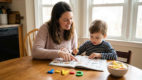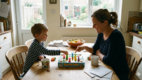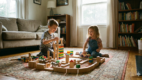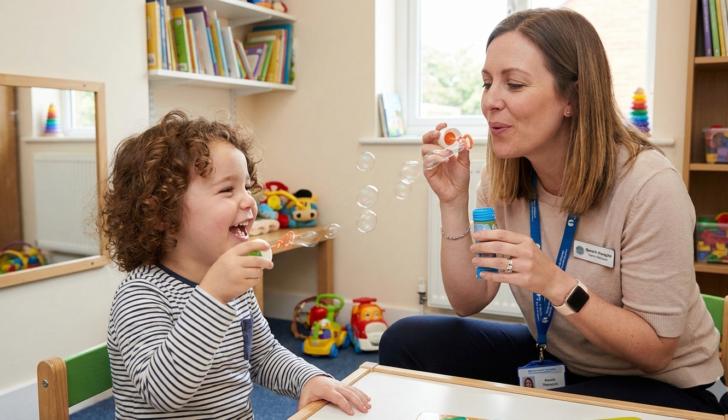
If you have ever peeked into your child’s speech therapy session and wondered, “Why are they just playing?” you are not alone. Many parents expect to see flashcards, drills, or worksheets. Instead, they see blocks, bubbles, pretend kitchens, or toy animals.
It might look like play, but underneath the laughter and imagination is serious, evidence-based therapy designed to build your child’s speech, language, and social communication skills in the most effective way possible.
As a speech-language pathologist, I can assure you that play is not a break from learning. Play is the learning. It is the child’s natural language. When we join them in that world, we open the door to communication growth that lasts.
Why Speech Therapy Looks Different for Young Children
Young children learn differently than older students or adults. Their brains are wired to explore, experiment, and imitate.
Think about how your child learned to walk or feed themselves, it happened through repetition, curiosity, and connection, not direct instruction. Speech and language develop the same way.
During play, children:
- Practice problem-solving and turn-taking
- Build vocabulary and sentence structure
- Strengthen attention, memory, and flexibility
- Learn to express wants, ideas, and feelings
- Experience joy and confidence in communication
When a therapist uses play, every moment is intentional. Each toy, game, and gesture has a purpose tailored to your child’s goals.
The Science Behind Play-Based Speech Therapy
Research in child development and neuroscience consistently shows that play-based learning leads to:
- Higher engagement and motivation
- Better generalization of skills from therapy to real life
- Reduced anxiety, which allows learning to stick
- Stronger relationships, which are the foundation for communication
In play, the brain releases dopamine, the “reward chemical” that strengthens memory and learning pathways. When a child is happy, relaxed, and connected, the brain is primed to absorb new information, especially language.
What Your SLP Is Doing While “Playing”
To an observer, therapy might look like a simple game, but the therapist is constantly analyzing, modeling, and scaffolding language. Here are examples of what is happening behind the scenes.
1. Targeting Speech Sounds During Play
What You See:
Your child is pushing toy cars down a ramp.
What Is Happening:
The SLP might be using the car game to practice the /k/ sound in “car,” “go,” or “crash.”
Each repetition feels natural and fun, not forced.
Why It Works:
Children learn faster when they are relaxed and motivated. Practicing speech sounds during play ensures that articulation skills transfer into real communication, not just drill-based responses.
Parent Script for Home:
“Your car goes crash! I heard your /k/ sound in ‘car.’ Let us do it again—ready, set, go!”
2. Building Vocabulary and Sentence Length
What You See:
The therapist and child are playing with a dollhouse.
What Is Happening:
The SLP is modeling new words and expanding on what your child says.
Example:
Child: “Baby sleep.”
Therapist: “Yes, the baby is sleeping in the bed. She is so tired.”
Why It Works:
Children learn new words best when they hear them in context and through repetition. Play provides hundreds of natural opportunities to model and expand language.
Parent Script:
“The baby is eating. She is hungry. Let us feed her again.”
3. Teaching Turn-Taking and Social Communication
What You See:
The therapist and child are rolling a ball back and forth.
What Is Happening:
The SLP is targeting joint attention, eye contact, turn-taking, and social language such as “my turn,” “your turn,” or “let us play together.”
Why It Works:
Social communication is the foundation for conversation. Children must first learn to share space, attention, and actions before sharing words.
Parent Script:
“My turn! Now your turn. We are playing together!”
4. Encouraging Requesting and Problem Solving
What You See:
Your child is trying to open a container of bubbles.
What Is Happening:
The therapist has intentionally given a “communication temptation”—something slightly challenging that encourages your child to ask for help or make a request.
Example:
Child: Grunts or looks at therapist
Therapist: “Oh, you need help! You can tell me, ‘Help me!’”
Child: “Help me!”
Why It Works:
Children learn that words have power. Each successful request teaches that communication gets results.
Parent Script:
“The lid is tight! You can tell me, ‘Help me open it.’ There you go!”
5. Supporting Attention and Emotional Regulation
What You See:
The SLP is following your child’s lead, even when they change toys frequently.
What Is Happening:
The therapist is using child-led therapy to build regulation and trust. They may use sensory strategies like movement, bubbles, or songs to help your child stay calm and focused.
Why It Works:
A regulated child can learn. A dysregulated child cannot. Following the child’s lead ensures that therapy feels safe and supportive.
Parent Script:
“You are showing me what you like! Let us play with the train a little longer, then it will be my turn.”
Real-Life Example: How Play Creates Progress
Case Example:
Liam, age 3, began therapy saying only single words and mostly pointing. During play with farm animals, his SLP consistently modeled short phrases such as “Go cow,” “Cow eat,” and “Big cow.” Within a few months, Liam began imitating two-word phrases naturally during play, without pressure.
His mother noticed he started using those same phrases at home: “Go car,” “Big truck,” “Mommy eat.”
Play gave Liam a comfortable, joyful context for practicing language and the progress transferred to his daily life.
Why Play Works Better Than Drills for Young Children
Drill-based therapy (for example, repeating flashcards or isolated sounds) may build accuracy, but play-based therapy builds meaningful communication.
Here is why:
| Drill-Based Practice | Play-Based Practice |
| Focuses on isolated repetition | Embeds repetition within real communication |
| Can cause frustration or fatigue | Keeps motivation high and reduces stress |
| May teach words without context | Builds understanding, not just imitation |
| Often adult-directed | Child-led and collaborative |
Children learn best when they are emotionally connected, actively engaged, and enjoying the process. Play achieves all three.
How Parents Can Support Play-Based Learning at Home
You do not need fancy materials or formal lessons to build speech and language. Simple, everyday play is enough when you know what to look for.
1. Follow Your Child’s Lead
Observe what captures your child’s interest and join in.
“You like the blocks! I will build with you. My turn, your turn.”
This teaches turn-taking, joint attention, and flexible language.
2. Add Language, Do Not Demand It
Instead of saying “Say car,” model language naturally:
“Car goes fast! Red car zoom!”
“Ready, set, go!”
When children feel invited instead of tested, they imitate more willingly.
3. Repeat and Expand
Repeat your child’s words, then expand with one or two new words.
Child: “Dog.”
Parent: “Big dog. Dog is running.”
This models grammar, vocabulary, and sentence structure in a meaningful way.
4. Use Everyday Routines
Speech therapy does not stop when the session ends. Embed language into meals, bath time, or dressing.
“We are washing your hands. Soap on. Rub, rub, rub. All clean!”
Children learn through rhythm and repetition in natural routines.
5. Celebrate Communication, Not Perfection
Whether your child uses a word, gesture, or sound—celebrate it!
“You told me what you wanted. I understand you!”
Positive feedback strengthens confidence and keeps communication joyful.
What About Older Children?
Play-based therapy is not limited to preschoolers. For older children, therapists often use games, creative activities, and functional conversations that feel age-appropriate but still target key skills.
- Board games target turn-taking and conversation repair
- Drawing or storytelling targets narrative structure
- Role-play or social games target pragmatic skills
Even older children learn best when therapy feels fun, interactive, and meaningful.
What to Expect From Your Child’s SLP
A good SLP will:
- Explain your child’s specific goals and how each activity supports them.
- Involve you in sessions or provide home practice ideas.
- Adjust play themes to your child’s interests and developmental level.
- Track progress carefully through data, observation, and feedback.
If you are ever unsure, ask your therapist to explain what skills they are targeting during play. Most SLPs love sharing the “why” behind the fun.
Final Thoughts: Play Is the Work of Childhood
When your child is “just playing” in therapy, they are actually:
- Building attention and focus
- Expanding vocabulary and sentence length
- Strengthening social connection
- Developing emotional regulation
- Learning that communication is powerful and enjoyable
Play is the most natural, efficient, and evidence-based path to language growth. It transforms therapy from a task into a partnership, one where learning feels like joy.
So next time you see your child blowing bubbles, stacking blocks, or feeding a toy baby, remember: beneath the smiles and laughter, important work is happening. Play is not a pause from progress. Play is progress.
Parent Takeaways
- Play is an evidence-based, intentional therapy method—not “just fun.”
- Every toy and game in speech therapy targets specific communication goals.
- Children learn best when therapy feels natural, engaging, and emotionally safe.
- Parents can use play at home to reinforce therapy goals through daily routines.
- Celebrate effort, connection, and communication—not only correctness.
Keep Learning & Stay Connected
Follow First Words Bright Futures on Facebook and Instagram for:
-
Daily speech tips
-
Fun activity ideas
-
Q&A with a pediatric SLP
Explore More:
- MDS: How to Give Specific Praise to Support Your Child’s Communication Skills
- MDS: Winter Indoor Play Ideas to Build Language Skills in Young Children
Disclaimer: This article offers general educational information. It is not a substitute for professional evaluation or treatment. Please consult a licensed Speech-Language Pathologist for personalized concerns regarding your child’s speech development.