The holiday season naturally invites play, exploration, and shared routines, all of which are essential for early language development. Young children learn most effectively through hands-on experiences, repetitive interactions, and responsive communication from caregivers. With this in mind, choosing thoughtful holiday gifts can make a meaningful impact on a child’s growth. This article outlines practical, age-appropriate gift ideas for babies, toddlers, and preschoolers, along with step-by-step strategies, sample scripts, and sensory-friendly alternatives for families..
Babies (0–12 Months)
Babies learn through gentle movement, eye contact, sound exploration, and simple routines. The best toys for this age are soft, slow, and calming.
1. Soft Books and Crinkle Books
Link to books
Why this toy helps:
Books encourage shared attention, sound play, early gestures, and bonding.
How to Play
- Sit face to face with your baby.
- Hold the book close to your face so your baby can look at both you and the pictures.
- Turn pages slowly.
- Repeat the same sounds or words each time you read.
Language to Model
- “Look.”
- “Wow.”
- “Turn page.”
- “Soft.”
- Animal sounds (moo, baa, quack)
Mini Script
- Adult: “Look. A cow. Moo moo.”
- Baby: (moves or smiles)
- Adult: “Yes, cow. Moo.”
2. High-Contrast Toys and Black-and-White Cards
Why this toy helps:
Young babies are drawn to high-contrast images, which strengthen early visual attention.
How to Play
- Hold the card 10–12 inches from your baby’s face.
- Move the card slowly side to side.
- Pause to allow your baby to respond with eye contact or movement.
Language to Model
- “Look here.”
- “Move.”
- “Stop.”
- “Eyes watching.”
3. Soft Blocks or Stackable Rings
Why this toy helps:
Babies learn cause and effect and build early motor skills.
How to Play
- Stack two blocks slowly.
- Pause and look at your baby.
- Allow your baby to knock them down.
- Repeat many times.
Language to Model
- “Up.”
- “More up.”
- “Down.”
- “Fall.”
- “Boom.”
Mini Script
- Adult: “Up, up…”
- Baby: (knocks down)
- Adult: “Down. Boom.”
4. Simple Musical Toys (Rattles, Egg Shakers, Drums)
Why this toy helps:
Rhythm encourages attention, imitation, and early sound exploration.
How to Play
- Shake the rattle slowly.
- Shake it fast.
- Pause and allow your baby to respond.
- Encourage your baby to hold or tap the instrument.
Language to Model
- “Shake.”
- “Fast.”
- “Slow.”
- “Stop.”
- “Go.”
Sensory-Friendly Holiday Gifts for Babies
- Textured toys
- Soft sensory balls
- Slow bubble machines
- Gentle light-up toys (no flashing lights)
How to Play
Place the textures on your baby’s hands or feet and describe the feeling:
- “Soft.”
- “Bumpy.”
- “Warm.”
Toddlers (1–3 Years)
Toddlers learn through active, hands-on play. The best toys encourage pretending, exploring, making choices, and taking turns.
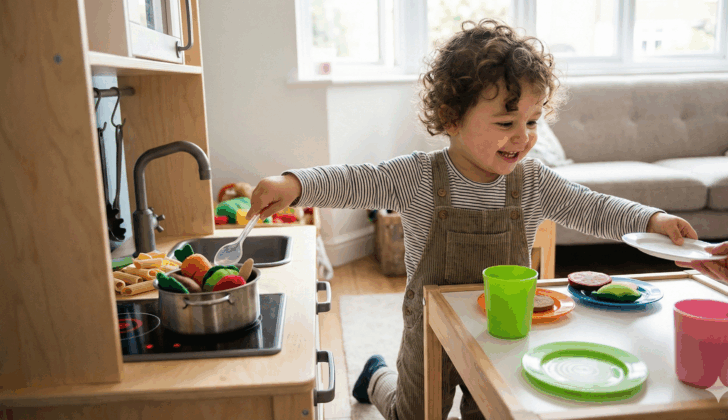
1. Play Kitchens and Food Sets
Why this toy helps:
Toddlers practice vocabulary, pretend play, and simple phrases.
How to Play
- Offer a choice: “Banana or cookie?”
- Pretend to wash, cut, stir, or eat.
- Let your toddler feed you or a toy.
Language to Model
- “Cut apple.”
- “Stir soup.”
- “Eat cookie.”
- “More please.”
- “All done.”
Mini Script
- Adult: “What do you want? Apple or cookie?”
- Toddler: “Cookie.”
- Adult: “Cookie. You want cookie. Here is cookie.”
2. Wooden Puzzles
Why this toy helps:
Puzzles build early problem solving, attention, and new words.
How to Play
- Hold up a piece and ask, “Where does this go?”
- Pause before helping.
- Celebrate every attempt.
Language to Model
- “In.”
- “Out.”
- “Find pig.”
- “Pig in.”
- “All done puzzle.”
3. Cars, Ramps, and Vehicle Sets
Why this toy helps:
Routines like “Ready, set, go” create predictable communication moments.
How to Play
- Place the car at the top of the ramp.
- Say, “Ready, set…” then pause.
- Let your toddler finish the phrase or gesture.
- Send the car down.
Language to Model
- “Go.”
- “Fast car.”
- “Slow car.”
- “Again.”
- “My turn, your turn.”
Mini Script
- Adult: “Ready, set…”
- Toddler: “Go!”
- Adult: “Go car. Fast car.”
4. Simple Musical Instruments
Why this toy helps:
Music encourages imitation, rhythm, shared joy, and early phrase building.
How to Play
- Tap or shake a slow rhythm.
- Tap a fast rhythm.
- Let your toddler copy your pattern.
- Switch roles.
Language to Model
- “Tap, tap.”
- “Bang drum.”
- “Stop.”
- “Go.”
- “My turn.”
Sensory-Friendly Holiday Gifts for Toddlers
- Kinetic sand (supervised)
- Chunky crayons or paint sticks
- Water mats
- Play tunnels
- Soft weighted lap pads
How to Play
Narrate sensory experiences:
- “Squishy sand.”
- “Cold water.”
- “Bright color.”
Keep sessions short and calm.
Preschoolers (3–5 Years)
Preschoolers are ready for more complex play, richer storytelling, and early problem solving.
1. Pretend Play Sets (Doctor Kits, Dollhouses, Tool Sets)
Why this toy helps:
Pretend play strengthens vocabulary, social language, sequencing, and sentence building.
How to Play
- Choose roles together.
- Act out simple routines (doctor checkup, fixing something, feeding a doll).
- Add small problems for your child to solve.
Language to Model
- “I am the doctor.”
- “Your turn to fix it.”
- “The baby is hungry.”
- “What should we do now?”
- “Let us try again.”
Mini Script
- Adult: “The baby is crying. What should we do?”
- Child: “Feed baby.”
- Adult: “Yes. Feed the baby. The baby feels better.”
2. Building Sets (Duplo, Magnetic Tiles, Wooden Blocks)
Why this toy helps:
These toys build spatial vocabulary, sequencing, and early storytelling.
How to Play
- Start building something simple.
- Narrate your actions.
- Add challenges or choices.
Language to Model
- “Tall tower.”
- “Short tower.”
- “On top.”
- “Next to.”
- “Let us build a bridge.”
Mini Script
- Adult: “This tower is tall. What should we add next?”
- Child: “Block.”
- Adult: “Yes, one more block on top.”
3. Board Games for Preschoolers
Games such as Don’t Break the Ice, Zingo, Pop the Pig, and Honey Bee Tree support turn taking, vocabulary development, and meaningful language interactions during play.
How to Play
- Explain the rules slowly.
- Take turns and narrate your moves.
- Encourage your child to talk about choices.
Language to Model
- “My turn.”
- “Your turn.”
- “I have green.”
- “I need one more.”
- “You win.”
4. Arts and Crafts Kits
Crafts encourage creativity, describing words, sequencing, and expressive language.
How to Play
- Set up materials in front of your child.
- Give simple directions: “Glue first, then stick.”
- Ask questions about choices.
Language to Model
- “Big piece.”
- “Little piece.”
- “Glue on.”
- “Stick here.”
- “Tell me about your picture.”
Sensory-Friendly Holiday Gifts for Preschoolers
- Kinetic sand or sensory bins
- Noise-reducing headphones
- Slow, calming light projectors
- Soft, squishy fidget toys
How to Play
Use calm, slow narration to support regulation:
- “Soft squeeze.”
- “Slow lights.”
- “The sand feels smooth.”
Final Thoughts
Holiday gifts do not need to be expensive or complicated to support language development. The most meaningful learning happens when adults join in play, repeat simple words, offer choices, and create warm moments of connection. With each of these gift ideas, your child receives not only a toy, but also high-quality experiences that build understanding, vocabulary, and early communication skills.
Follow First Words Bright Futures on Facebook and Instagram for:
-
Daily speech tips
-
Fun activity ideas
-
Q&A with a pediatric SLP
Want more SLP articles? Visit:
- MDS: Holiday Language Activities for Toddlers (Ages 1–3)
- MDS: Understanding School Speech Therapy Terms: A Parent’s Guide to IFSPs, IEPs, and More
Disclaimer: This article offers general educational information. It is not a substitute for professional evaluation or treatment. Please consult a licensed Speech-Language Pathologist for personalized concerns regarding your child’s speech development.