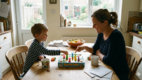
Introduction: From Nearby Observer to True Play Partner
Many loving adults sit close by while children play. You make sure the pieces are safe, you cheer on the tower, you hand over the missing block. That support matters. However, children gain even more when the adult becomes a responsive play partner. Being a play partner does not mean taking over. It means getting on your child’s level, noticing what is meaningful to them, and adding small language and play ideas that grow skills while keeping joy at the center.
This article will show you exactly how to do that, what to watch for, how to join in, and what to say. You will also learn why these strategies work for attention, communication, and connection.
Why Joining Children in Play Grows Language
- Shared attention builds understanding. When you are focused on the same thing, your child links words to actions and objects more accurately.
- Back-and-forth moments create conversation. Play is a natural place to practice turns, eye gaze, gestures, sounds, and then words.
- Emotion powers memory. Feeling seen and successful helps the brain store new vocabulary and ideas.
- Repetition with variety strengthens learning. Children hear the same words used in slightly different ways as you build on their play.
- Safety to try. When adults follow instead of direct, children are more likely to take language risks and try new skills.
The Play Partner Posture: What to do before you say anything
Think “PACE.”
- P—Position yourself. Sit on the floor at your child’s eye level. Place your face where they can see it easily.
- A—Attune. Pause for 10–20 seconds to simply watch. Notice hands, eyes, sounds, and micro-interests (for example, lining up cars, opening and closing doors).
- C—Copy. Do one thing the way your child is doing it. Copying says, “I see you. Your idea matters.”
- E—Expand. Add one small new action or one small new word or phrase. Keep it brief and connected to what your child is already doing.
What to watch for
- Focus of attention. What object or action is getting the most time?
- Communication signals. Looks, gestures, sounds, short words, scripts from shows, or silence.
- Play stage. Exploring, functional play (using items as intended), relational play (putting pieces together), early pretend, or small “rituals” like lining up.
- Energy level. Calm, fast, or big-movement needs.
- Comfort signs. Smiles, soft shoulders, steady breathing show readiness to connect.
How to join without taking over
Use the “1-1-1 rule”: one comment, one action, then one wait.
- Comment: Describe what your child is doing (“Car goes up”).
- Action: Add a tiny related move (push your car behind theirs).
- Wait: Count to five in your head. Let your child respond with a look, a sound, a move, or a word.
If your child shifts activities, shift with them. Keep language simple, slow, and firmly tied to the current action.
Language You Can Use Right Away
These scripts are models. Adjust to sound like you.
Self-Talk and Parallel Talk
- Self-Talk (you talk about your actions):
“I stack block. Up. Up. Oops, it falls.” - Parallel Talk (you narrate your child’s actions):
“You roll car. Fast. It bumps the wall.”
Copy-Then-Add
- Copy what your child does.
- Add one small idea.
Example: Your child lines up animals.
- You: (line up one more) “Cow in line.”
- Add: (whisper) “Cow waits. Moo.”
Choice-Giving
Offer real choices with words and visuals.
- “Car or bus?” (hold both up)
- “More push or all done?” (gesture stop for all done)
Expansions and Recasts
- Expansion: Child says “dog.” You say, “Big dog.”
- Recast: Child says “dog run.” You say, “The dog is running.”
Step-by-step play scenes with scripts
1) Cars and trucks
Goal: Grow verbs, early phrases, and turn taking.
- Position at the ramp beside your child.
- Watch one round.
- Copy with your own car.
- Expand with one verb.
Script:
Adult: “Ready… set… go.” (rolls car)
Wait.
Adult: “My car goes up. Your turn.”
Wait.
Adult: “Crash. Big crash.”
If the child vocalizes, you expand: “Yes, fast car.”
Add-ons:
- Use location words: “up, down, over, under, in.”
- Make a mini-story: “Red car is tired. It parks. Shh, sleep.”
2) Farm or animal set
Goal: Vocabulary, pretend play, and simple problem solving.
- Put a few animals in view, others hidden.
- Follow your child’s lead with one animal.
- Offer a gentle problem.
Script:
Adult: “Pig walks. Squish, squish.”
Child: moves cow
Adult: “Cow says ‘moo.’ Cow is hungry.” (pause)
Child: looks at barn
Adult: “Food in barn?” (shrugs, opens door) “Oh! Corn. Pig eats. Munch, munch.”
Add-ons:
- Two-word models: “Cow drinks,” “Pig sleeps.”
- Emotions: “Pig is sad. No food. Help pig?”
3) Trains
Goal: Repetitive language with predictable turns.
- Copy the loop your child makes.
- Add a small job for each car.
Script:
Adult: “Train goes round.”
Wait.
Adult: “Bridge coming. Low.” (duck head)
Adult: “Cargo car stops. Load up.” (puts block in)
Adult: “All aboard.” (hand to ear to listen)
Add-ons:
- Sequence words: “First load, then go.”
- Social practice: “My turn push. Your turn push.”
4) Play-Doh or clay
Goal: Action words, requesting, and body part vocabulary.
- Mirror what your child is making.
- Offer choices for tools.
Script:
Adult: “I roll. Roll, roll.”
Child: pats dough
Adult: “You pat. I cut?” (shows cutter)
Child: reaches
Adult: “Cut please.” (waits) “Cut… please.” (if child attempts any sound, hand tool)
Adult: “Nice ask. Cut the snake. Chop, chop.”
Add-ons:
- Describing words: “Long snake, tiny eyes.”
- Pretend snack: “Hot pancake. Blow. Safe now.”
5) Stuffed animals or dolls
Goal: Early pretend and short sentences.
- Choose the toy your child touches first.
- Use caring routines.
Script:
Adult: “Bear is sleepy.” (yawns) “Night-night, bear.”
Wait.
Adult: “Bear up. Hungry now.”
Child: offers cup
Adult: “Thank you. Bear drinks. Gulp, gulp. All done.”
Add-ons:
- Feelings: “Bear is mad. No cookie.”
- Solutions: “Hug bear. Better.”
When Your Child Uses Scripted or Repetitive Language
Scripts from shows or repeated lines can be a bridge to flexible language. Try:
- Join the rhythm, then shape it.
Child: “To the rescue!”
Adult: “To the rescue… car to the rescue,” while moving the car. - Map script to the moment.
“To the rescue” becomes “Daddy to the rescue” when someone helps pick up blocks. - Offer a short fill-in.
Adult: “To the…” (pause) Child: “rescue!”
Adult: “Yes, rescue. Rescue the cow.”
Gentle Prompts That Keep the Lead with Your Child
- “Show me.”
- “Your turn.”
- “Help me do it like you.”
- “Hmm… what next?”
- Point, look, and wait instead of directing with many words.
Troubleshooting Common Bumps
- Child ignores you: Lower your voice, move closer, mirror their action, and try one-word narration.
- Child grabs or says “no”: Validate and offer a parallel action. “You want it. I will use the blue one. You have red.”
- Child lines up toys only: Respect the pattern. Join the line with one new prop. “Ambulance in line. Wee-oo.”
- Child leaves often: Shorten the scene. Aim for 60–90 seconds of connected play, then reset and try again later.
- You feel silly: Start with quiet parallel talk. Smile. Small is enough.
A five-minute daily routine to build the habit
- Two minutes: Watch and copy. No instructions, just join.
- One minute: Add language. Two or three short phrases tied to actions.
- One minute: Small pretend twist. A problem to solve or a feeling to name.
- One minute: Clean-up talk. “Blocks in. All done blocks. Time for snack.”
Quick reference phrases
- “You push car. Fast.”
- “My turn. Your turn.”
- “Up… down.”
- “In… out.”
- “Open. Close.”
- “More please.”
- “All done.”
- “Help me.”
- “First __, then __.”
How this looks over a week
- Day 1: Copy and comment only.
- Day 2: Copy, comment, and add one new verb.
- Day 3: Keep verbs and add a location word.
- Day 4: Add turn-taking language.
- Day 5: Add a tiny pretend moment with a feeling word.
- Weekend: Repeat the favorite moments. Take a short video for yourself to notice progress.
Encouraging signs to celebrate
- Longer looks or more shared smiles
- New or clearer sounds and words
- More turns before moving on
- Spontaneous copying of your simple phrases
- Bringing a toy to you to start play
Progress may be quiet at first. Small connections compound into strong communication over time.
Final Encouragement
You do not need special toys, long scripts, or extra time. You only need your child, a few minutes at eye level, and a willingness to follow their lead. When you become a play partner watching first, copying second, and expanding last, you build language, confidence, and relationship in the moments you already share.
Keep Learning & Stay Connected
Follow First Words Bright Futures on Facebook and Instagram for:
-
Daily speech tips
-
Fun activity ideas
-
Q&A with a pediatric SLP
Explore More:
- MDS: How to Use Narration to Boost Your Child’s Language
- MDS: Why Modeling Language Works Better Than Correcting Your Child’s Speech
Disclaimer: This article offers general educational information. It is not a substitute for professional evaluation or treatment. Please consult a licensed Speech-Language Pathologist for personalized concerns regarding your child’s speech development.