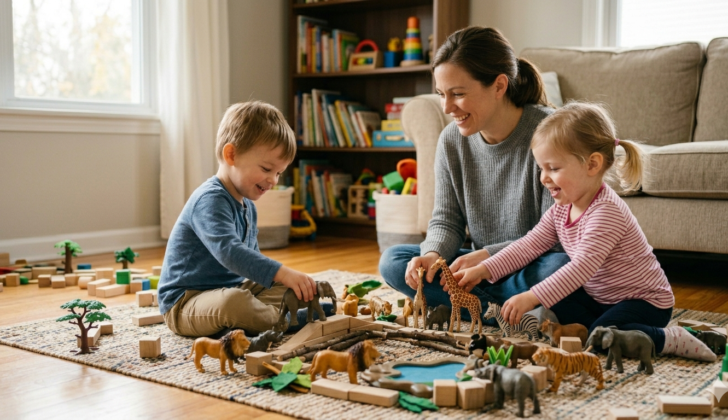
Narrating your child’s play is one of the most effective strategies for building communication skills at home. When adults describe what a child is doing, seeing, and experiencing during play, children hear rich language connected to meaningful actions. This helps them understand new vocabulary, learn how sentences are formed, and begin using language more independently.
Many parents and caregivers naturally talk with their children, but narrating play is a specific strategy that can be used intentionally to boost speech and language development. This article will guide you step by step through what narration is, what to say, what to avoid, and exactly how to do it. No prior knowledge is assumed.
You will find clear examples, scripts, and detailed directions that you can begin using immediately during everyday play.
What Does “Narrating Play” Mean?
Narrating play means describing what your child is doing, seeing, thinking, and feeling during play in simple, clear language.
You are gently putting your child’s actions into words as they play.
For example, instead of sitting silently while your child builds with blocks, you might say:
“You are stacking the blocks.”
“That tower is getting very tall.”
“You put the blue block on top.”
Narration gives children a steady stream of language connected directly to their actions. This helps them learn new words and understand how language works.
Why Narrating Play Supports Speech and Language Development
Narrating play helps children develop:
- Vocabulary
- Sentence structure
- Listening skills
- Attention
- Social communication
- Understanding of actions and emotions
- Confidence using language
When children hear language connected to what they are doing, their brains make strong connections between words and meaning. This is much more effective than teaching words in isolation.
Narration also reduces pressure. Children are not being quizzed or corrected. They are simply hearing language modeled in a supportive way.
When to Narrate Your Child’s Play
You can narrate during almost any activity:
- Playing with toys
- Drawing or coloring
- Outdoor play
- Bath time
- Pretend play
- Building or puzzles
- Sensory play
- Playing with siblings
You do not need extra time in your day. Narration fits into what you are already doing.
Start with 5–10 minutes per day of intentional narration and build from there.
Step 1: Get at Your Child’s Level
Before you begin narrating, position yourself so your child can easily hear and see you.
Step-by-Step Directions
- Sit or kneel near your child.
- Face the same direction as your child when possible.
- Observe quietly for a moment.
- Notice what your child is doing or looking at.
- Begin narrating based on their focus, not yours.
Following your child’s lead is essential. Narrate what they are interested in, not what you think they should be doing.
Step 2: Start With Simple Descriptions
Begin by describing exactly what your child is doing. Keep your language simple and clear.
Examples of Simple Narration
“You are driving the car.”
“The car is going fast.”
“You are building a tall tower.”
“You are stirring the pretend soup.”
“You are feeding the baby doll.”
These simple statements help children connect actions with words.
Important Tip
Do not expect your child to repeat you. Narration is about modeling language, not testing.
Step 3: Expand on What Your Child Is Doing
Once you begin simple narration, you can expand by adding more details.
Add Descriptive Words
Add colors, sizes, and actions.
“You are driving the red car.”
“That is a big truck.”
“You are pouring the juice.”
“The baby is sleeping in the bed.”
Add Feelings and Thoughts
This builds emotional vocabulary and social understanding.
“The baby looks tired.”
“You are excited about your tower.”
“That crash surprised you.”
“You are proud of your picture.”
Step 4: Use the “Say Less, Stress Less” Rule
Many adults accidentally talk too much during play. Too many words can overwhelm children.
Use short, clear sentences. Pause often to let your child process.
Good Example
“You are building.”
“Block on top.”
“Tall tower.”
Overwhelming Example
“You are building such an amazing tower and you are using so many different colors and I wonder how tall you are going to make it because that looks really big.”
Keep narration calm and simple.
Step 5: What to Say During Play (With Scripts)
Below are helpful scripts you can use during different types of play.
During Block Play
“You are stacking blocks.”
“That one goes on top.”
“Your tower is tall.”
“Oh no, it fell down.”
“You are building it again.”
Encourage language gently:
“Tell me about your tower.”
“What should we add next?”
During Pretend Play
“You are feeding the baby.”
“The baby is hungry.”
“You are cooking dinner.”
“Stir, stir, stir.”
“The food is hot.”
Model dialogue:
“Baby says, ‘More please.’”
“You say, ‘Here you go.’”
During Car or Train Play
“The train is moving.”
“Choo choo.”
“It is going fast.”
“The train stopped.”
“Now it is backing up.”
Add direction words:
“It is going up.”
“It is going down.”
“It is going around.”
During Art or Coloring
“You are drawing a circle.”
“That is a blue line.”
“You are coloring carefully.”
“I see a happy face.”
Encourage expression:
“Tell me about your picture.”
“What should we draw next?”
Step 6: What to Avoid When Narrating Play
Knowing what not to say is just as important as knowing what to say.
Avoid Too Many Questions
Constant questions can feel like a test.
Avoid:
“What color is that?”
“What is that called?”
“How many blocks?”
“What sound does that make?”
Instead Say:
“You chose a blue crayon.”
“That is a big truck.”
“You have three blocks.”
“The cow says moo.”
Children learn more from hearing language than from being quizzed.
Avoid Correcting Too Quickly
If your child says something incorrectly, avoid immediate correction.
Instead of:
“No, say it like this.”
Try:
“Yes, that is a dog. The dog is running.”
You are modeling the correct language without creating pressure.
Avoid Taking Over the Play
Let your child lead. Narration should follow their interests.
Avoid:
“No, build it this way.”
“Do not do that.”
“Here, let me show you.”
Instead:
“You are building it your way.”
“That is a creative idea.”
“You are trying something new.”
Step 7: Use the “3 to 1” Rule
Aim for three comments for every one question.
Comments build language. Too many questions can slow communication.
Example:
Comment: “You are building a tower.”
Comment: “It is very tall.”
Comment: “You added a blue block.”
Question: “What should we add next?”
This keeps communication balanced and supportive.
Step 8: Encourage Interaction Without Pressure
After narrating for a while, pause and give your child a chance to respond.
Wait quietly for 5–10 seconds. Many children need extra time to process and respond.
If your child responds:
Expand on what they say.
Child: “Car.”
Adult: “Yes, a fast car is driving.”
If your child does not respond:
Continue narrating without pressure.
Step 9: Narrating Play Between Siblings
If siblings are playing together, narration can support communication between them.
Example Scripts
“You are building together.”
“Your brother gave you a block.”
“You are taking turns.”
“You both have great ideas.”
“You solved the problem.”
Encourage communication:
“Tell your sister what you need.”
“Ask your brother for help.”
“Say, ‘My turn please.’”
Common Mistakes and How to Fix Them
Talking Too Much
Fix: Use short sentences and pauses.
Asking Too Many Questions
Fix: Turn questions into comments.
Leading the Play
Fix: Follow your child’s interests.
Expecting Immediate Talking
Fix: Model language without pressure.
A Simple Daily Plan for Parents
If you are unsure where to start, follow this easy routine.
Step 1: Choose one play time each day (10 minutes).
Step 2: Sit near your child.
Step 3: Observe quietly for one minute.
Step 4: Begin simple narration.
Step 5: Add descriptive words.
Step 6: Pause and allow response time.
Step 7: End with praise and connection.
Example closing:
“I loved playing with you.”
“You had great ideas today.”
“We will play again later.”
Final Thoughts
Narrating your child’s play is one of the most natural and powerful ways to support speech and language development. It does not require special training or materials. It only requires your presence, attention, and intentional language.
When you describe what your child is doing, thinking, and feeling during play, you are building their vocabulary, strengthening their understanding of language, and helping them feel seen and supported.
Progress may take time. Some children will begin using more words quickly. Others will take longer. What matters most is consistency and a calm, supportive approach.
Every time you sit beside your child and gently narrate their play, you are helping build the foundation for communication, connection, and confidence that will support them for years to come.
Keep Learning & Stay Connected
Follow First Words Bright Futures on Facebook and Instagram for:
-
Daily speech tips
-
Fun activity ideas
-
Q&A with a pediatric SLP
Explore More:
- MDS: How Speech Delays Affect Social Skills and Friendships
- MDS: How to Use Narration to Boost Your Child’s Language
Disclaimer: This article offers general educational information. It is not a substitute for professional evaluation or treatment. Please consult a licensed Speech-Language Pathologist for personalized concerns regarding your child’s speech development.