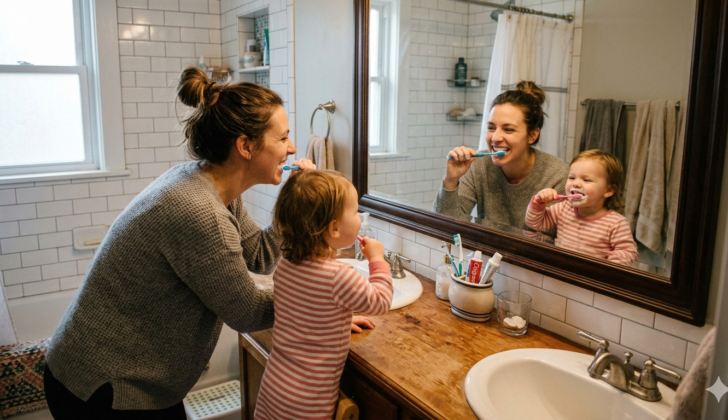
Mirrors are one of the most powerful tools for supporting speech and language development in young children. A mirror is something you already have in your home.It can help your child learn how sounds are made, improve awareness of their mouth movements, and build confidence communicating.
As a speech-language pathologist, I often use mirrors in therapy sessions because they naturally support learning through visual feedback, imitation, and connection. When used intentionally, mirrors help children understand what their mouth is doing when they talk.
This article will explain:
- Why mirrors are so helpful for speech and language development
- When mirror work is most beneficial
- How to use mirrors at home in simple, natural ways
- Step-by-step activities with real-life scripts
- What to watch for if your child continues to struggle
Why Mirrors Help Children Learn to Talk
When adults speak, we rarely think about how our lips, tongue, and jaw move. For children, those movements are brand new.
A mirror helps children:
- See how sounds are made
- Connect what they feel in their mouth with what they see
- Notice differences between sounds (for example, /p/ vs /m/)
- Imitate movements more accurately
- Build awareness of facial expressions and mouth shapes
Many children learn best when they can see + hear + feel what is happening at the same time.
When Mirror Work Is Most Helpful
Using a mirror can be especially beneficial if your child:
- Has unclear speech or sound errors
- Struggles to imitate sounds or words
- Watches your mouth closely when you talk
- Gets frustrated when trying to say words
- Is learning early sounds like /p, b, m, t, d/
- Is working on blending sounds together
- Is learning to use pronouns or short phrases
Mirror work is also very helpful for children who are:
- Visual learners
- Gestalt language processors
- Late talkers
- Working on articulation or speech clarity
Important Mindset: This Is Not a “Drill”
Mirror activities should feel:
- Playful
- Curious
- Short (1–3 minutes at a time)
- Pressure-free
You do not need to sit your child down and “practice.” The best learning happens when mirrors are part of normal routines.
Simple, Everyday Mirror Activities
Below are easy ways to use a mirror naturally throughout the day. Each includes step-by-step guidance and example language.
Activity 1: “Look at My Mouth” Sound Play
Best for: early sound development, imitation, articulation
When: brushing teeth, getting dressed, before bed
How to Do It:
- Stand next to your child in front of a mirror.
- Point to your mouth as you say a sound.
- Pause and let your child watch.
- Invite them to try — without pressure.
Example Scripts:
- “Look at my mouth. P goes like this—puh, puh, puh.”
- “My lips are popping! Can you try?”
- “Let’s make the m sound. Mmm… like yummy!”
If your child does not copy you, that is okay. Watching is still learning.
Activity 2: Mirror Copycat Game
Best for: imitation, attention, and confidence
When: during play or transitions
How to Play:
- Stand or sit together in front of a mirror.
- Say, “Let’s be copycats!”
- Make a simple mouth movement or sound.
- Let your child copy — or just watch.
Try These:
- Smiling big
- Opening and closing your mouth
- Sticking out your tongue
- Saying “ahhh,” “ooo,” or “mmm”
Helpful Script:
- “You’re watching my mouth.”
- “Now I’ll watch yours!”
- “We’re making the same sound!”
This builds awareness without pressure to speak perfectly.
Activity 3: Mirror Talk During Daily Routines
Best for: consistency without adding extra tasks
When: brushing teeth, washing hands, getting dressed
Example: Toothbrushing
- “I’m brushing my teeth.”
- “Look, my mouth is open.”
- “I say ‘ahhh.’”
- “Now you say ‘ahhh’!”
Example: Getting Dressed
- “My mouth is saying ‘shirt.’”
- “Your turn. Shirt.”
- “I see your mouth moving!”
You are modeling clear speech while making your child aware of how sounds look and feel.
Activity 4: Emotions and Expressions in the Mirror
Best for: expressive language and social communication
How to Do It:
Stand together and make different facial expressions.
- Happy face
- Sad face
- Silly face
- Surprised face
Then label them:
- “I look happy!”
- “You look surprised!”
- “My mouth is smiling.”
This builds emotional vocabulary while strengthening facial awareness.
Activity 5: Mirror + Sound Blending
Best for: children learning to combine sounds
How to Do It:
- Choose a simple word (e.g., “me,” “bee,” “ball”).
- Say each sound slowly while looking in the mirror.
- Blend the sounds together.
Example:
- “B…ee… bee!”
- “M…e… me!”
- “B…a…t… bat!”
Seeing how the mouth moves during blending can make a big difference for some children.
What If My Child Refuses to Look in the Mirror?
That is okay.
Some children need time to feel comfortable. Try:
- Standing side-by-side instead of face-to-face
- Using a small handheld mirror instead of a big one
- Letting them watch you first
- Keeping sessions very short (10–30 seconds)
You can also narrate without requiring participation:
- “I see my mouth moving.”
- “I see my lips touching.”
Learning still happens through observation.
How Often Should We Do Mirror Work?
Short and consistent is best:
- 1–3 minutes at a time
- 1–2 times per day
- Built into routines you already do
You do not need long sessions for progress to happen.
When to Seek Extra Support
Consider reaching out to a speech-language pathologist if:
- Your child avoids vocalizing or imitating sounds
- Speech is difficult to understand for unfamiliar listeners
- Your child seems frustrated trying to communicate
- Progress feels very slow despite consistent modeling
Early support can make a big difference and often feels like play rather than therapy.
Final Thoughts
Mirrors give children something powerful: visual feedback.
They help children connect how speech feels, sounds, and looks—all at the same time.
You do not need special tools, long lessons, or perfect practice.
You simply need a mirror, a moment, and a little bit of play.
Keep Learning & Stay Connected
Follow First Words Bright Futures on Facebook and Instagram for:
-
Daily speech tips
-
Fun activity ideas
-
Q&A with a pediatric SLP
Explore More:
- MDS: How to Teach “I” vs “Me” to Young Children
- MDS: Oral Motor Skills and Speech: What Parents Need to Know
Disclaimer: This article offers general educational information. It is not a substitute for professional evaluation or treatment. Please consult a licensed Speech-Language Pathologist for personalized concerns regarding your child’s speech development.