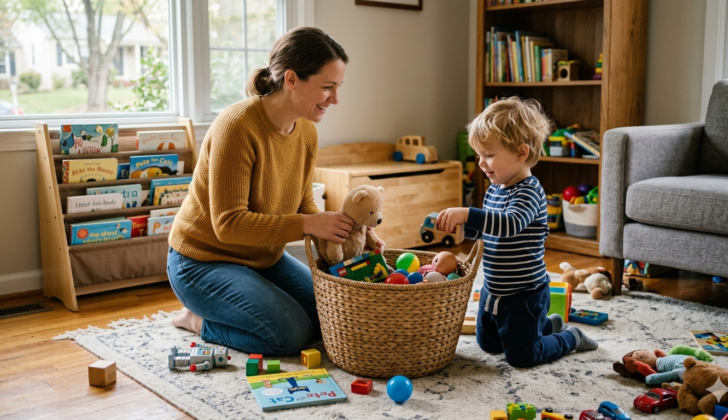
For many families, cleaning up toys can feel like one of the most challenging parts of the day. Toys are everywhere, children are tired, and cooperation may be low. However, what if clean-up time could become one of the most valuable opportunities for building your child’s speech and language skills?
Routines offer powerful learning moments because they are predictable and meaningful. Cleaning up toys happens regularly, involves real objects, and provides natural opportunities for conversation, listening, and following directions. When adults use intentional language during clean-up time, children learn vocabulary, sentence structure, and communication skills in a natural and supportive way.
This article will guide you step by step through how to encourage language while cleaning up toys. It is written for parents and caregivers who may have no prior knowledge of speech and language strategies. You will find clear explanations, easy-to-follow steps, scripts you can use immediately, and simple adjustments that can make a big difference in your child’s communication development.
Why Clean-Up Time Supports Language Development
Children learn language best when it is connected to real experiences. Cleaning up toys involves sorting, organizing, labeling, and following directions. These actions naturally support communication development.
During clean-up routines, children practice:
- Listening and understanding directions
- Learning new vocabulary
- Using descriptive words
- Answering simple questions
- Problem solving
- Categorizing and sorting
- Taking turns and cooperating
- Expressing needs and ideas
Since clean-up happens regularly, children hear the same helpful words and phrases repeatedly. Repetition strengthens understanding and use of language.
Step 1: Set the Tone Before Clean-Up Begins
Children are more likely to communicate and cooperate when clean-up time feels calm and predictable.
Step-by-Step Directions
- Give a gentle warning before clean-up begins.
- Use a calm and positive tone.
- Invite your child to help rather than giving a sudden command.
- Join your child during the clean-up process.
Script for Parents
“In five minutes, it will be time to clean up.”
“It is almost clean-up time.”
“We will clean up together.”
“Let us get ready to put the toys away.”
Preparing your child helps them transition more smoothly and remain engaged.
Step 2: Use Simple and Clear Language
During clean-up, use short and clear sentences to describe actions.
Examples
“Pick up the blocks.”
“Put the cars in the bin.”
“The dolls go here.”
“You are cleaning up.”
“We are working together.”
Simple language is easier for children to understand and imitate.
Avoid long explanations. Focus on clear, direct phrases connected to actions.
Step 3: Build Vocabulary Naturally
Cleaning up toys provides excellent opportunities to build vocabulary.
Words to Model
- Clean
- Messy
- Put away
- In
- Out
- Under
- On top
- Big
- Small
- Broken
- Full
- Empty
Step-by-Step Directions
- Hold or point to a toy.
- Label it clearly.
- Add a simple description.
- Repeat throughout clean-up.
Script Example
“This is a car.”
“A red car.”
“The car goes in the bin.”
“The bin is full.”
“We need another basket.”
Repeated exposure helps children learn and use new words.
Step 4: Encourage Sorting and Categorizing
Sorting toys into groups supports vocabulary, thinking, and organization skills.
You can sort by:
- Type of toy
- Color
- Size
- Owner
- Location
Step-by-Step Directions
- Choose one sorting rule.
- Explain it simply.
- Model first.
- Invite your child to try.
Script for Parents
“Blocks go in this basket.”
“Cars go in this box.”
“Stuffed animals go on the bed.”
“Let us find all the blue toys.”
Encourage participation:
“Can you find more cars?”
“Put the animals here.”
Step 5: Practice Following Directions
Clean-up time is ideal for building listening and direction-following skills.
Start simple and gradually increase complexity.
One-Step Directions
“Pick up the doll.”
“Put it in the basket.”
“Close the lid.”
Two-Step Directions
“Pick up the blocks and put them in the box.”
“Find the truck and give it to me.”
Step-by-Step Directions for Parents
- Give a direction clearly.
- Pause and wait.
- Offer help if needed.
- Praise effort.
Script
“Put the car in the bin.”
“Nice listening.”
“You did it.”
Step 6: Expand What Your Child Says
When your child speaks, expand their words into longer phrases.
Child: “Car.”
Adult: “Yes, a blue car.”
Child: “All done.”
Adult: “You are all done cleaning.”
Child: “Mine.”
Adult: “That is your toy.”
Expansion helps children hear more complex language without feeling corrected.
Step 7: Use Repetition and Predictable Phrases
Consistent language helps children learn faster. Use the same helpful phrases each day.
Examples:
“Clean up time.”
“Put it away.”
“Toys go in.”
“All done.”
“Great helping.”
Predictable language encourages participation and understanding.
Step 8: Encourage Problem Solving
Clean-up naturally creates opportunities for problem solving.
Example Situations
- A toy does not fit in the bin
- A piece is missing
- The basket is full
- Something is broken
Step-by-Step Directions
- Point out the problem calmly.
- Encourage your child to think of a solution.
- Model language if needed.
Script for Parents
“This bin is full.”
“What should we do?”
“We need another basket.”
“Let us move these toys.”
Problem solving builds critical thinking and expressive language.
Step 9: What to Avoid During Clean-Up
Avoid Too Many Questions
Too many questions can feel overwhelming.
Instead of:
“Where does this go?”
“What color is that?”
Try:
“The puzzle goes on the shelf.”
“That is a yellow block.”
Avoid Negative Language
Replace criticism with guidance.
Instead of:
“You are making a mess.”
Try:
“Let us work together.”
“We are cleaning up.”
Avoid Doing Everything Yourself
Allow your child to participate, even if it takes longer.
Participation builds language and confidence.
Step 10: Encourage Communication Between Siblings
If siblings are present, clean-up time can support cooperative communication.
Step-by-Step Directions
- Give each child a role.
- Encourage them to talk to each other.
- Model helpful phrases.
Script for Parents
“You pick up the blocks.”
“Your sister will pick up the dolls.”
“Ask your brother for help.”
“Say, ‘Can you give me that?’”
“Say, ‘Here you go.’”
Praise teamwork:
“You worked together.”
“You helped each other.”
“That was great cleaning.”
Step 11: Make Clean-Up Playful
A playful approach increases engagement and communication.
Ideas
- Sing a clean-up song
- Set a gentle timer
- Pretend toys are going to sleep
- Toss soft toys into baskets
- Race gently against the clock
Script Example
“The toys are tired.”
“They are going to sleep.”
“Put them in their bed.”
“Goodnight toys.”
Playfulness keeps the mood positive and encourages participation.
Step 12: End With Positive Connection
How clean-up ends matters. A positive ending encourages future cooperation and communication.
Closing Script
“You were a great helper.”
“We cleaned up together.”
“Thank you for helping.”
“I loved working with you.”
Positive reinforcement builds confidence and willingness to communicate.
A Simple Daily Plan for Parents
If you are unsure where to begin, follow this routine.
Step 1: Give a warning before clean-up begins.
Step 2: Join your child during clean-up.
Step 3: Use simple language to describe actions.
Step 4: Encourage sorting and following directions.
Step 5: Expand your child’s words.
Step 6: Keep the tone calm and positive.
Step 7: End with praise and connection.
Consistency is more important than perfection.
Final Thoughts
Communication skills are built in everyday moments, often when families least expect it. Cleaning up toys may feel like a routine task, but it is filled with opportunities for connection, learning, and growth. When adults slow down and use intentional language during these small moments, children begin to understand more, say more, and participate more confidently.
You do not need a complicated plan or special materials to support your child’s speech and language development. You only need to turn ordinary routines into shared experiences filled with simple, supportive language. Over time, these brief daily interactions strengthen vocabulary, listening skills, and confidence in communication.
Each time you clean up together, you are not only organizing toys. You are building stronger communication skills, deeper connection, and a foundation for lifelong learning through the power of everyday conversation.
Keep Learning & Stay Connected
Follow First Words Bright Futures on Facebook and Instagram for:
-
Daily speech tips
-
Fun activity ideas
-
Q&A with a pediatric SLP
Explore More:
- MDS: Open-Ended Toys: The Secret to Boosting Your Child’s Language Skills
- MDS: Toy Rotation: The Simple Trick to Boost Your Child’s Language Skills
Disclaimer: This article offers general educational information. It is not a substitute for professional evaluation or treatment. Please consult a licensed Speech-Language Pathologist for personalized concerns regarding your child’s speech development.