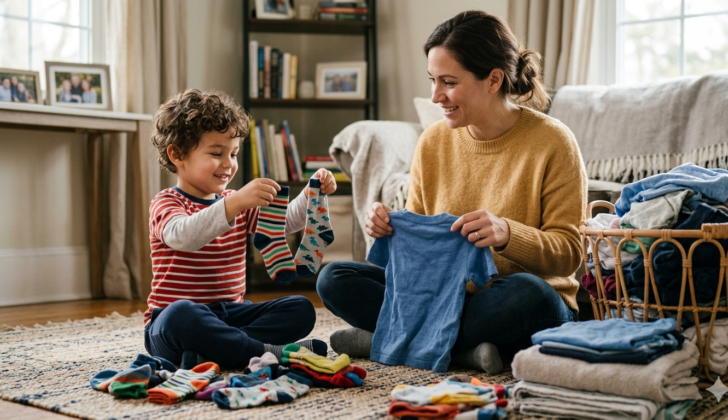
Speech and language development does not only happen during structured learning time. It happens all day long during everyday routines. One of the most overlooked opportunities for building strong communication skills is something many families already do regularly: folding laundry.
Laundry routines are predictable, repetitive, and filled with opportunities for meaningful conversation. Children can see, touch, sort, match, and help. This creates the perfect environment for language learning. You do not need special materials, flashcards, or extra time. You only need intentional language and simple strategies.
This article will guide you step by step through how to encourage speech and language development while folding laundry. It is written for parents and caregivers who may have no prior knowledge of speech and language strategies. You will find clear explanations, scripts, and detailed directions that you can begin using right away.
Why Laundry Is a Perfect Language-Building Routine
Children learn language best when it is connected to real-life experiences. Laundry provides:
- Repetition
- Predictable steps
- Hands-on involvement
- Opportunities for labeling and describing
- Turn taking
- Following directions
- Problem solving
- Conversation
Since laundry happens regularly, children get repeated exposure to the same vocabulary and sentence structures. Repetition helps language stick.
Laundry routines also reduce pressure. Children are engaged in a shared activity rather than being asked to sit and perform. This creates a natural and relaxed learning environment.
Step 1: Invite Your Child to Participate
Language develops best when children are actively involved. Even young toddlers can help with laundry.
Step-by-Step Directions
- Bring the laundry basket to a comfortable space.
- Invite your child to sit near you.
- Give them one simple job.
- Begin talking about what you are doing.
Script for Parents
“I am going to fold laundry.”
“Come help me.”
“You can help with socks.”
“We are working together.”
Keep the tone warm and encouraging. The goal is connection and participation, not perfection.
Step 2: Start With Simple Language
Begin by describing what you and your child are doing. Use short, clear sentences.
Examples
“I see a shirt.”
“This is a big towel.”
“You found socks.”
“We are folding clothes.”
“The shirt is soft.”
“The towel is blue.”
You are modeling vocabulary and sentence structure without pressure.
Do not expect your child to repeat you. Simply hearing language is powerful.
Step 3: Build Vocabulary Naturally
Laundry provides opportunities to introduce many useful words.
Clothing Vocabulary
- Shirt
- Pants
- Socks
- Pajamas
- Dress
- Jacket
- Towel
Descriptive Words
- Big
- Small
- Soft
- Warm
- Clean
- Wet
- Dry
- Long
- Short
Step-by-Step Directions
- Hold up an item.
- Label it clearly.
- Add one descriptive word.
- Repeat naturally throughout the routine.
Script Example
“This is a shirt.”
“A blue shirt.”
“The shirt is clean.”
“We fold the shirt.”
Repetition helps children learn new words.
Step 4: Encourage Sorting and Categorizing
Sorting builds vocabulary and thinking skills.
You can sort by:
- Color
- Size
- Person
- Type of clothing
Step-by-Step Directions
- Choose one sorting category.
- Explain it simply.
- Model first.
- Invite your child to try.
Script for Parents
“Let us find all the socks.”
“Socks go here.”
“Shirts go here.”
“This is Daddy’s shirt.”
“This is your shirt.”
Encourage your child to help.
“Can you find more socks?”
“Put the socks in this pile.”
Step 5: Use Simple Directions
Laundry is a perfect time to practice following directions.
Start with one-step directions and gradually increase.
One-Step Directions
“Give me the towel.”
“Find a sock.”
“Put this in the basket.”
Two-Step Directions
“Find the shirt and give it to me.”
“Pick up the socks and put them here.”
Step-by-Step Directions for Parents
- Give a simple direction.
- Pause and wait.
- Help if needed.
- Praise effort.
Script
“Put the towel in the basket.”
“Great listening.”
“You did it.”
Step 6: Expand What Your Child Says
If your child uses single words or short phrases, expand them into longer sentences.
Child: “Sock.”
Adult: “Yes, a blue sock.”
Child: “Mine.”
Adult: “That is your shirt.”
Child: “Wet.”
Adult: “The clothes were wet. Now they are dry.”
Expansion models longer sentences without correction.
Step 7: Use Repetition and Predictable Phrases
Children learn language through repetition. Use the same helpful phrases each time you do laundry.
Examples:
“We fold the clothes.”
“Fold, fold, fold.”
“Socks together.”
“Match the socks.”
“All done folding.”
Predictable language helps children anticipate and participate.
Step 8: Encourage Conversation Without Pressure
Pause occasionally and give your child a chance to talk.
Wait quietly for 5–10 seconds.
If your child speaks, respond and expand.
If your child does not speak, continue modeling without pressure.
Conversation Starters
“Whose shirt is this?”
“What should we fold next?”
“Where do the socks go?”
Keep questions simple and limited. Too many questions can feel overwhelming.
Step 9: What to Avoid
Avoid Too Many Questions
Constant questions can feel like a test.
Instead of:
“What color is this?”
Try:
“This is a red shirt.”
Avoid Correcting Harshly
If your child says something incorrectly, model instead of correcting.
Child: “Dat sock.”
Adult: “Yes, that is a sock.”
Avoid Taking Over
Allow your child to participate, even if it takes longer.
Participation builds confidence and language.
Step 10: Include Siblings When Possible
If siblings are present, laundry can become a shared language-building activity.
Step-by-Step Directions
- Give each child a role.
- Encourage communication.
- Model cooperative language.
Script for Parents
“You find the socks.”
“Your brother will fold towels.”
“Ask your sister for help.”
“Say, ‘Can I have that shirt?’”
“You are working together.”
Praise teamwork and communication.
Step 11: Add Playfulness to the Routine
Making laundry playful increases engagement and language use.
Ideas
- Toss socks into a basket
- Pretend clothes are characters
- Sing a folding song
- Play “find the match” with socks
Script Example
“The socks are friends.”
“They found each other.”
“Match the socks.”
“They are together again.”
Playfulness keeps children motivated to communicate.
Step 12: Keep It Short and Positive
You do not need to narrate the entire laundry process. Even 10 minutes of intentional language can make a difference.
End on a positive note.
Closing Script
“You were a great helper.”
“We folded the clothes together.”
“Thank you for helping me.”
“I love spending time with you.”
Positive experiences encourage future participation and communication.
A Simple Daily Plan for Parents
If you are unsure where to start, follow this easy routine.
Step 1: Invite your child to help with laundry.
Step 2: Sit together with the laundry basket.
Step 3: Use simple labels and descriptions.
Step 4: Encourage sorting or matching.
Step 5: Give simple directions.
Step 6: Expand your child’s words.
Step 7: End with praise and connection.
Consistency matters more than perfection.
Final Thoughts
Language development happens during everyday moments. Folding laundry may seem like a simple chore, but it is filled with opportunities for connection, communication, and learning.
When you intentionally talk, describe, and engage with your child during routines like laundry, you are building vocabulary, sentence structure, listening skills, and confidence. These small, consistent moments add up over time.
Keep Learning & Stay Connected
Follow First Words Bright Futures on Facebook and Instagram for:
-
Daily speech tips
-
Fun activity ideas
-
Q&A with a pediatric SLP
Explore More:
Disclaimer: This article offers general educational information. It is not a substitute for professional evaluation or treatment. Please consult a licensed Speech-Language Pathologist for personalized concerns regarding your child’s speech development.