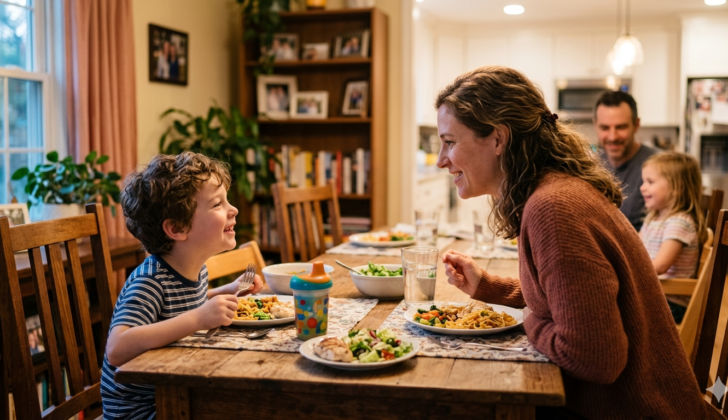
For many families, dinner time is one of the few moments in the day when everyone gathers in the same place. It is a natural pause in busy schedules and an opportunity to connect. While sharing a meal together is important for family bonding, it can also be one of the most powerful ways to support your child’s speech and language development.
Conversation skills are not something children simply develop on their own. They are learned through practice, modeling, and gentle support. The dinner table provides a consistent and meaningful setting where children can practice listening, speaking, asking questions, and sharing ideas.
This article will guide you step by step through how to encourage conversation at the dinner table in ways that feel natural and manageable. It is written for parents and caregivers who may have no prior knowledge of speech and language strategies. You will find clear explanations, simple scripts, and detailed directions that you can begin using right away.
Why Dinner Table Conversation Matters for Language Development
Conversation is one of the most complex communication skills children learn. It involves:
- Taking turns
- Listening to others
- Responding appropriately
- Using vocabulary
- Forming sentences
- Staying on topic
- Asking and answering questions
The dinner table offers a predictable, daily opportunity to practice all of these skills in a relaxed and familiar environment.
When adults model and support conversation during meals, children learn how conversations work. They learn that communication is about sharing experiences, listening to others, and connecting through language.
Step 1: Set the Stage for Conversation
Before encouraging conversation, create an environment that supports connection.
Step-by-Step Directions
- Turn off televisions and limit devices if possible.
- Sit together when you can.
- Keep the mood calm and welcoming.
- Avoid rushing through the meal.
Even a short shared meal can provide valuable conversation time when the environment is supportive.
Script for Parents
“I am happy we are eating together.”
“This is our time to talk.”
“I want to hear about your day.”
Setting this expectation helps children understand that conversation is part of mealtime.
Step 2: Start With Simple Comments
Many children need a model before they know how to participate in conversation.
Begin by making simple comments about the meal or the day.
Examples
“This pasta is warm.”
“I like the strawberries.”
“I had a busy day today.”
“I saw a big dog on my walk.”
Simple comments model how to share information. They show children what conversation sounds like.
Step 3: Use Easy Conversation Starters
Some children struggle to answer broad questions such as “How was your day?” Instead, use specific prompts.
Helpful Starters
“What made you smile today?”
“What was something fun you did?”
“Who did you play with?”
“What was your favorite part of today?”
“Did anything surprise you today?”
Ask one question at a time and give your child time to think.
Step 4: Model Turn Taking in Conversation
Conversation is like a game of catch. One person talks, then another responds.
Children need to see this modeled.
Step-by-Step Directions
- Ask a simple question.
- Listen to your child’s response.
- Respond with interest.
- Add a related comment.
- Invite another turn.
Script Example
Adult: “What did you play at recess?”
Child: “Soccer.”
Adult: “You played soccer. That sounds fun.”
Adult: “Who did you play with?”
This pattern teaches back-and-forth conversation.
Step 5: Expand What Your Child Says
If your child gives short answers, expand them into longer sentences.
Child: “Pizza.”
Adult: “You had pizza for lunch.”
Child: “Played outside.”
Adult: “You played outside with your friends.”
Expansion helps children hear how ideas can be expressed in longer sentences without feeling corrected.
Step 6: Encourage Everyone to Participate
Some children talk easily while others need more support. Invite each family member to share something.
Step-by-Step Directions
- Give each person a turn to talk.
- Keep sharing brief and positive.
- Offer support if needed.
- Praise participation.
Script for Parents
“It is your turn to share.”
“Tell us one thing about your day.”
“Thank you for sharing.”
“I like hearing your ideas.”
Participation builds confidence and communication skills.
Step 7: Teach Conversation Skills Directly
Some children benefit from explicit teaching about how conversation works.
Skills to Model
- Looking at the speaker
- Waiting for a turn
- Listening
- Responding
- Asking questions
Script for Parents
“Let us listen while your sister talks.”
“Now it is your turn.”
“You can ask a question.”
“Say, ‘What happened next?’”
Gentle coaching helps children learn expected behaviors.
Step 8: Use Descriptive and Feeling Words
Encourage your child to describe experiences and emotions.
Examples
“That sounds exciting.”
“Were you proud of that?”
“That must have been funny.”
“Did you feel happy or frustrated?”
This builds emotional vocabulary and deeper conversation.
Step 9: What to Avoid at the Dinner Table
Avoid Too Many Questions in a Row
Rapid questioning can feel overwhelming.
Instead of asking many questions, balance with comments.
Example:
“That sounds fun.”
“You were busy today.”
“You worked hard.”
Avoid Correcting Constantly
Focus on communication rather than perfection.
If your child makes a mistake, model the correct form gently.
Child: “I goed outside.”
Adult: “You went outside. That sounds fun.”
Avoid Turning Dinner Into a Test
Conversation should feel relaxed and enjoyable, not like a quiz.
Step 10: Support Conversation Between Siblings
Encourage siblings to talk to each other, not only to adults.
Step-by-Step Directions
- Prompt one child to ask another a question.
- Model appropriate responses.
- Praise respectful listening.
Script for Parents
“Ask your brother about his day.”
“Listen while she talks.”
“That was a kind question.”
“You answered clearly.”
Sibling conversation builds social communication skills.
Step 11: Use Predictable Dinner Table Routines
Predictable routines help children feel comfortable participating.
Ideas
- Share one good thing about the day
- Share something you learned
- Share something you are looking forward to
- Take turns choosing a question
Consistency builds confidence and expectation.
Step 12: Keep It Positive and Supportive
The goal is connection, not perfection. Even brief conversations make a difference.
Praise effort and participation.
Closing Script
“I loved talking with you.”
“Thank you for sharing.”
“I enjoy our family dinners.”
“I am glad we talked together.”
Positive endings encourage future conversation.
A Simple Plan for Parents
If you are unsure where to begin, follow this routine.
Step 1: Sit together and create a calm environment.
Step 2: Begin with simple comments about the day or meal.
Step 3: Ask one or two specific questions.
Step 4: Expand on your child’s responses.
Step 5: Encourage turn taking.
Step 6: Praise participation and listening.
Step 7: End with positive connection.
Small, consistent efforts lead to strong communication growth.
Final Thoughts
Conversation skills grow through shared experiences and meaningful interaction. The dinner table offers a natural opportunity for families to slow down, listen to one another, and practice communication in a supportive environment. These daily conversations help children learn how to express themselves, respond to others, and stay engaged in back-and-forth exchanges.
You do not need elaborate activities or long discussions to support language development. Short, positive interactions each day can have a lasting impact. When families create space for conversation and model interest in one another’s thoughts and experiences, children begin to see communication as enjoyable and meaningful.
Over time, these shared moments at the table help build confidence, strengthen relationships, and support the language skills children need for school, friendships, and everyday life.
Keep Learning & Stay Connected
Follow First Words Bright Futures on Facebook and Instagram for:
-
Daily speech tips
-
Fun activity ideas
-
Q&A with a pediatric SLP
Explore More:
- MDS: How to Help Your Child Learn to Ask Questions | Parent’s Guide
- MDS: Stop the Quiz: How Fewer Questions Help Your Child Talk More
Disclaimer: This article offers general educational information. It is not a substitute for professional evaluation or treatment. Please consult a licensed Speech-Language Pathologist for personalized concerns regarding your child’s speech development.