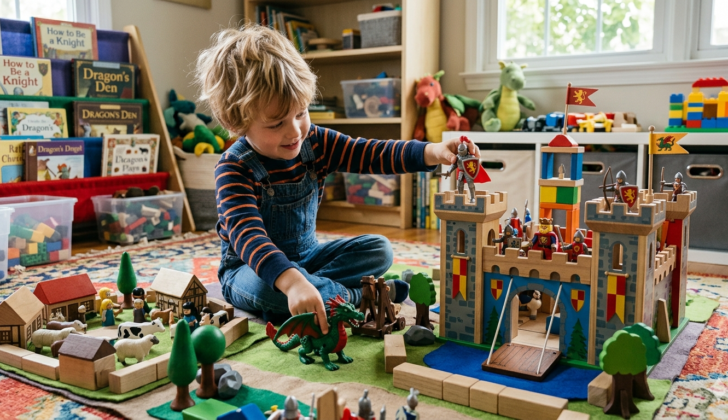
Play is often described as the work of childhood. It is how children explore, imagine, problem solve, and communicate. Many parents and caregivers know that play is important, but fewer realize that the type of play a child engages in can have a powerful impact on speech and language development.
One of the most effective ways to support deeper language skills is by encouraging play themes. Play themes help children move beyond simple play actions and into richer, more meaningful communication. When children stay within a theme and expand on it, their vocabulary grows, their sentences become longer, and their storytelling skills develop.
This article will explain why play themes matter, how they support language development, and exactly how parents and caregivers can support themed play at home. You will find clear explanations, scripts, and step-by-step directions. No prior knowledge is assumed.
What Are Play Themes?
A play theme is the central idea or storyline of play.
It is what the play is “about.”
Examples of play themes include:
- Going to the doctor
- Cooking in a kitchen
- Running a restaurant
- Taking care of a baby
- Building a construction site
- Going to school
- Going on a trip
- Visiting a grocery store
When children play within a theme, they connect actions, vocabulary, and ideas around a shared topic. This creates deeper learning and richer communication.
Why Play Themes Matter for Language Development
Many young children move quickly from toy to toy without developing a storyline. While exploration is important, staying within a theme allows language to grow in depth.
When a child engages in themed play, they practice:
- Using new vocabulary related to the theme
- Creating longer sentences
- Asking and answering questions
- Sequencing events
- Problem solving
- Using imagination
- Telling simple stories
These skills form the foundation for conversation, reading comprehension, and storytelling.
Without support, some children remain at a basic play level. They may label objects or perform simple actions but struggle to expand ideas or sustain interaction. Encouraging play themes helps move them forward.
Step 1: Follow Your Child’s Interests
The most successful play themes begin with your child’s interests.
Observe what naturally captures your child’s attention:
- Cars and trucks
- Animals
- Cooking
- Superheroes
- Dolls
- Building
- School
- Doctors
Choose a theme based on what your child already enjoys. This increases motivation and engagement.
Step-by-Step Directions
- Watch your child play for a few minutes.
- Notice what toys or activities they choose.
- Select one theme connected to that interest.
- Join the play gently without taking over.
Example:
If your child enjoys toy animals, begin an animal care or zoo theme.
Step 2: Start With Simple Themed Play
Do not expect complex pretend play immediately. Begin with simple actions within a theme.
Example: Doctor Theme
Start with basic actions:
- Check temperature
- Listen to heartbeat
- Give a pretend shot
- Put on a bandage
Script for Parents
“You are the doctor.”
“The patient is sick.”
“Check the heartbeat.”
“Give the teddy bear a bandage.”
“The teddy bear feels better.”
Keep language simple and clear.
Step 3: Add Vocabulary Within the Theme
Play themes provide an excellent opportunity to introduce new vocabulary naturally.
Doctor Theme Vocabulary
- Doctor
- Nurse
- Patient
- Medicine
- Bandage
- Stethoscope
- Hurt
- Better
How to Add Vocabulary
Step-by-Step Directions
- Say the new word clearly.
- Connect it to an action.
- Repeat it naturally during play.
- Encourage your child to use it if they are ready.
Script Example
“This is a stethoscope.”
“The doctor uses the stethoscope.”
“Listen to the heartbeat.”
“You are using the stethoscope.”
Repetition helps words stick.
Step 4: Expand the Theme Gradually
Once a theme begins, help your child expand it by adding small details.
Example: Restaurant Theme
Start simple:
- Cook food
- Serve food
- Eat food
Then expand:
- Take orders
- Pay for food
- Clean the table
- Pack food to go
Step-by-Step Directions
- Begin with one simple action.
- Add one new idea at a time.
- Model language for each new step.
- Allow your child to lead when possible.
Script for Expansion
“The customer is hungry.”
“What would you like to eat?”
“I would like pizza.”
“Here is your pizza.”
“Time to pay.”
“Thank you for coming.”
Step 5: Use Sequencing Language
Play themes help children learn sequences. Sequencing supports storytelling and conversation.
Use words such as:
- First
- Next
- Then
- Last
Example Script
“First we cook the food.”
“Next we put it on the plate.”
“Then we eat.”
“Last we clean up.”
Repeat these words often during themed play.
Step 6: Encourage Problem Solving Within the Theme
Adding small problems makes play more engaging and language-rich.
Example Problems
- The baby is sick.
- The car broke down.
- The restaurant ran out of food.
- The animal escaped.
Step-by-Step Directions
- Introduce a simple problem.
- Pause and wait.
- Encourage your child to think of a solution.
- Model language if needed.
Script for Parents
“Oh no. The baby is sick.”
“What should we do?”
“We need a doctor.”
“Let us help the baby.”
Problem solving encourages conversation and critical thinking.
Step 7: Model Conversations During Play
Many children need help learning how characters talk to each other.
You can model both sides of the conversation.
Example: Grocery Store Theme
Parent models:
“Hello.”
“Hello. I want to buy apples.”
“Here are your apples.”
“Thank you.”
“You are welcome.”
Encourage your child to take one role.
“Now you be the cashier.”
“Say, ‘How can I help you?’”
This builds conversational skills.
Step 8: What to Avoid During Themed Play
Avoid Taking Over the Play
Let your child lead whenever possible.
Instead of:
“No, do it this way.”
Try:
“That is an interesting idea.”
“Tell me about your plan.”
Avoid Too Many Questions
Too many questions can interrupt play.
Instead of:
“What is that?”
“What color?”
Try:
“You are cooking soup.”
“That soup looks hot.”
Avoid Switching Themes Too Quickly
Stay within one theme for at least 10–15 minutes when possible. Depth is more valuable than constant change.
Step 9: Supporting Play Themes Between Siblings
Siblings can build rich language together through shared themes.
Step-by-Step Directions
- Choose one shared theme.
- Assign simple roles.
- Model communication.
- Support turn taking.
Script for Parents
“You are both running a restaurant.”
“You are the cook.”
“You are the customer.”
“Ask your sister what she wants.”
“Tell your brother the food is ready.”
Praise teamwork and communication.
“You worked together.”
“You talked to each other.”
“That was great playing.”
Step 10: Building Longer and Richer Language
As your child becomes comfortable with themed play, you can gently encourage more complex language.
Expand Sentences
Child: “Baby sleep.”
Adult: “The baby is sleeping in the crib.”
Child: “Car broken.”
Adult: “The car is broken. We need to fix it.”
Encourage Storytelling
After play, say:
“Tell me what happened in your game.”
“Who was the doctor?”
“What did you cook?”
This helps children practice narrative skills.
A Simple Daily Plan for Parents
If you are unsure where to begin, follow this routine.
Step 1: Choose one theme your child enjoys.
Step 2: Gather simple toys or props.
Step 3: Sit and join your child for 10–15 minutes.
Step 4: Model simple language within the theme.
Step 5: Add one new idea or problem.
Step 6: Encourage conversation.
Step 7: End with praise and connection.
Example closing:
“I loved playing restaurant with you.”
“You had great ideas.”
“We will play again tomorrow.”
Final Thoughts
Play themes are more than simple pretend play. They are a powerful tool for building depth in your child’s language. When children stay within a theme and expand their ideas, they learn to use richer vocabulary, longer sentences, and more complex communication.
You do not need special toys or training to support themed play. Your presence, modeling, and encouragement are what matter most.
Start small. Follow your child’s interests. Add language gently. Expand ideas over time. Celebrate progress along the way.
Every time you support a play theme, you are helping your child build the communication skills needed for conversation, storytelling, learning, and connection.
Keep Learning & Stay Connected
Follow First Words Bright Futures on Facebook and Instagram for:
-
Daily speech tips
-
Fun activity ideas
-
Q&A with a pediatric SLP
Explore More:
Disclaimer: This article offers general educational information. It is not a substitute for professional evaluation or treatment. Please consult a licensed Speech-Language Pathologist for personalized concerns regarding your child’s speech development.