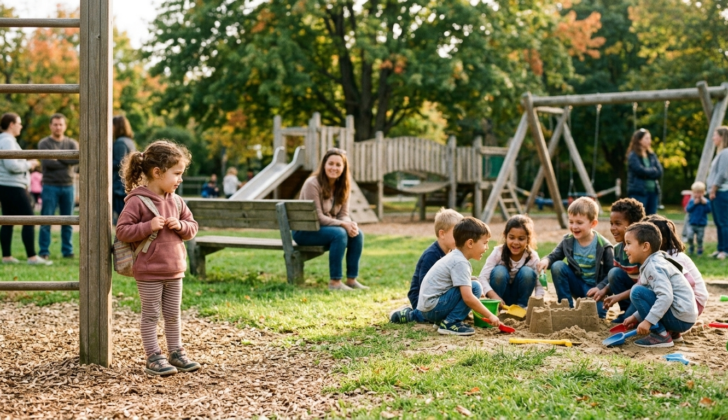
Many young children watch group play before they join it. They stand nearby at the playground, stay close to a parent at birthday parties, or quietly observe classmates building with blocks. Parents often wonder if they should encourage their child to join or if they should wait and see.
Shyness is not a problem that needs to be “fixed.” Many thoughtful, observant children take time to warm up to new situations. However, some shy children need support learning the language and social steps that help them move from watching to participating.
Joining play requires several skills working together:
- noticing what other children are doing
- understanding the social situation
- choosing a way to enter the activity
- using words to communicate with peers
- managing feelings like nervousness or uncertainty
For many children, the hardest part is knowing what to say or do first. This article will help parents bridge social-emotional development and language by teaching children the small steps of joining group play. You will find book recommendations, simple scripts, and easy activities that can help your child practice these skills in a supportive way.
Why Joining Play Can Be Difficult for Some Children
Joining group play involves more than walking over to other children. It requires several social and language skills that develop gradually.
Children must learn to:
- observe what other children are doing
- understand the rules of the activity
- decide how to approach the group
- use language that invites interaction
- handle feelings if the first attempt does not work
A child who is shy may also feel worried about being rejected or making a mistake. Because of this, they may choose to watch rather than participate.
Watching is actually an important learning step. Many shy children are gathering information before they act. Parents can support this natural process by helping children learn simple language tools and clear steps for entering play.
The Goal: From Watching to Participating
Instead of pushing children into social situations, the goal is to help them build confidence in manageable steps.
Think of joining play as a short sequence:
- Watch what the group is doing
- Move closer to the activity
- Find a simple way to join
- Use a short phrase to enter the play
Children who know what to say often feel more confident approaching others.
Books are a wonderful place to practice these ideas because they show characters facing similar situations. Children can talk about what the character might do without feeling pressure themselves.
How to Read Books to Teach Social Skills
You can use the following simple routine with almost any story that includes friendship or play.
Step 1: Before Reading
Tell your child what you will look for in the story.
You might say:
- “Today we are going to look for ways the characters join play.”
- “Let us see what the character does when they want to play with others.”
- “We will practice some words we can use with friends.”
Keep this short and positive.
Step 2: During Reading
Pause when a character is watching others play or trying to join.
Ask simple questions such as:
- “What are the other children doing?”
- “What could the character say?”
- “What would help them join the game?”
If your child is unsure, you can model an answer.
For example:
“Maybe the character could say, ‘Can I play too?’”
Step 3: After Reading
Help your child connect the story to their own experiences.
You might ask:
- “When do you watch other children play?”
- “What could you say if you wanted to join?”
- “Which idea from the story could help you?”
If your child does not answer, you can offer a model.
“Sometimes I feel nervous meeting new people. I start by saying hello.”
Helpful Parent Script for Teaching Social Language
Parents can use a simple sequence when talking about social situations.
Notice → Name → Model → Practice
- Notice
“I see the character watching the group.” - Name the situation
“They want to play but they are not sure how to join.” - Model the language
“They could say, ‘Can I play too?’” - Practice together
“Let us practice saying it together.”
Practicing during calm reading time helps children remember the words later.
Books That Help Teach Children How to Join Play
1. The Invisible Boy by Trudy Ludwig
Focus: feeling included, noticing others, inviting someone to join
This story follows a quiet child who often feels unnoticed until another child reaches out in kindness.
Reading Prompts
- “Why do you think Brian is watching instead of joining?”
- “What did the other child do that helped Brian feel included?”
- “How could someone invite Brian to play?”
Parent Script
“Sometimes children feel unsure about joining a group. A friendly invitation can make a big difference. You can say, ‘Do you want to play with us?’”
Activity: Practice Inviting Others
Steps:
- Use two stuffed animals or toys.
- Pretend one toy is playing and the other is watching.
- Model the invitation.
Example:
Toy 1: “Do you want to play with me?”
Toy 2: “Yes. Thank you.”
- Let your child take turns practicing both roles.
This helps children learn that play invitations can go both directions.
2. Llama Llama Time to Share by Anna Dewdney
Focus: sharing space, cooperative play, social communication
Although this book focuses on sharing, it naturally supports conversations about playing with others.
Reading Prompts
- “What made playtime difficult at first?”
- “What helped the children play together?”
- “What words could they use?”
Parent Script
“When children play together, they need to talk about turns. You can say, ‘Can I have a turn when you are done?’”
Activity: Turn-Taking Practice
Steps:
- Choose a simple toy such as blocks or cars.
- Model asking for a turn.
Example:
“I would like a turn when you are done.”
- Practice waiting and switching.
- Praise the language used.
“You asked for a turn. That was very clear.”
3. Will You Be My Friend? by Eric Carle
Focus: meeting new friends and initiating interaction
This story follows a character searching for friendship.
Reading Prompts
- “What does the character do when they meet someone new?”
- “What could they say to start playing?”
- “What would you say?”
Parent Script
“Sometimes all you need to do is say hello. A friendly greeting can start a new game.”
Example phrases children can practice:
- “Hi. What are you playing?”
- “Can I play with you?”
- “Do you want to play tag?”
Activity: Greeting Practice
Steps:
- Stand a few steps away from your child.
- Pretend you are another child at the playground.
- Practice walking up and saying hello.
Example:
Child: “Hi. What are you playing?”
Parent: “We are building a tower. Do you want to help?”
- Switch roles and repeat.
Practicing this movement and language can make real situations feel easier.
4. Clark the Shark by Bruce Hale
Focus: learning social rules and participating appropriately
This book can open discussions about how to join play in a positive way.
Reading Prompts
- “What made it hard for Clark to play with friends?”
- “What helped him learn the rules?”
- “What can children do when they join a group game?”
Parent Script
“When you join a game, it helps to watch first. Then you can ask how the game works.”
Example phrase:
“Can you show me how to play?”
Activity: Watch Then Join
Steps:
- Pretend a small group of toys is playing a game.
- Show your child how to watch for a moment.
- Model asking a question.
Example:
“Can you show me how to play?”
- Let your child practice entering the play.
This teaches that observing first can be a helpful strategy.
Simple Language Phrases Children Can Use to Join Play
Children often need short, clear phrases they can remember easily.
Here are helpful examples:
- “Hi.”
- “What are you playing?”
- “Can I play too?”
- “Can I have a turn?”
- “Can you show me how?”
- “Do you want to play with me?”
You can practice these phrases at home during playtime or when reading stories.
Role-Play Activities That Build Social Confidence
Role-playing gives children a safe place to practice before real social situations.
Activity: Playground Practice
Steps:
- Pretend the couch or floor area is a playground.
- Use toys to represent children playing.
- Have your child practice walking up and using a joining phrase.
- Model friendly responses.
Example:
Child: “Can I play too?”
Parent: “Yes. You can help build the tower.”
Activity: Join the Game
Steps:
- Begin playing a simple game such as building blocks.
- Have your child pretend they are joining the group.
- Practice asking to join.
Example phrase:
“Can I build with you?”
- Celebrate the attempt, even if the words are not perfect.
Encouragement builds confidence.
Activity: Two Choice Practice
Some children feel overwhelmed by open-ended questions. Offering choices can help.
Example:
“Would you say ‘Can I play?’ or ‘What are you playing?’”
Let your child choose and practice.
What to Do If Your Child Freezes in Social Situations
It is common for shy children to feel overwhelmed when many children are present. If this happens, try the following steps.
- Allow observation time
Watching helps children understand what is happening. - Stand nearby for support
Your presence can provide reassurance. - Suggest a simple entry point
You might quietly say, “You could ask if you can help build.” - Praise effort rather than outcome
“I noticed you walked closer to the group. That was brave.”
Small steps build confidence over time.
A Simple Weekly Plan for Practicing Social Language
Short practice sessions can make a big difference.
Day 1
Read a book and identify moments when characters join play.
Day 2
Practice one joining phrase.
Day 3
Role-play joining a game with toys.
Day 4
Practice greeting or asking to join during family playtime.
Even five minutes of practice can help children remember what to do.
Encouraging Words for Parents and Caregivers
Shy children often have thoughtful and observant personalities. They notice details, watch carefully, and learn from what they see. With gentle guidance, these strengths can help them develop meaningful friendships.
Learning to join group play takes time. The most helpful support parents can offer is patience, encouragement, and opportunities to practice social language in calm settings.
Books provide a safe and engaging way to explore these skills together. When you pause during stories, talk about what characters say, and practice simple phrases, you are helping your child build the confidence and language needed to connect with others.
Small conversations during story time can lead to big changes on the playground.
Keep Learning & Stay Connected
Follow First Words Bright Futures on Facebook and Instagram for:
-
Daily speech tips
-
Fun activity ideas
-
Q&A with a pediatric SLP
Explore More:
- MDS: Why My 4-Year-Old Hits Instead of Using Words
- MDS: Teaching Kids to Ask for Help: A Powerful Skill That Reduces Meltdowns
Disclaimer: This article offers general educational information. It is not a substitute for professional evaluation or treatment. Please consult a licensed Speech-Language Pathologist for personalized concerns regarding your child’s speech development.