“Why does my child not listen?”
“I feel like I am repeating myself all day.”
“They understand, but they still will not do it.”
If this sounds familiar, you are not alone. Following directions is a skill that develops over time, and many young children need more support than we expect. One of the most effective ways to help is surprisingly simple:
Use “first, then” language.
This small shift can make directions clearer, reduce resistance, and help children understand what is expected of them.
What Is “First, Then”?
“First, then” is a way of giving directions that breaks tasks into two clear parts:
What needs to happen now
What will happen next
For example:
“First clean up, then we go outside.”
Instead of hearing one long instruction, your child hears a clear sequence. This makes it easier to process, understand, and follow.
Why “First, Then” Works
Young children are still developing their ability to:
- Process language
- Understand time
- Manage transitions
- Stay flexible
When directions are too long or unclear, children can feel overwhelmed or unsure of what to do.
“First, then” works because it:
- Simplifies expectations
- Creates predictability
- Connects effort with a positive outcome
- Reduces power struggles
It helps children see that one thing leads to another.
What “First, Then” Is Not
It is important to understand that “first, then” is not a bribe or a reward system.
It is not:
“If you do this, I will give you something.”
Instead, it is:
“This is what happens next.”
The “then” should be something natural, expected, or already part of the routine whenever possible.
How to Start Using “First, Then”
You do not need anything special to begin. You can start using this language today. Begin by choosing one routine or situation where your child tends to struggle.
This might be:
- Cleaning up toys
- Getting dressed
- Turning off a device
- Transitioning between activities
Start small and stay consistent.
Step-by-Step: Teaching “First, Then”
Step 1: Keep It Simple
Use short, clear phrases.
Instead of:
“Can you please go clean up all your toys so we can get ready to go outside?”
Try:
“First clean up, then outside.”
Step 2: Say It Before the Transition
Give the direction before the moment becomes difficult. This helps your child prepare.
Step 3: Pair It with a Visual (Optional but Powerful)
Some children benefit from seeing the sequence.
You can:
- Point to the activity
- Use simple pictures
- Draw it on paper
Visuals make the concept more concrete.
Step 4: Follow Through Calmly
Once you give the direction, stay consistent.
If your child resists, calmly repeat:
“First clean up, then outside.”
Avoid adding extra words or changing the expectation.
Step 5: Acknowledge Effort
When your child follows through, notice it.
“You did it. You cleaned up, now we go outside.”
This reinforces understanding.
Real-Life Examples
Here are simple ways to use “first, then” throughout your day:
Morning Routine
“First get dressed, then breakfast.”
Playtime
“First clean up, then new toy.”
Mealtime
“First dinner, then dessert.”
Leaving the House
“First shoes on, then we go.”
Screen Time
“First tablet off, then snack.”
When Your Child Pushes Back
It is normal for children to resist at first, especially if this is new.
When that happens:
Stay calm and keep your language simple. Repeat the same phrase without adding extra explanations. Acknowledge feelings, but hold the boundary.
For example:
“I know you want to keep playing. First clean up, then outside.”
Consistency is what helps this strategy work over time.
Activities to Practice “First, Then”
You can also practice this skill during low-pressure moments.
During Play
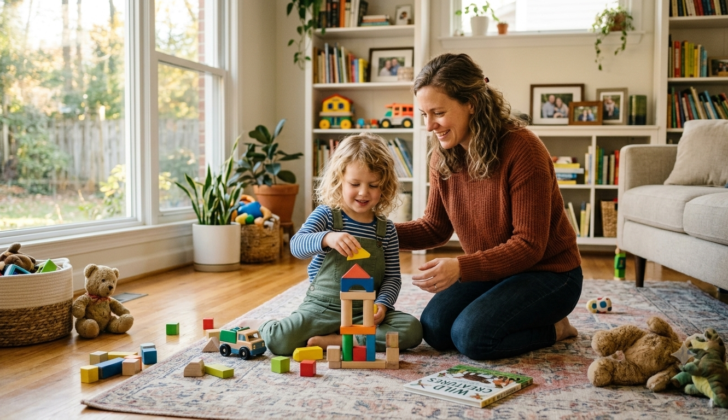
Use toys to model sequences:
“First the car goes up, then it goes down.”
During Daily Routines
Repeat the same phrases each day:
“First bath, then book.”
Repetition builds understanding.
Make It a Game
You can turn it into something fun:
“First jump, then clap!”
“First spin, then sit!”
This helps your child learn the pattern in a playful way.
Common Mistakes to Avoid
Using long sentences can make directions harder to follow. Keep it short and clear.
Changing expectations after you say it can be confusing. Stay consistent.
Using it only during challenging moments makes it harder to learn. Practice it during calm times too.
Over-explaining during resistance can overwhelm your child. Simple and steady is best.
How This Supports Speech and Language Development
“First, then” does more than improve behavior. It builds important language skills.
Your child is learning:
- Sequencing
- Understanding cause and effect
- Following directions
- Predicting what comes next
- Using functional language
These are foundational communication skills.
A Simple Way to Start Today
Pick one moment today and try this:
👉 “First ____, then ____.”
Keep it short. Keep it consistent.
That is enough to begin.
Final Thoughts
Following directions is not just about listening. It is about understanding, processing, and feeling supported. When you use “first, then,” you are giving your child a clear and manageable way to move through their day.
You are showing them:
“I understand what to do.”
“I know what is coming next.”
“I can do this.”
That confidence makes all the difference.
Keep Learning & Stay Connected
Follow First Words Bright Futures on Facebook and Instagram for:
-
Daily speech tips
-
Fun activity ideas
-
Q&A with a pediatric SLP
Explore More:
- MDS: How to Give Specific Praise to Support Your Child’s Communication Skills
- MDS: How to Use Mirrors to Improve Your Child’s Speech
Disclaimer: This article offers general educational information. It is not a substitute for professional evaluation or treatment. Please consult a licensed Speech-Language Pathologist for personalized concerns regarding your child’s speech development.