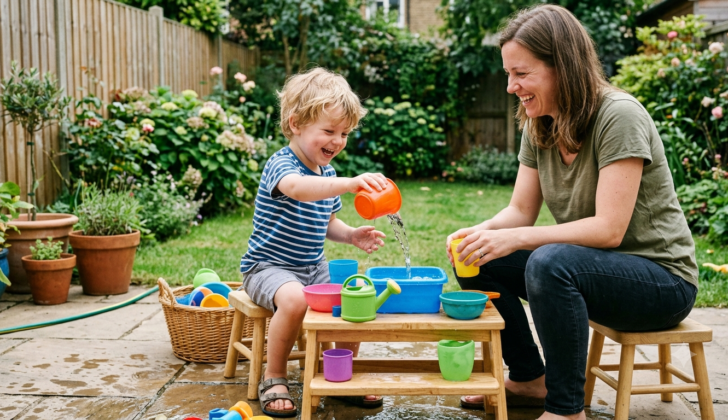
If you have ever watched a child play with water, you already know something important: water play naturally grabs children’s attention.
Children love to:
- Pour
- Splash
- Scoop
- Dump
- Stir
- Spray
- Squeeze
- Wash
- Drip
- Float
That excitement is exactly why water play can be such a powerful tool for speech and language development. Water play creates the perfect environment for early language learning because it is:
- hands-on,
- repetitive,
- interactive,
- and full of opportunities for meaningful communication.
This article is designed to build on earlier sensory play topics by focusing specifically on:
- teaching action words,
- building early sentences,
- modeling language naturally during play,
- and helping children move from single words to more connected phrases.
We will also talk about:
- why action words are so important,
- how children learn early sentence structures,
- easy water play setups,
- practical activities,
- and realistic scripts families can use at home.
Why Action Words Matter So Much
When many people think about early language, they think of labeling objects:
- ball
- car
- dog
- cup
Those words are important, but children also need action words, sometimes called verbs. Action words help children talk about what people and objects are doing.
Examples include:
- pour
- splash
- wash
- jump
- stir
- open
- push
- squeeze
- dump
- spray
These words are incredibly important because they help children:
- build sentences,
- describe experiences,
- answer questions,
- tell stories,
- and participate in conversations.
Without action words, language stays very limited. A child who only labels items might say: “Water.” When including verbs the might say:
“Pour water.”
“Mommy pouring.”
“I splash water!”
That is a huge step forward in communication development.
Why Water Play Is Perfect for Teaching Verbs
Water play naturally includes movement and repetition. Children often repeat the same actions over and over:
- filling cups,
- dumping containers,
- squeezing sponges,
- splashing hands.
That repetition is incredibly helpful for language learning. Children hear the same words connected to the same actions again and again.
For example:
“Pour.”
“You poured it.”
“More pouring.”
“Pour it out!”
This repeated exposure helps children understand and eventually use those words independently. Water play is also motivating. Children are usually emotionally engaged and excited, which helps the brain learn language more effectively.
What Are Early Sentences?
Early sentences are short combinations of words children begin using as language develops.
Examples include:
- “More water”
- “Wash baby”
- “Daddy splash”
- “Pour it”
- “Big splash”
- “I want water”
These short phrases are incredibly important because they help children move from single-word communication into more meaningful interaction. Children do not usually jump from one word directly into full conversations. Language grows gradually.
For example:
| Stage | Example |
| Single Word | “Water” |
| Two Words | “More water” |
| Early Sentence | “Pour more water” |
| Longer Sentence | “I want to pour the water” |
Water play creates endless opportunities for practicing these combinations naturally.
The Goal Is Not Constant Talking
One important thing to remember: teaching language through play should not feel like a test.
Children learn best when adults:
- join the play,
- model language,
- repeat words naturally,
- and keep interactions fun and low pressure.
You do not need to constantly ask:
“What is this?”
“What are you doing?”
“What color is it?”
Too many questions can sometimes reduce communication because children begin feeling pressured. Instead, focus on commenting, modeling, and interacting.
How to Model Action Words During Water Play
The simplest strategy is this:
Say the action while the action is happening.
This helps children connect words with real experiences.
For example:
- “Splash!”
- “Pour water.”
- “Wash baby.”
- “Squeeze sponge.”
- “Stir it.”
- “Dump it out.”
Children learn language best when words are connected to meaningful experiences they can see and feel.
Repetition Is Extremely Important
Children need to hear words many times before they begin using them independently. That means repetition is helpful, not harmful.
For example, during pouring play you might say:
- “Pour.”
- “You poured it.”
- “More pouring.”
- “Pour it in.”
- “Pour it out.”
This repeated language exposure helps action words stick.
How to Expand Language Naturally
Once children start using single words, adults can help expand language by modeling slightly longer phrases. This is called language expansion.
Example
| Child Says | Adult Expands To |
| “Splash” | “Big splash!” |
| “Water” | “More water” |
| “Pour” | “Pour water” |
| “Baby” | “Wash baby” |
The goal is not forcing imitation. The goal is helping children hear slightly bigger language models during meaningful play.
Easy Water Play Setups for Language Learning
1. Pouring Station
Materials
- Plastic cups
- Measuring cups
- Funnels
- Bowls
- Water
Language Targets
- Pour
- Full
- Empty
- More
- In
- Out
Parent Scripts
“Pour it in.”
“Uh oh, it spilled!”
“More water?”
“Cup full!”
“Now empty.”
Sentence Building Ideas
- “Pour water.”
- “More water.”
- “Cup empty.”
- “Daddy pour water.”
This activity is excellent for repetition and early two-word combinations.
2. Toy Washing Station
Children love washing toys, dolls, cars, or animals.
Materials
- Small toys
- Sponge
- Soap bubbles
- Washcloth
- Water bin
Language Targets
- Wash
- Scrub
- Clean
- Dirty
- Dry
- Splash
Parent Scripts
“Wash the car.”
“Scrub scrub scrub!”
“Baby dirty.”
“Now clean!”
“Dry the baby.”
Early Sentence Ideas
- “Wash baby.”
- “Car dirty.”
- “Clean car.”
- “Dry it.”
This activity naturally encourages pretend play and sequencing too.
3. Sponge Squeeze Activity
Materials
- Sponges
- Bowls
- Water
Language Targets
- Squeeze
- Wet
- Drip
- Full
- Empty
Parent Scripts
“Squeeze the sponge.”
“Water dripping!”
“Wet sponge.”
“Drip drip drip.”
Early Sentence Ideas
- “Squeeze sponge.”
- “Water drip.”
- “Big squeeze!”
Children often enjoy repeating this activity many times, which creates excellent opportunities for repetitive language modeling.
4. Animal Rescue Water Play
Materials
- Toy animals
- Ice cubes or water bin
- Cups or droppers
Language Targets
- Help
- Swim
- Splash
- Hide
- Rescue
- Pour
Parent Scripts
“Oh no! The animals need help!”
“Pour water.”
“Fish swimming!”
“Splash turtle!”
Early Sentence Ideas
- “Help turtle.”
- “Fish swim.”
- “Pour water.”
- “Big splash!”
This activity encourages imagination and playful interaction while supporting communication.
5. Spray Bottle Fun
Spray bottles are wonderful for teaching verbs because the action is very clear and repetitive.
Materials
- Small spray bottle
- Water
- Outdoor surface or bathtub wall
Language Targets
- Spray
- Wet
- Wipe
- Clean
- Squeeze
Parent Scripts
“Spray the wall!”
“Now wipe.”
“Wet window.”
“Spray more!”
Early Sentence Ideas
- “Spray water.”
- “Wall wet.”
- “Clean window.”
How to Encourage More Communication During Water Play
Pause Before Giving More
Children are more likely to communicate when adults pause briefly instead of anticipating every need immediately.
For example:
- Hold the cup for a second
- Pause before pouring more water
- Wait before turning on the faucet
This creates natural communication opportunities.
Parent Script
“You want more?”
“More water?”
“Help please?”
Even gestures, sounds, or eye contact count as communication.
Follow Your Child’s Interests
Some children love:
- Dumping
- Stirring
- Scooping
- Spraying
- Washing
That is okay. You do not need to control the play constantly. Children learn more language when they feel engaged and interested. Join what they already enjoy doing.
Avoid Overcorrecting Speech
If a child says:
“Wa wa”
You do not need to say:
“No, say water.”
Instead, model naturally:
“More water!”
“Splash water!”
Children learn language through hearing it repeatedly in meaningful interactions.
Use Simple, Repetitive Language
Children learn language more easily when adults keep phrases short and repetitive.
Good examples:
- “Big splash!”
- “Pour it.”
- “Wash baby.”
- “More water.”
- “Squeeze sponge.”
Simple language is easier for children to process and eventually imitate.
Water Play Also Supports Other Communication Skills
Beyond vocabulary and sentence building, water play also helps children practice:
- Turn taking
- Joint attention
- Following directions
- Requesting
- Attention
- Social interaction
- Pretend play
These foundational skills all support communication development.
Everyday Water Opportunities Count Too
You do not need elaborate sensory bins every day. Water play naturally happens during:
- Bath time
- Washing hands
- Watering plants
- Helping with dishes
- Playing outside
- Pool time
- Rain puddles
These moments can become rich language opportunities with just a few simple language models.
When to Seek Additional Support
Some children need extra support developing language skills. Consider reaching out to a speech-language pathologist if your child:
- Uses very few words
- Has difficulty combining words
- Rarely imitates language
- Becomes frustrated communicating
- Has difficulty understanding language
- Struggles interacting socially
Early support can make communication easier and more enjoyable for children and families.
Final Thoughts
Water play is much more than entertainment. It creates natural opportunities for children to hear, practice, and use meaningful language during playful interactions. Action words and early sentences grow best when children:
- feel engaged,
- hear repetitive language,
- experience real actions,
- and connect communication with enjoyable experiences.
You do not need perfect activities or structured lessons.
You simply need:
- playful connection,
- simple language,
- repetition,
- and shared moments together.
Sometimes the smallest activities create the biggest opportunities for communication growth.
Keep Learning & Stay Connected
Follow First Words Bright Futures on Facebook and Instagram for:
-
Daily speech tips
-
Fun activity ideas
-
Q&A with a pediatric SLP
Explore More:
- MDS: Sensory Play Activities That Support Speech and Language
- MDS: How to Be a Play Partner: Simple Ways to Build Language Through Play
Disclaimer: This article offers general educational information. It is not a substitute for professional evaluation or treatment. Please consult a licensed Speech-Language Pathologist for personalized concerns regarding your child’s speech development.