Raising a child who is learning two languages is a beautiful and powerful gift. It allows children to connect with family, culture, and community in meaningful ways. At the same time, many parents and caregivers wonder:
“Am I doing this the right way?”
“Will learning two languages confuse my child?”
“Should I stick to one language instead?”
These are very common concerns and the answer is reassuring. Children are fully capable of learning more than one language. In fact, their brains are built for it. What matters most is how language is modeled and supported in everyday life.
This guide will walk you through exactly how to model vocabulary across two languages in a way that feels natural, effective, and easy to implement at home.
First, Let Us Clear Up a Common Myth
Learning two languages does not cause confusion or delay.
You may notice your child:
- Mixing languages in one sentence
- Using a word from one language instead of another
- Understanding more than they can say
This is normal and expected. It shows that your child is actively learning and organizing both languages.
What Does “Modeling Vocabulary” Mean?
Modeling vocabulary simply means: Showing your child how to use words in real-life situations.
Instead of asking your child to repeat or perform, you are:
- Talking about what they see
- Labeling actions and objects
- Expanding on what they say
This is one of the most effective ways children learn language.
How Bilingual Modeling Works
You do not need to translate everything or teach like a classroom. Children learn best when language is:
- Natural
- Repetitive
- Connected to real experiences
There are many ways to support two languages at home. There is no single “perfect” method.
Step-by-Step: How to Model Vocabulary Across Two Languages
Step 1: Use Both Languages in Meaningful Moments
Language sticks best when it is connected to what your child is doing.
Example during snack:
- “Apple. You are eating an apple.”
- “Manzana. Estás comiendo una manzana.”
You can say both naturally, one after the other, without pressure.
Step 2: Keep Sentences Simple and Clear
Children learn more from simple, repeated phrases than long explanations.
Examples:
- “Big truck.” / “Camión grande.”
- “Wash hands.” / “Lavar manos.”
Step 3: Follow Your Child’s Lead
Talk about what your child is already focused on. If your child is playing with a ball:
- “Ball! Throw the ball.”
- “Pelota. Tira la pelota.”
This increases engagement and learning.
Step 4: Repeat, Repeat, Repeat
Repetition is key for both languages.
You might feel like you are saying the same thing often and that is exactly what helps your child learn.
Step 5: Expand What Your Child Says
When your child uses a word or short phrase, build on it.
Child says:
“Dog”
You model:
- “Yes, a big dog!”
- “Sí, un perro grande.”
Easy Ways to Model Two Languages Throughout the Day
During Play
- Label toys and actions
- Use simple phrases
Example:
“Car goes fast!”
“El carro va rápido.”
During Daily Routines
- Narrate what is happening
Example:
“Putting on shoes.”
“Poniendo los zapatos.”
During Mealtime
- Talk about food, actions, and preferences
Example:
“Drink milk.”
“Toma leche.”
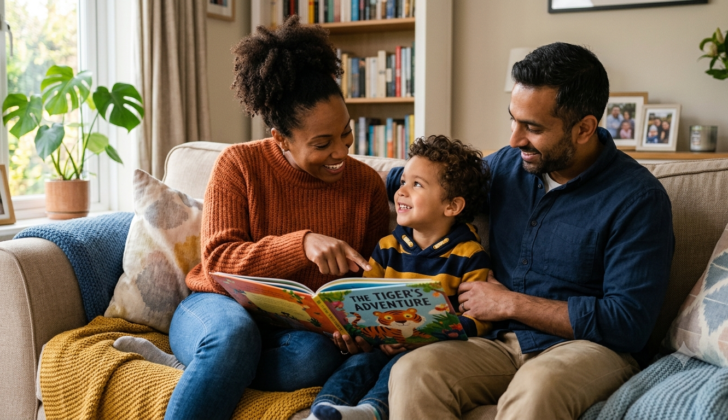
During Book Reading
- Label pictures in both languages
- Keep it interactive
Example:
“Look, a cat!”
“Mira, un gato.”
Helpful Scripts for Parents
Here are simple, natural ways to model both languages without making it feel forced.
Label + Repeat in Both Languages
“Ball. Pelota.”
Short Phrase in One Language, Repeat in Another
“Wash hands. Lavar manos.”
Expand in Both Languages
“You want juice. You want more juice.”
“Quieres jugo. Quieres más jugo.”
Comment Instead of Question
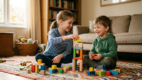
“You are building a tower.”
“Estás construyendo una torre.”
Activities to Support Bilingual Vocabulary
1. The “Name It Twice” Game
Pick everyday items and name them in both languages.
- “Table. Mesa.”
- “Door. Puerta.”
Keep it playful and low pressure.
2. Toy Talk Time
Choose a toy and describe everything your child is doing.
- Actions
- Objects
- Descriptions
Use both languages naturally.
3. Daily Routine Language Practice
Pick one routine (bath, meals, bedtime) and consistently use both languages.
Repetition within routines builds strong vocabulary.
4. Sing Songs in Both Languages
Songs are a powerful way to build vocabulary and memory.
What If I Am Stronger in One Language?
That is completely okay.
Use the language you are most comfortable with for:
- Connection
- Conversation
- Emotional expression
If possible, expose your child to the second language through:
- Another caregiver
- Books or music
- Daily routines
Consistency matters more than perfection.
Common Mistakes to Avoid
Trying to “Test” Your Child Too Often
Focus on modeling instead of asking:
“What is this?”
Forcing Repetition
Children learn by hearing and using language naturally.
Worrying About Mixing Languages
Language mixing is a normal part of bilingual development.
Thinking You Need to Be Perfect
You do not. Consistency and exposure are what matter most.
How This Supports Speech and Language Development
Modeling vocabulary across two languages helps children:
- Build vocabulary in both languages
- Strengthen understanding (receptive language)
- Use more words and phrases (expressive language)
- Develop flexible thinking
- Communicate across different environments
Bilingualism is a strength, not a barrier.
A Simple Way to Start Today
Start with this:
Pick one routine
Use simple words in both languages
Repeat them daily
That is enough to begin.
Final Thoughts
Supporting two languages does not require special training or perfect consistency.
It requires connection, repetition, and intention.
When you model language across both languages, you are giving your child:
“I can understand.”
“I can communicate.”
“I belong in both worlds.
Keep Learning & Stay Connected
Follow First Words Bright Futures on Facebook and Instagram for:
-
Daily speech tips
-
Fun activity ideas
-
Q&A with a pediatric SLP
Explore More:
Disclaimer: This article offers general educational information. It is not a substitute for professional evaluation or treatment. Please consult a licensed Speech-Language Pathologist for personalized concerns regarding your child’s speech development.