As a speech-language pathologist working with young children, I often hear parents say:
“My child melts down in busy places.”
“They will not sit still.”
“They hate certain clothes or certain foods.”
It is important to know, your child is not being difficult.
Many of these behaviors are connected to something called sensory processing.
When you begin to understand your child’s sensory system, things start to make more sense. Your thinking shifts from “What is wrong?” to “What does my child need?” That shift changes how you respond, how your child feels, and how communication begins to grow.
What Is Sensory Processing?
Sensory processing is how your child’s brain takes in information, makes sense of it, and responds.
Your child is constantly experiencing the world through more than just the five basic senses. In addition to sight, sound, touch, taste, and smell, there are other systems that play a critical role in how your child moves and feels in their body. These include movement (vestibular), body awareness (proprioceptive), and internal body signals such as hunger or emotional states (interoception).
For some children, this process runs smoothly. For others, the brain may take in too much information, not enough information, or have difficulty organizing it.
This is why one child may seek constant movement while another avoids noise, touch, or busy environments. Neither is wrong. They are simply different sensory needs.
Why Sensory Processing Matters for Communication
This is where my role as a speech-language pathologist comes in.
Before a child can listen, talk, play, or learn, their body has to feel regulated.
If a child is overwhelmed by sound, movement, or touch, their brain is focused on coping, not communicating. If a child is under-stimulated and seeking input, their body is focused on getting that need met.
In both cases, communication is not the priority.
In my sessions, I often see that when we support a child’s sensory system first, everything else begins to fall into place. Attention improves. Engagement increases. Language starts to come more naturally.
That is why sensory support is not separate from communication. It is the foundation of it.
Understanding What You Are Seeing at Home
When you begin looking through a sensory lens, everyday moments start to make more sense.
A child who refuses certain foods may be reacting to texture, smell, or even visual appearance.
A child who cannot sit during a book may not be misbehaving. Their body may need movement in order to stay engaged.
A child who melts down in a store may be overwhelmed by lights, sounds, and movement all at once.
These behaviors are not random. They are your child’s way of trying to feel comfortable and regulated.
What You Can Do: Simple Ways to Support Your Child
The goal is not to change your child. The goal is to support their body so they can feel calm, engaged, and ready to communicate.
Below are simple, realistic ways to do that throughout your day.
Start with the Body: Using “Heavy Work” to Build Regulation
One of the most effective ways to help your child feel calm and organized is through what we call heavy work. This includes activities like pushing, pulling, lifting, and carrying.
This type of input gives the body strong feedback, which helps the nervous system settle.
You do not need special equipment. You can build this into your normal routine.
For example, you might:
- Have your child carry laundry to another room
- Ask them to push a basket across the floor
- Let them help bring in groceries
Keep it simple and short. Even one to three minutes can make a difference, especially before sitting down for an activity.
As you do this, your language matters. You might say:
“I need a strong helper. Can you carry this for me?”
“Push, push, push. Use your strong muscles.”
“Your body is working hard. That helps it feel calm.”
You are not just giving them a task. You are helping their body get ready to learn and communicate.
Build Language Through Play (Without Making It Complicated)
Children learn language best when they are engaged and interested. Sensory play is a natural way to create those moments.
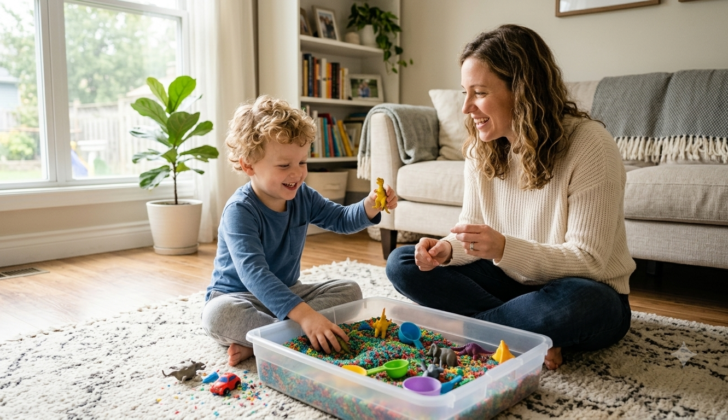
A simple sensory bin with rice, beans, or sand can go a long way. Add a few toys, sit next to your child, and follow their lead.
The key is not to take over the play. Instead, watch what your child is doing and talk about it.
If they are digging, you say,
“You are digging. Dig, dig, dig.”
If they find a toy, you might say,
“I see a cow. The cow is hiding.”
Keep your language simple and connected to their actions. This helps your child understand and eventually use those words themselves.
Use Movement to Improve Attention
Many children need movement in order to focus.If your child is having trouble sitting, try adding short movement breaks before or during activities.
This might look like:
- Jumping 10 times
- Walking like a bear across the room
- Spinning and then stopping
After movement, bring the body back to calm with a deep breath or a quiet moment.
You can guide this by saying:
“Jump 10 times. Ready, go.”
“Now freeze. Take a deep breath in… and out.”
“Your body is ready. Let us sit and read.”
You are helping your child shift from movement into attention in a supported way.
Support Your Child When They Feel Overwhelmed
There will be moments when your child feels like everything is too much. In those moments, logic and language will not work right away. The goal is to help them feel safe and calm.
Creating a small, cozy space at home can be very helpful. This might include:
- Pillows
- A blanket
- Dim lighting
Introduce this space when your child is calm so it feels safe and familiar.
When they begin to feel overwhelmed, guide them there gently:
“Your body looks overwhelmed.”
“Let us go to a quiet space.”
“I am right here with you.”
This teaches your child that it is okay to step away and regulate.
Turn Everyday Moments into Learning Opportunities
You do not need extra time or special activities to support your child’s sensory system. Some of the best opportunities happen during your normal day.
While walking outside, you might say:
“I hear a loud truck.”
“The wind feels cold.”
“Touch the tree. It feels rough.”
These small moments build awareness, understanding, and language all at the same time.
What Progress Looks Like
As you begin to support your child in these ways, changes may be gradual, but they are meaningful.
You may notice:
- Your child calms more quickly
- They stay engaged longer
- They begin to communicate more
- Daily routines feel smoother
These are signs that your child is feeling more regulated and supported.
Final Thoughts
Sensory processing is not something to fix. It is something to understand. When you begin to see your child’s behavior as communication, everything shifts. You respond differently. Your child feels more supported. And communication becomes more natural. You are not just helping your child behave better. You are helping them feel better.When a child feels regulated, safe, and understood, that is when real growth begins.
Keep Learning & Stay Connected
Follow First Words Bright Futures on Facebook and Instagram for:
-
Daily speech tips
-
Fun activity ideas
-
Q&A with a pediatric SLP
Explore More:
- MDS: When Should Toddlers Start Using Phrases?
- MDS: Toy Rotation: The Simple Trick to Boost Your Child’s Language Skills
Disclaimer: This article offers general educational information. It is not a substitute for professional evaluation or treatment. Please consult a licensed Speech-Language Pathologist for personalized concerns regarding your child’s speech development.