Have you ever noticed that the more you talk during a meltdown, the less your child seems to hear? Young children understand what they can see far better than what they can only hear.
When a child is overwhelmed, upset, or dysregulated, language alone is often not enough. You may find yourself repeating directions, offering reassurance, or trying to explain, but your child still struggles to respond.
This is where visuals can make a meaningful difference. Visual supports help children understand expectations, express emotions, and move through challenging moments with more confidence and less frustration.
What Are Visual Supports?
Visual supports are anything your child can see that helps them understand what is happening or what is expected.
This can include:
- Pictures
- Icons or symbols
- Simple drawings
- Written words (for older children)
- Objects used as cues
Visuals give children a steady reference point, especially when emotions are high.
Why Visuals Help with Emotional Regulation
When children are upset, their brains are focused on emotions, not language.
In those moments:
- Processing spoken directions becomes difficult
- Attention decreases
- Frustration increases
Visuals help by:
- Reducing the amount of language needed
- Making expectations clear
- Providing predictability
- Supporting independence
In my work, I often see children calm more quickly and participate more successfully when visuals are used consistently.
When Should You Use Visuals?
Visuals are helpful in many everyday situations, especially:
- Transitions (ending preferred activities)
- Daily routines (morning, bedtime)
- Waiting situations
- Managing big emotions
- Learning new expectations
If your child struggles in a situation more than once, that is a great place to add a visual.
Types of Visuals You Can Use at Home
Let us break this down into simple, practical options.
- First–Then Boards
This is one of the easiest and most effective tools.
What it looks like:
- “First” (non-preferred task)
- “Then” (preferred activity)
Example:
“First clean up, then play outside.”
Why it works:
It helps children see that something they enjoy is coming next.
2. Visual Schedules
These show the order of activities in a day or part of the day.
Examples:
- Morning routine (wake up → get dressed → eat breakfast → school)
- Bedtime routine
Tip:
Start small. You do not need to map out the entire day.
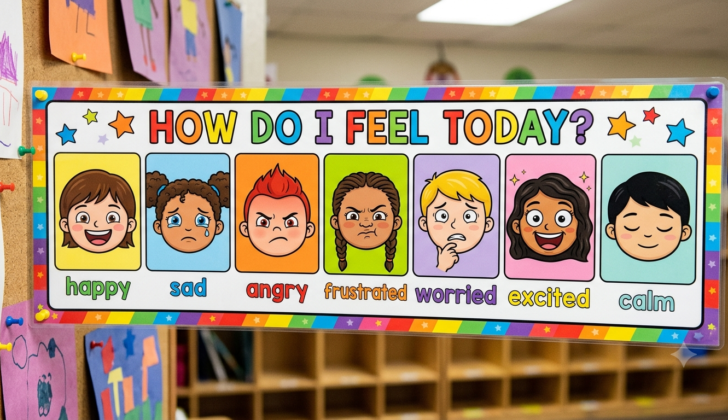
3. Emotion Visuals
These help children identify and express feelings.
Examples:
- Happy, sad, mad, frustrated, tired
- A feelings chart with faces
This supports both emotional awareness and language development.
4. Choice Boards
These allow children to make simple decisions.
Example:
“Do you want puzzle or blocks?”
This can reduce frustration and increase cooperation.
5. Calm-Down Visuals
These show your child what they can do when they feel overwhelmed.
Examples:
- Take a deep breath
- Ask for help
- Hug a stuffed animal
- Sit in a quiet space
Step-by-Step: How to Start Using Visuals
Step 1: Pick One Situation
Start with a specific challenge.
For example:
- Leaving the house
- Turning off a device
- Bedtime routine
Keep it simple.
Step 2: Choose One Visual Tool
Do not introduce everything at once.
Start with:
- First–then board
or - Simple picture cue
Step 3: Introduce It During Calm Moments
Show your child the visual when they are regulated.
Script:
“This shows what we do. First we clean up, then we go outside.”
Practice using it when things are going well.
Step 4: Use It Consistently
When the moment comes, refer back to the visual.
Script:
“Look. First clean up, then outside.”
Point to the visual instead of repeating long explanations.
Step 5: Pair with Simple Language
Keep your words short and clear.
Visual + simple language = most effective support
Real-Life Scripts Using Visuals
During a Transition
“Look at the board. First tablet off, then snack.”
During Big Emotions
“I see you are upset. Let us look. You can take a deep breath or ask for help.”
During a Routine
“Next is brushing teeth. Then we read a book.”
Offering Choices
“Here are your choices. Blocks or cars?”
Activities to Build Emotional Regulation with Visuals
1. Create a Calm-Down Corner
Include:
- A few calming items (soft toy, blanket)
- A simple calm-down visual
Teach your child how to use it when they are calm.
2. Make a Feelings Check-In Routine
Once or twice a day, ask:
“How are you feeling?”
Use a visual chart and let your child point or label.
3. Practice “What Can I Do?” Scenarios
Use pretend play or real-life examples.
Example:
“You feel mad. What can you do?”
Point to visual options.
4. Let Your Child Help Make the Visuals
Children are more engaged when they are involved.
- Draw pictures together
- Use photos of your child
- Let them choose images
What to Do When It Is Not Working
If your child is still struggling, consider:
- Is the visual too complex? Simplify it
- Is it being introduced during a meltdown instead of before?
- Is there too much language paired with it?
- Is it being used consistently?
Visuals take time and repetition.
Common Mistakes to Avoid
Using Too Many Visuals at Once
Start small. Build gradually.
Only Using Visuals During Problems
Teach and practice them during calm moments first.
Expecting Immediate Results
This is a learning process.
How Visuals Support Speech and Language Development
Visual supports do more than reduce meltdowns.
They help children:
- Learn new vocabulary (feelings, actions, routines)
- Understand sequencing and concepts like “first” and “then”
- Express needs and emotions
- Participate in conversations
- Build independence
When children understand more, they communicate more.
A Simple Way to Begin Today
You do not need special materials.
Start with this:
Draw two boxes on paper
Write or draw “First” and “Then”
Use it for one routine today
That is enough to begin.
Final Thoughts
Emotional regulation is not something children simply “have.” It is something they learn with support, practice, and consistency.
Visuals give children a way to:
“I understand what is happening.”
“I know what to do.”
“I can handle this.”
When children feel capable, everything becomes easier—for them and for you.
Keep Learning & Stay Connected
Follow First Words Bright Futures on Facebook and Instagram for:
-
Daily speech tips
-
Fun activity ideas
-
Q&A with a pediatric SLP
Explore More:
Disclaimer: This article offers general educational information. It is not a substitute for professional evaluation or treatment. Please consult a licensed Speech-Language Pathologist for personalized concerns regarding your child’s speech development.