Listening is something many adults take for granted. We assume that if a child can hear, then they can listen. However, listening is much more complex than that. It involves paying attention, understanding language, remembering what was said, and then responding in a meaningful way. For many young children, especially those still developing language, listening is a skill that needs to be taught, supported, and practiced.
If you have ever felt like your child is “not listening,” you are not alone. You might find yourself repeating directions, raising your voice, or wondering if your child is simply ignoring you. In many cases, the challenge is not behavior. It is skill. The encouraging part is that listening skills can be built in ways that feel natural, engaging, and even fun.
Play is one of the most powerful ways to support this development. Children learn best when they are moving, laughing, and connected to you. When listening is practiced through play, it becomes less about compliance and more about connection and learning.
What Does “Listening” Actually Mean?
Before jumping into activities, it helps to understand what is happening behind the scenes when a child listens. Listening is not just about hearing words. It is a combination of several important skills working together.
A child must first be able to focus their attention. They need to notice that someone is speaking and shift their focus to that person. From there, they process what they hear, make sense of the language, and hold onto that information long enough to act on it. This might look simple, but for a young child, it is a complex task.
That is why a child might struggle to follow directions, seem distracted, or frequently ask for repetition. These moments are not signs that something is “wrong.” They are opportunities to build skills.
Start With Connection, Not Correction
One of the most effective ways to support listening is surprisingly simple: connect before you give a direction. Many times, adults speak to children from across the room or while the child is deeply engaged in play. From the child’s perspective, they may not even realize they are being spoken to.
Instead, take a moment to get close. Say your child’s name, lower yourself to their level, and make sure you have their attention before speaking.
You might say,
“Look at me. I have something important to tell you.”
This small shift can make a significant difference. When a child is already tuned in, they are much more likely to understand and respond.
It is also helpful to keep your language simple at first. Start with one clear direction rather than several at once. After giving the direction, pause. Give your child time to process. It can be tempting to repeat yourself quickly, but that pause is where learning happens.
If your child still does not respond, gently model the action while repeating the direction. This shows them what the words mean without turning it into a moment of frustration.
Turning Play Into Powerful Learning
The beauty of building listening skills through play is that it does not require anything complicated. Everyday games and routines can become opportunities for growth with just a small shift in how you interact.
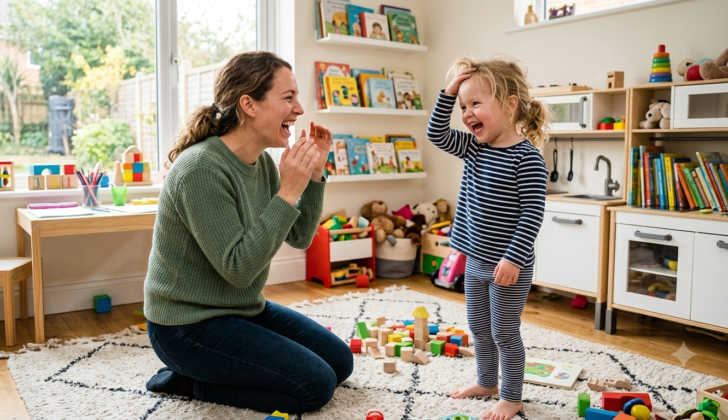
Take a classic game like “Simon Says.” While it may seem simple, it requires a child to listen carefully, process language, and control their impulses. You might begin with directions like, “Simon says touch your head,” or “Simon says clap your hands.” Then, try giving a direction without saying “Simon says” and see if your child can pause and think before acting.
As your child becomes more confident, you can increase the challenge by adding two-step directions or letting them take the lead. You might say,
“Listen carefully. Only do it when I say ‘Simon says.’ Ready?”
This type of playful structure builds attention and self-control in a way that feels fun rather than demanding.
Another powerful activity is a barrier game. In this game, your child must listen closely to recreate something they cannot see. You can sit across from each other with a book or box in between you. Using identical toys or objects, you build something on your side and give directions for your child to copy it.
For example, you might say,
“Put the red block on top of the blue block,”
or
“Put the car next to the house.”
Since your child cannot see what you are doing, they must rely entirely on listening and understanding your words. This strengthens both comprehension and attention. You can adjust the difficulty by using fewer items for beginners or adding more detailed directions as your child grows.
Even everyday routines like cleaning up can become meaningful listening opportunities. Instead of saying, “Clean up your toys,” try turning it into a game.
You might say,
“I am going to give you a mission. Listen carefully. Find the blue car and put it in the basket.”
This transforms a general direction into a specific, engaging task. As your child improves, you can expand to multi-step directions such as,
“Find the red block and the green block and put them in the bin.”
Songs are another natural and effective way to build listening skills. Action songs like “Head, Shoulders, Knees, and Toes” or “If You Are Happy and You Know It” encourage children to listen, remember, and respond. One simple way to increase the challenge is to pause before the action and wait.
For example,
“If you are happy and you know it…” (pause)
This pause invites your child to fill in the action, strengthening both listening and memory in a playful way.
Building toys also provide a great opportunity for listening practice. During play, you can guide your child step-by-step.
You might say,
“Put a blue block down. Now put a red block on top.”
As your child becomes more comfortable, you can add more steps or introduce positional language like “next to” or “on top.” Eventually, you can switch roles and let your child give you directions, which builds both listening and expressive language skills.
Keeping It Fun and Engaging
Children are much more likely to stay engaged when activities feel playful and unexpected. Adding a bit of silliness can go a long way.
Try giving directions like,
“Touch your nose with your elbow,”
or
“Hop two times and clap three times.”
You might introduce it by saying,
“This is a silly listening game. You have to listen very carefully.”
This keeps the focus on fun while still strengthening important skills.
Another helpful structure is using “first, then” language. This helps children understand sequencing and prepares them for more complex directions.
For example,
“First clap, then jump,”
or
“First touch your head, then sit down.”
Using your fingers to visually show “first” and “then” can make this even clearer.
Using Stories to Build Listening
Reading together is one of the simplest and most effective ways to build listening and comprehension. As you read, you can pause and ask questions that encourage your child to think about what they heard.
You might ask,
“Who was in the story?”
“What did they do?”
“What happened first?”
Before you begin, you can set the expectation by saying,
“Listen closely because I am going to ask you a question after.”
This helps your child stay engaged and practice holding onto information.
Supporting Your Child at Their Level
Every child is different, and it is important to adjust your expectations based on where your child is right now.
If your child is having difficulty, simplify the task. Use shorter directions, add gestures or pointing, and model the action. Slow down your speech and give extra time for processing.
If your child is ready for more, you can gradually increase the challenge by adding steps, introducing new vocabulary, or encouraging them to take the lead during activities.
Making Listening Part of Everyday Life
One of the most encouraging things about building listening skills is that it does not require extra time. You can embed these opportunities into your daily routines.
While getting dressed, you might say,
“Put on your socks, then your shoes.”
At mealtime,
“Get your cup and put it on the table.”
During bath time,
“Wash your arms, then your legs.”
Even in the car, simple games like “I spy something red” can encourage listening and attention.
These small, consistent moments add up in meaningful ways.
Common Challenges and Simple Shifts
It is very common for parents to give too many directions at once, repeat instructions too quickly, or speak from across the room. These habits are understandable, especially during busy days, but small changes can make a big difference.
Breaking directions into smaller steps, pausing to allow processing time, and getting close before speaking can all improve how your child responds.
It is also important to keep the experience positive. When listening becomes a test, children may shut down. When it feels like play, they lean in.
What Progress Looks Like
Progress in listening skills often happens gradually. You may notice your child responding more quickly, following directions with fewer reminders, or staying engaged in activities for longer periods of time.
These small shifts are meaningful. They are building the foundation for learning, communication, and independence.
Final Thoughts
Building listening skills does not require perfection. It requires connection, consistency, and a willingness to meet your child where they are.
When you take a moment to get on your child’s level, use simple and clear language, and turn everyday interactions into playful opportunities, you are supporting more than just listening.
You are helping your child learn how to understand, respond, and connect with the world around them. That is powerful work. That confidence makes all the difference.
Keep Learning & Stay Connected
Follow First Words Bright Futures on Facebook and Instagram for:
-
Daily speech tips
-
Fun activity ideas
-
Q&A with a pediatric SLP
Explore More:
- MDS: Everyday Speech Therapy: Boost Language Skills During Clean-Up
- MDS: How to Give Specific Praise to Support Your Child’s Communication Skills
Disclaimer: This article offers general educational information. It is not a substitute for professional evaluation or treatment. Please consult a licensed Speech-Language Pathologist for personalized concerns regarding your child’s speech development.