“He can say it at home, but not at school.”
“She knows all her colors, but will not answer when asked.”
“I know he knows it… he just will not say it.”
If you have ever found yourself thinking this, you are not alone. This is one of the most common concerns parents share, and it can feel confusing and frustrating. It often leaves families wondering if their child is being stubborn, shy, or simply not trying.
The reassuring truth is this: there is a meaningful difference between knowing something and being able to say it in the moment. Once you understand that difference, it becomes much easier to support your child in a way that builds confidence rather than pressure.
What Is the Difference?
When we talk about knowledge, we are referring to what your child understands. This includes recognizing familiar objects, following directions, and making sense of the language they hear every day. Many children understand far more than they are able to express.
Performance, on the other hand, is what your child can show you in real time. This might look like answering a question, labeling an object, or using words in a new setting. These moments require not only knowledge, but also confidence, processing, and comfort.
A child can have strong understanding and still struggle to express it. That gap is not unusual, it is part of development.
Why Children “Know It” but Do Not Say It
There are several reasons this happens, and most of them have nothing to do with a child being unwilling.
One of the biggest factors is pressure. When a child is asked a direct question, even something simple, it can feel like they are being tested. That pressure alone can make it harder to respond, even when they know the answer.
Processing time also plays a role. Children need time to take in what was said, think of a response, and organize how to say it. When adults move quickly or repeat the question, it can interrupt that process rather than support it.
Environment matters as well. It is very common for children to communicate differently depending on where they are. Many children talk more at home and less in unfamiliar or structured settings like school. This difference is often referred to as a performance gap, and it is developmentally appropriate.
Emotions can also impact communication. If a child feels unsure, shy, or overwhelmed, they may choose not to speak, even when they know the answer. At the same time, expressive language itself is still developing. Knowing a word and using it easily are two separate skills.
What This Does Not Mean
It is important to pause here, because this is where many parents become concerned.
This does not mean your child is ignoring you or refusing on purpose. It does not mean they are being difficult or oppositional. More often, it means they need support bridging the gap between understanding and expression.
When we shift how we respond, we can help close that gap in a way that feels safe and encouraging for the child.
How to Support Your Child (Without Increasing Pressure)
One of the most effective changes you can make is surprisingly simple: reduce the number of direct questions and increase the number of comments.
Instead of asking your child to perform, begin by modeling the language you want them to learn. For example, rather than asking, “What is this?” you might say, “That is a dog.” This removes the pressure and gives your child the words in a way that feels natural.
It can also be helpful to invite participation without demanding it. Fill-in-the-blank phrases, such as “Ready, set…” or familiar songs, create opportunities for your child to join in when they are ready. These moments feel playful, rather than evaluative.
Another powerful tool is wait time. After you speak, pause. Even a few extra seconds gives your child the space they need to process and respond. It may feel long to you, but it often makes a significant difference.
As your child begins to communicate, it is important to accept all attempts. Communication does not need to be perfect to be meaningful. A sound, a gesture, or part of a word is still progress. When children feel successful, they are more likely to keep trying.
Small Language Shifts That Make a Big Difference
In everyday interactions, subtle changes in how you speak can have a powerful impact.
Instead of asking, “What color is this?” try saying, “I see a blue car.”
Instead of, “What is that?” try, “That is a big truck.”
Instead of, “Say ball,” try, “Ball. You have the ball.”
These shifts reduce pressure while still providing rich language input. Over time, children begin to use these words more independently.
Building Confidence Through Everyday Activities
You do not need special materials or structured lessons to support expressive language. In fact, some of the most effective learning happens during simple, everyday moments.
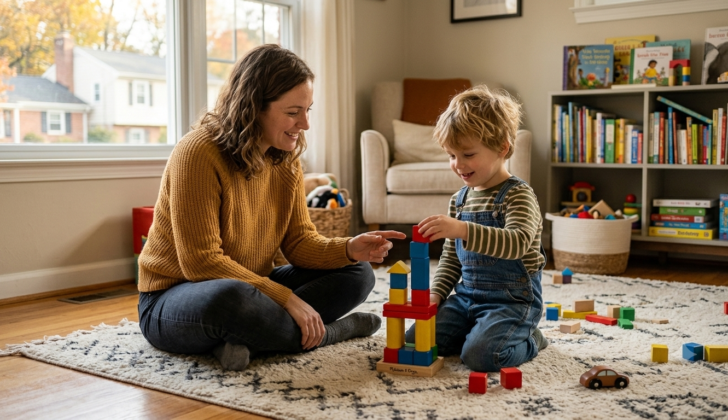
Play is one of the best opportunities. Sitting with your child and talking about what they are doing creates a natural, low-pressure environment for language. You might describe actions, label objects, or expand on what they are already focused on.
Songs and rhymes are another helpful tool. Because they are predictable and repetitive, children often feel more comfortable joining in. Pausing before a familiar word can gently invite participation.
Books with repeated phrases offer similar benefits. Children begin to anticipate what comes next and may start to fill in words on their own. Even daily routines, such as mealtime or getting ready for bed, provide consistent opportunities to model simple, functional language.
When Your Child Does Not Respond
It is important to remember that a lack of response does not mean a lack of understanding.
If your child does not answer, continue modeling, keep your language simple, and maintain a low-pressure environment. Learning is still happening, even when it is not immediately visible.
Progress in communication is not always linear. Some days your child may say more, and other days less. What matters most is consistency and support over time.
Common Mistakes to Be Aware Of
There are a few patterns that can unintentionally make it harder for children to respond.
Asking too many questions in a row can feel overwhelming. Pushing for repetition can increase resistance. Comparing how your child communicates at home versus school can also create unnecessary concern. Each environment places different demands on a child, and variation is expected.
Even when your child is quiet, they are learning, observing, and building language behind the scenes.
A Simple Place to Start
If you take one thing from this, let it be this:
Replace one question with a comment today.
That small shift can open the door to more communication, more confidence, and more connection.
Final Thoughts
It can be difficult to watch your child struggle to express something you know they understand. However, communication is not just about knowledge. It is about feeling comfortable enough to use it.
When you reduce pressure and create supportive opportunities, you are helping your child move from understanding to expression. You are showing them that their voice matters and that they are safe to use it.
That is where meaningful communication truly begins.
Keep Learning & Stay Connected
Follow First Words Bright Futures on Facebook and Instagram for:
-
Daily speech tips
-
Fun activity ideas
-
Q&A with a pediatric SLP
Explore More:
- MDS: Selective Mutism in Children: What Parents Should Know
- MDS: How Visual Supports Help Children Regulate Big Emotions
Disclaimer: This article offers general educational information. It is not a substitute for professional evaluation or treatment. Please consult a licensed Speech-Language Pathologist for personalized concerns regarding your child’s speech development.