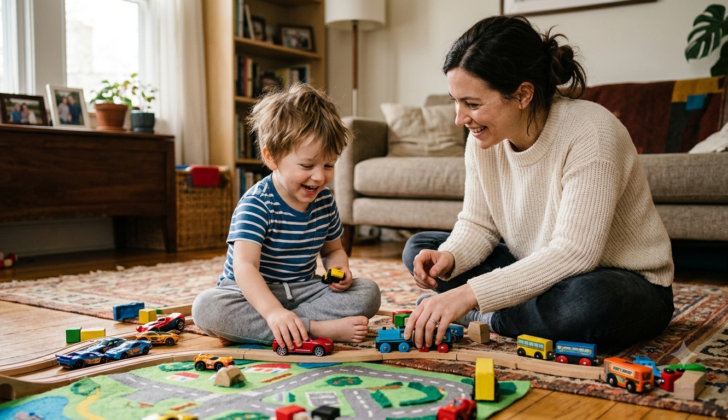
If your child struggles when things do not go their way, has a hard time trying new ideas, or gets stuck doing things one specific way, you are not alone.
You might hear things like:
- “They are rigid.”
- “They do not like change.”
- “They get upset when play does not go how they expect.”
And you might be wondering:
How do I help my child become more flexible… without constant battles. One of the best ways to build flexible thinking is already something your child is meant to do. This is easily done through pretend play.
What is flexible thinking?
Flexible thinking means your child can:
- Try new ideas
- Handle small changes
- Go along with someone else’s idea
- Shift when something does not go as planned
This is a huge skill for:
- Social interactions
- Problem solving
- Communication
It is important to know that communication is not just talking. It is going back and forth, adjusting, and responding to others.
Why pretend play matters for communication
Pretend play naturally builds:
- Back-and-forth interaction
- Imagination
- Language use
- Problem solving
It teaches your child:
“There is more than one way to do something.”
That is flexible thinking.
What this might look like if your child struggles
You might notice:
- They play the same way every time
- They get upset if you change the play
- They do not want others to join
- They repeat the same scripts or actions
This is not them being difficult. This is your child needing support with flexibility.
The goal
What skill we are targeting
Flexible thinking and shared play
Why it matters for communication
Flexible thinkers can:
- Take turns in conversation
- Respond to others
- Adjust their language
- Stay engaged longer
Where to start: join, do not lead
Before you try to change anything, you need to enter your child’s world. Watch what they are already doing. Then join it. If your child is lining up cars, you sit next to them and do the same.
What to say
“Car.”
“Line up.”
“Another car.”
Keep it simple. You are building connection first.
Step 1: Add a small change
Once your child is comfortable with you in their play, you introduce a very small change. Not a big one. Just enough to stretch their thinking.
Example
Your child is lining up cars.
You gently drive one car.
What to say
“Car go.”
“Vroom.”
Watch your child’s reaction.
If they accept it, great. If not, you pull back and try again later.
Step 2: Expand the idea
Now we start building pretend play.
What to do
Turn the cars into a simple story.
Maybe one car gets stuck.
What to say
“Oh no. Car stuck.”
“Help car.”
“Push.”
You are adding a problem and a solution. This builds both language and flexible thinking.
Step 3: Offer choices
Flexible thinking grows when children learn there is more than one option.
What to do
Give two simple choices during play.
What to say
“Car go fast or slow?”
“Car sleep or go?”
You are showing your child that play can change.
Step 4: Let your child lead again
This is very important.
After you add something new, give control back.
What to say
“Your turn.”
“What next?”
Even if your child goes back to their original way of playing, that is okay. You are slowly building flexibility over time.
Real-life pretend play ideas
You do not need fancy toys. You can use what you already have.
Kitchen play
What skill we are targeting: flexible thinking in routines
What to do: pretend to cook together
What to say:
“Stir the soup.”
“Oh no, no spoon. Use hands?”
“Hot or cold?”
Doll or stuffed animal play
What skill we are targeting: perspective taking and problem solving
What to do: act out simple situations
What to say:
“Baby is sad.”
“Why sad?”
“Give hug or food?”
Blocks
What skill we are targeting: handling change and problem solving
What to do: build and gently disrupt
What to say:
“Build tower.”
“Oh no, it fell.”
“Fix it.”
What if my child resists?
This will happen and that is okay.
What to do
- Keep changes very small
- Stay calm
- Go back to their idea if needed
What to say
“It is okay.”
“We can do it your way.”
“Let us try again later.”
You are building trust, not forcing change.
What this looks like in real life
Your child is playing with trains the same way they always do. Instead of correcting or directing, you sit next to them. You copy what they are doing. Then you slowly add:
“Train stop.”
Pause.
Then:
“Train go.”
Later, you add:
“Oh no, train stuck.”
Over time, your child starts to accept these changes. Then they start to create their own. That is flexible thinking.
Final thoughts
If your child struggles with flexibility, it is easy to feel stuck or frustrated, but you do not need to force change. You build it slowly through connection and play.
When you:
- Join your child’s play
- Add small changes
- Use simple language
- Stay calm and flexible yourself
You are teaching your child how to think in new ways.
That skill carries over into:
- Communication
- Social interactions
- Everyday life
Start small. One play moment at a time. That is how flexibility grows.
Keep Learning & Stay Connected
Follow First Words Bright Futures on Facebook and Instagram for:
-
Daily speech tips
-
Fun activity ideas
-
Q&A with a pediatric SLP
Explore More:
- MDS: Helping Young Children Build Flexible Thinking Skills
- MDS: Open-Ended Toys: The Secret to Boosting Your Child’s Language Skills
Disclaimer: This article offers general educational information. It is not a substitute for professional evaluation or treatment. Please consult a licensed Speech-Language Pathologist for personalized concerns regarding your child’s speech development.