Have you ever watched your child run into a problem and feel completely stuck? Here are some familiar examples:
The toy will not work.
A friend takes something.
Something does not go their way.
You notice that instead of solving it, your child might:
- Cry or melt down
- Walk away
- Get stuck repeating the same idea
- Say “I do not know”
This leaves you thinking…
“How do I actually teach them what to do?”
Problem solving and perspective taking are skills. Children are not born knowing how to do this.The best way to teach these skills is in everyday moments.
What do these skills actually mean?
Problem solving means your child can:
- Notice a problem
- Think of a solution
- Try something
Perspective taking means your child can:
- Understand that other people have thoughts and feelings
- Recognize that those thoughts and feelings might be different from their own
These two skills go together.
Why this matters for communication
Communication is not just asking for things.
It is:
- Understanding others
- Responding to situations
- Working through challenges
- Staying in interactions
If a child cannot problem solve or understand another person’s perspective, you might see:
- Frequent conflicts
- Difficulty with peer play
- Limited back-and-forth conversation
- Frustration and shutdowns
When we build these skills, communication becomes more meaningful and more successful.
What this might look like if your child needs support
You might notice your child:
- Gets stuck when something does not work
- Repeats the same idea instead of trying something new
- Has difficulty sharing or taking turns
- Struggles to understand how others feel
- Becomes upset quickly in social situations
This is not your child being difficult. This is your child needing support with flexible thinking and understanding others.
The goal
What skill we are targeting
Problem solving and perspective taking
Why it matters for communication
These skills help your child:
- Navigate social situations
- Stay engaged in play
- Use language for more than just requesting
- Build relationships
Start here: slow it down and stay with the problem
When a problem happens, our instinct is to fix it right away. If we always solve it for our child, they do not learn how to do it themselves. Instead, we stay with the problem.
What to do
Pause. Do not rush to fix.
Label what is happening.
What to say
“Oh no. The block fell.”
“That is a problem.”
You are helping your child notice the problem first.
Step 1: Name the problem
Children cannot solve something they do not understand.
What to do
Use simple language to describe the situation.
What to say
“The toy is stuck.”
“The car will not move.”
“You both want the same toy.”
Keep it clear and simple.
Step 2: Think of options
Many children think there is only one way to do something. We want to show them there are choices.
What to do
Offer 2–3 simple solutions.
What to say
“What can we do?”
“We can push it… or we can ask for help.”
If your child does not respond, you model:
“Let us try pushing.”
Step 3: Try a solution
Now your child takes action.
What to do
Support them as they try.
What to say
“Push.”
“Try again.”
“You did it.”
If it does not work:
“That did not work. Let us try something else.”
You are teaching persistence and flexibility.
Now let us bring in perspective taking
Most problems involve another person. This is where perspective taking comes in.
Step 4: Talk about what others think and feel
What skill we are targeting
Understanding others’ thoughts and feelings
Why it matters for communication
This helps your child:
- Share
- Take turns
- Respond appropriately
- Stay in social interactions
What to do
Narrate what another person might be thinking or feeling.
What to say
“She looks sad.”
“He wants a turn.”
“She is waiting.”
You are making the invisible visible.
Step 5: Connect it back to your child
Now help your child respond to that perspective.
What to do
Guide them toward a solution that includes the other person.
What to say
“He wants a turn. What can we do?”
“We can give a turn or say ‘wait’.”
Real-life example: sharing a toy
Your child grabs a toy from another child. Instead of immediately correcting, you guide.
What to do
Stay calm and step in.
What to say
“You both want the toy.”
“That is a problem.”
Then:
“She is sad. She wanted it.”
Pause.
“What can we do?”
If needed:
“Give a turn or ask for a turn.”
You are walking your child through the process.
Real-life example: something breaks
Your child gets upset when a toy does not work.
What to do
Stay with them and guide the steps.
What to say
“Oh no. It broke.”
“That is a problem.”
“What can we do?”
“Fix it or ask for help.”
What if my child says “I do not know”?
This is very common.
What to do
Model and keep it simple.
What to say
“That is okay. I will help.”
“We can try this.”
Over time, your child will start to generate ideas on their own.
What this looks like in real life
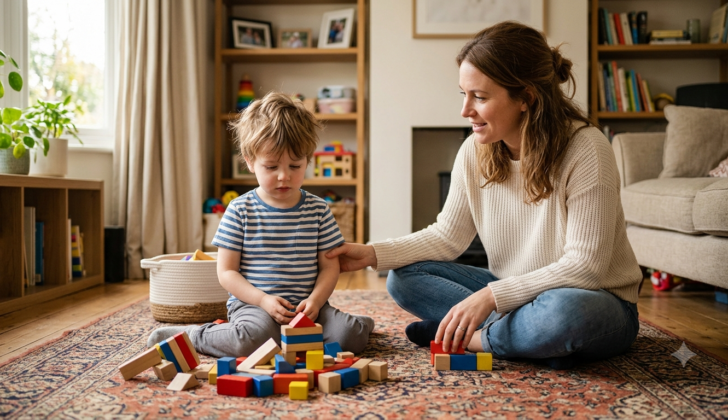
Your child is building a tower and it falls. Instead of fixing it, you sit next to them.
“Oh no. It fell. That is a problem.”
Pause.
“What can we do?”
They shrug.
You say:
“Build again or make it smaller.”
They try.
You support.
This is how the skill grows.
Final thoughts
Problem solving and perspective taking take time. These are not one-time lessons. They are built through everyday moments.
When you:
- Slow down
- Stay with the problem
- Use simple language
- Guide instead of fix
You are teaching your child how to think, not just what to do. That skill carries into:
- Communication
- Social interactions
- School and learning
Start small.
One problem at a time. That is how confidence grows.
Keep Learning & Stay Connected
Follow First Words Bright Futures on Facebook and Instagram for:
-
Daily speech tips
-
Fun activity ideas
-
Q&A with a pediatric SLP
Explore More:
- MDS: How to Be a Play Partner: Simple Ways to Build Language Through Play
- MDS: How to Build Flexible Thinking in Children Through Pretend Play
Disclaimer: This article offers general educational information. It is not a substitute for professional evaluation or treatment. Please consult a licensed Speech-Language Pathologist for personalized concerns regarding your child’s speech development.